Backdoor.Win64.Gsb: A Go Implant Hiding Behind Nuclear Reactor Simulations
Reversing a novel Go-compiled backdoor distributed by GCleaner that uses nuclear reactor physics type names and CJK-obfuscated function names to evade detection, with only 15.8% VirusTotal detection despite allocating RWX memory and calling SyscallN directly.

Something strange showed up at the top of my triage queue yesterday morning. A 1.4MB PE binary, tagged as a Go executable, zero family matches in our similarity engine, and a risk score that pinned the needle. My first thought was that it was mislabeled. Go binaries are bulky by nature, and the automated packer detection had flagged it as MPRESS, which turned out to be a false positive. The entropy was normal. The sections looked standard. Nothing screamed malware at a glance.
Then I opened the strings.
Mixed in with the usual Go runtime noise were type names I had never seen in a malware sample before: BeamEnvelope, ControlDrum, FuelRodBundle, XenonTransientTable, dopplerCoefficientNeg. These are real nuclear reactor physics terms, control drums are used in space reactor designs, xenon transients affect reactor power output, fuel rod bundles are core structural elements. Either someone was accidentally compiling a nuclear engineering simulation with malicious intent, or this was the most creative obfuscation scheme I’d encountered.
It was the latter.
Buried under the reactor math, I found syscall.LoadLibrary, syscall.GetProcAddress, syscall.SyscallN, and a VirtualAlloc call requesting PAGE_EXECUTE_READWRITE memory. The function names weren’t in English, they were randomized Chinese characters. The build path pointed to a framework called Factory-v3. And the binary was signed with a valid Authenticode certificate from www[.]glass[.]com.
This post documents the full teardown: how I mapped the obfuscation layers, identified the malicious functions hiding inside reactor simulation code, traced the kill chain back to a GCleaner Pay-Per-Install distribution network, and extracted the C2 configuration. At the time of analysis, only 12 out of 76 VirusTotal engines detected this sample.
Sample
| Property | Value |
|---|---|
| SHA-256 | 072533c1d31d83b056a1a9f4174a23763c53597df1c89ad9c545df2c3bb35f5e |
| MD5 | 650c00bed1b3ce7db2e8ddfb949a5576 |
| SHA-1 | 350c7b55675d1cd6903ac8f12dcdceace13f1d43 |
| File Size | 1,448,064 bytes (1.38 MB) |
| Format | PE32+ x86-64, Windows GUI subsystem |
| Language | Go 1.24.5 |
| Sections | 8 (including .symtab. Go symbol table) |
| Overlay | 2,176 bytes — Authenticode signature |
| Certificate | Valid, issued to www[.]glass[.]com (Country Unknown) |
| Timestamp | 0 (zeroed — deliberately stripped) |
| Build Path | Factory-v3/builder/temp/7061c16a7a05b72f2cf8d5e57bdcc1d0/main.go |
| Compiled | ~2026-04-06 (first seen date) |
| VT Detection | 12/76 (15.8%) |
Identification: Backdoor.Win64.Gsb (Kaspersky dynamic detection). Distributed as a second-stage payload by the GCleaner Pay-Per-Install loader.
Kill Chain
 GCleaner PPI → Go backdoor drop → reactor cover code → payload build → VirtualAlloc RWX → dynamic API resolution → SyscallN → C2 connection
The sample doesn’t arrive on its own. According to Loader Insight Agency, this binary is distributed by GCleaner, a Pay-Per-Install (PPI) service that has been active since 2019. GCleaner operators sell installation slots on compromised machines to other threat actors, who provide their payloads for distribution. Five separate delivery tasks were observed between April 6–8, 2026.
The chain:
1
2
3
4
5
Victim machine (pre-compromised)
    → GCleaner PPI stub executes
    → Downloads 072533c1...exe from C2
    → Drops and executes the Go backdoor
    → Backdoor connects to 72[.]61[.]25[.]108:6789/tcp
This means the Gsb backdoor operator is likely distinct from the GCleaner operator, they’re a customer of the PPI service. MalwareBazaar tagged this sample as “SmokeLoader,” but that appears to be a misclassification, SmokeLoader is traditionally a Delphi/C++ loader, not a Go binary.
Why This Sample Evades Detection
Before diving into the reversing, it’s worth understanding why only 15.8% of AV engines flagged this. The evasion isn’t based on packing or encryption, it’s structural:
-
Valid Authenticode signature, the binary is signed by
www[.]glass[.]comwith a valid certificate chain. Many AV engines and EDR products apply reduced scrutiny to signed binaries. -
Go binary structure. Go compiles to statically linked, monolithic executables with thousands of standard library functions embedded. The malicious code is a tiny fraction of the binary, drowned out by legitimate Go runtime.
-
Nuclear reactor simulation cover code, the binary performs actual floating-point math operations on reactor physics data structures (
map[GridRef]float64), making behavioral heuristics see “math application” rather than “backdoor.” -
CJK function names, signature engines that pattern-match on ASCII function names find nothing recognizable. The obfuscated names are randomized Chinese character sequences.
-
Runtime-encrypted C2 config, no plaintext URLs, IPs, or domains in the binary. Static scanners have nothing to match.
-
Dynamic API resolution, instead of importing suspicious APIs in the PE import table, the binary resolves them at runtime via
LoadLibrary/GetProcAddress.
The result: Kaspersky’s dynamic sandbox is the only vendor that identified this as Backdoor.Win64.Gsb. ReversingLabs flagged it with a generic heuristic. Most engines rated it clean.
The Two Obfuscation Layers
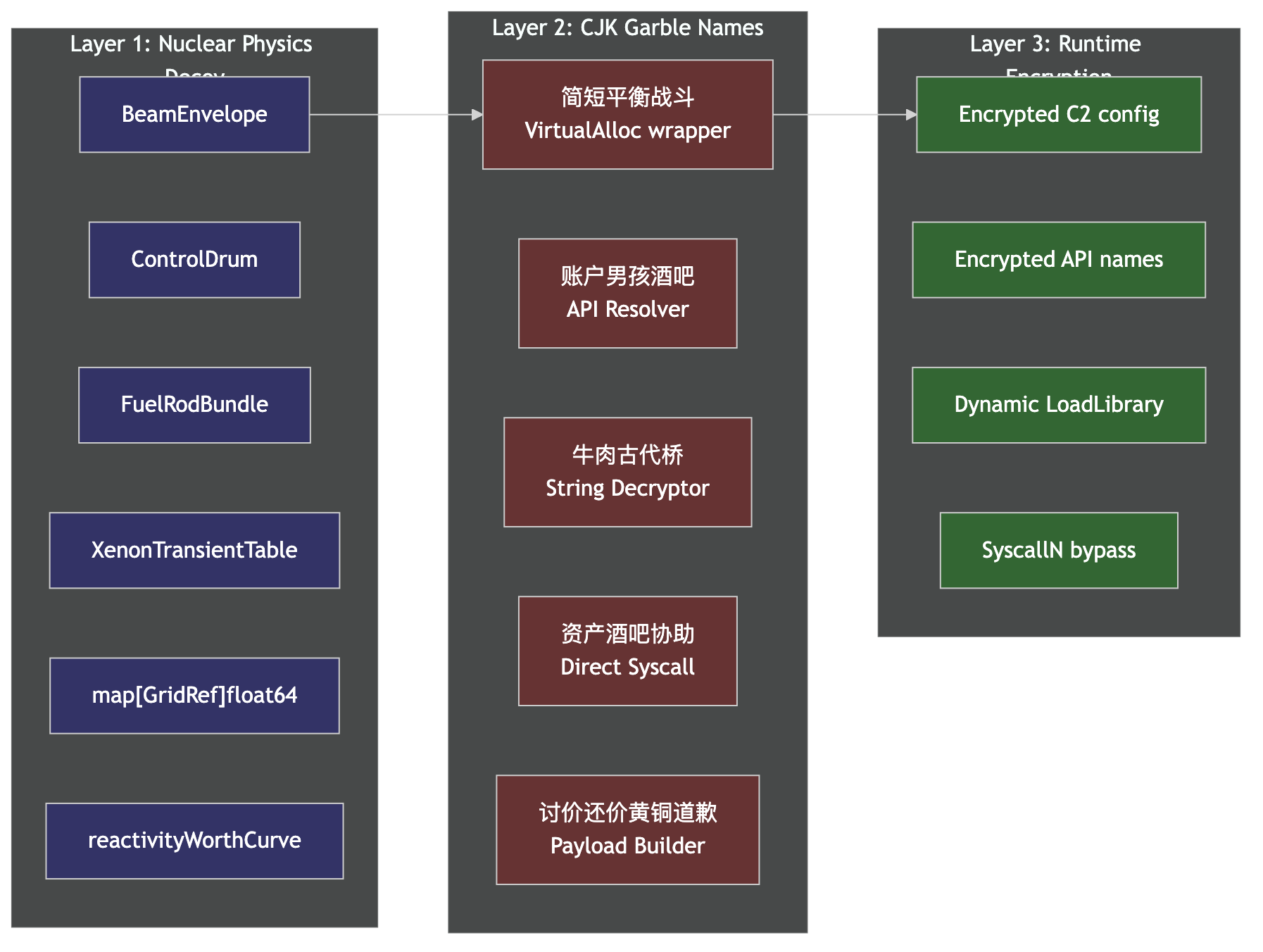 Three concentric layers: nuclear physics decoy types → CJK garble function names → runtime-encrypted config and API names
Layer 1: Nuclear Reactor Physics Decoy Types
The Go type system embeds type names in the binary. The developer chose names from nuclear reactor engineering:
| Type Name | Nuclear Engineering Meaning |
|---|---|
main.BeamEnvelope | Neutron beam spatial distribution profile |
main.ControlDrum | Rotatable absorber cylinder in space reactors |
main.FuelRodBundle | Assembly of fuel rods in a reactor core |
main.GridRef | Core lattice coordinate reference |
main.LatticeCell | Single unit cell in the reactor core grid |
main.MagnetFlavor | Magnetic confinement parameter (fusion context) |
main.XenonTransientTable | Xenon-135 poisoning transient lookup data |
And the field names go deeper: reactivityWorthCurve, dopplerCoefficientNeg, xenonConcentrationPpm, claddingIntegrityScore, rotationAngleDegrees. These aren’t random strings, they’re technically accurate physics terms that would pass cursory inspection by an analyst unfamiliar with nuclear engineering.
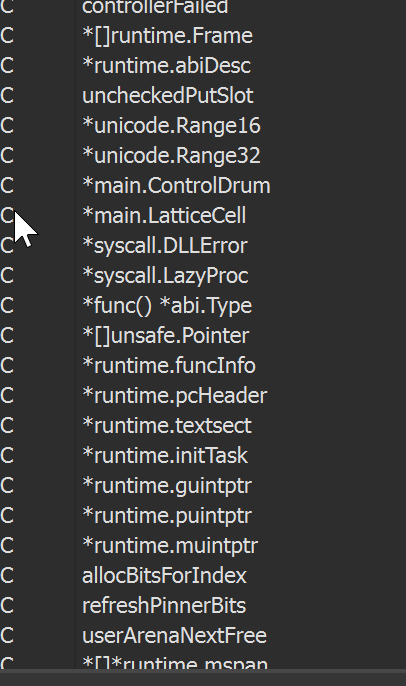 IDA strings view showing
 *main.ControlDrum and *main.LatticeCell among Go runtime type metadata
The binary actually performs reactor simulation math. In main.main, I found map[GridRef]float64 being populated with IEEE 754 double values like 1.0, 1.5, and 125.7, plausible reactor parameters. The runtime.rand calls seed the simulation. This isn’t dead code, it executes and produces results. It’s a functional cover story.
Layer 2: CJK Garble-Style Function Names
The actual function names are randomized Chinese character sequences, a technique associated with the garble obfuscation tool or a custom variant of it:
| Address | CJK Name | Translation | Actual Purpose |
|---|---|---|---|
0x471740 | main.简短平衡战斗 | Brief Balance Battle | DLL procedure execution via LazyProc.Call |
0x471ec0 | main.main | (not obfuscated) | Entry point — reactor setup + goroutine launch |
0x4727a0 | main.提升武装意识到 | Improve Armed Awareness | Slice/map operations, runtime.rand |
0x472fc0 | main.账户男孩酒吧 | Account Boy Bar | LoadLibrary + GetProcAddress |
0x4738a0 | main.也青铜爆炸 | Also Bronze Explosion | Map access, memory allocation |
0x473d60 | main.牛肉古代桥 | Beef Ancient Bridge | String decryption (called before GetProcAddress) |
0x4740e0 | main.资产酒吧协助 | Asset Bar Assist | SyscallN + LazyProc.Find, direct syscalls |
0x4747c0 | main.讨价还价黄铜道歉 | Bargain Brass Apology | Largest function (3,973 bytes), payload builder |
The Chinese characters form grammatically nonsensical phrases. “Beef Ancient Bridge,” “Bargain Brass Apology”, which is the hallmark of garble-style random word selection from a dictionary.
An important caveat for attribution: the CJK function names don’t indicate a Chinese-speaking developer. Scanning the full binary for non-ASCII characters reveals a multilingual distribution:
| Script | Character Count |
|---|---|
| Cyrillic (Russian) | 1,326 |
| Arabic | 1,294 |
| CJK (Chinese) | 1,237 |
| Hangul (Korean) | 189 |
| Hiragana (Japanese) | 3 |
Cyrillic and Arabic characters actually outnumber the CJK characters, they appear in other obfuscated identifiers (struct fields, type data, inner variable names) that aren’t as visible as the top-level function names. There are no Chinese locale markers (zh-CN, GBK, etc.) anywhere in the binary, and no standard garble version string.
This multilingual mixing is a deliberate obfuscation choice by the Factory-v3 builder: it breaks ASCII-based signature tools, complicates text-based searching, and, most importantly, serves as a false flag for attribution. An analyst who only sees the CJK function names in IDA might wrongly conclude this is a Chinese operation. The Cyrillic and Arabic presence tells a different story: the builder’s word dictionary intentionally mixes scripts to muddy origin analysis.
The names survive in the .symtab section because the developer didn’t strip symbols, probably to avoid breaking Go’s runtime reflection and stack traces.
Reversing the Malicious Core
I used radare2 for disassembly since GoReSym failed to parse the pclntab (it was stripped or modified). The afl command with Go-aware analysis (aang) recovered all function boundaries.
The Entry Point: Reactor Math → Payload Launch
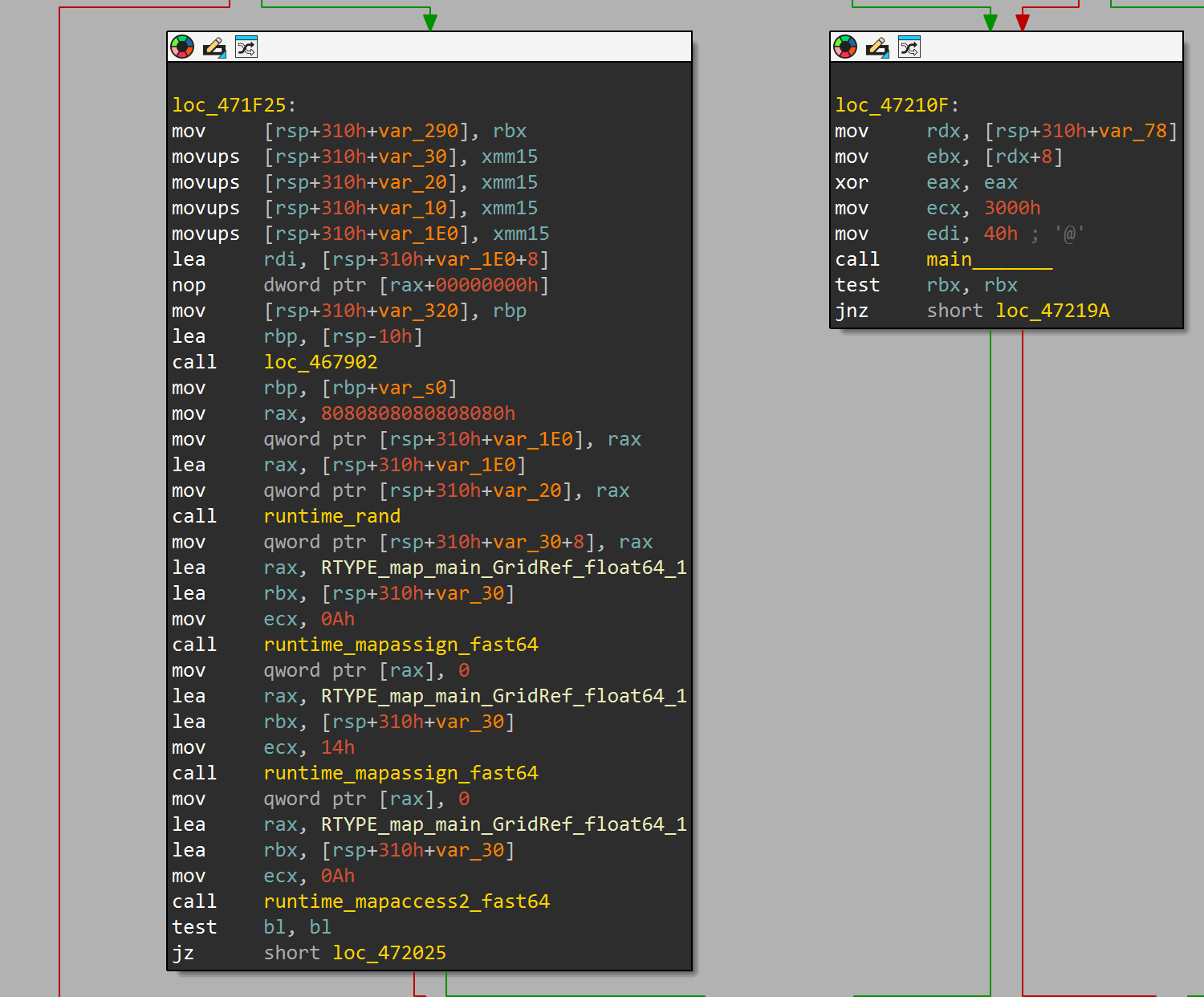 IDA graph view: left block shows reactor cover code (
runtime_rand, mapassign_fast64, RTYPE_map_main_GridRef_float64); right block shows the VirtualAlloc call with ecx = 3000h and edi = 40h, the transition from cover to payload
main.main (2,255 bytes) starts with what looks like a legitimate application, it creates map[GridRef]float64 lattices, populates them with reactor physics values, and calls runtime.rand for simulation seeding. But buried in the middle of this math, at offset 0x4720e0, it launches the real payload:
; main.main — the transition from cover to payload
; After ~300 bytes of reactor simulation setup:
0x004720e0  call  sym.main.__6              ; main.讨价还价黄铜道歉 — build payload
0x004720e5  mov   qword [var_298h], rax     ; store payload pointer
0x004720ed  mov   rcx, qword [rax]          ; load payload base address
0x004720f0  mov   ebx, dword [rax + 8]      ; load payload size
0x004720f6  mov   ecx, 0x3000               ; MEM_COMMIT | MEM_RESERVE
0x004720fb  mov   edi, 0x40                 ; PAGE_EXECUTE_READWRITE ← RWX!
0x00472100  call  sym.main.                 ; main.简短平衡战斗 → VirtualAlloc
0x00472105  test  rbx, rbx                  ; check for error
0x00472108  jne   0x47210f                  ; retry on failure
0x3000 is MEM_COMMIT | MEM_RESERVE. 0x40 is PAGE_EXECUTE_READWRITE. This allocates a writable and executable memory region, the classic preparation for shellcode injection or reflective loading. The payload data comes from main.讨价还价黄铜道歉 (the 3,973-byte function), which builds the executable payload at runtime.
If the first VirtualAlloc call fails, the code retries at 0x472126 with the same parameters, persistence in allocation.
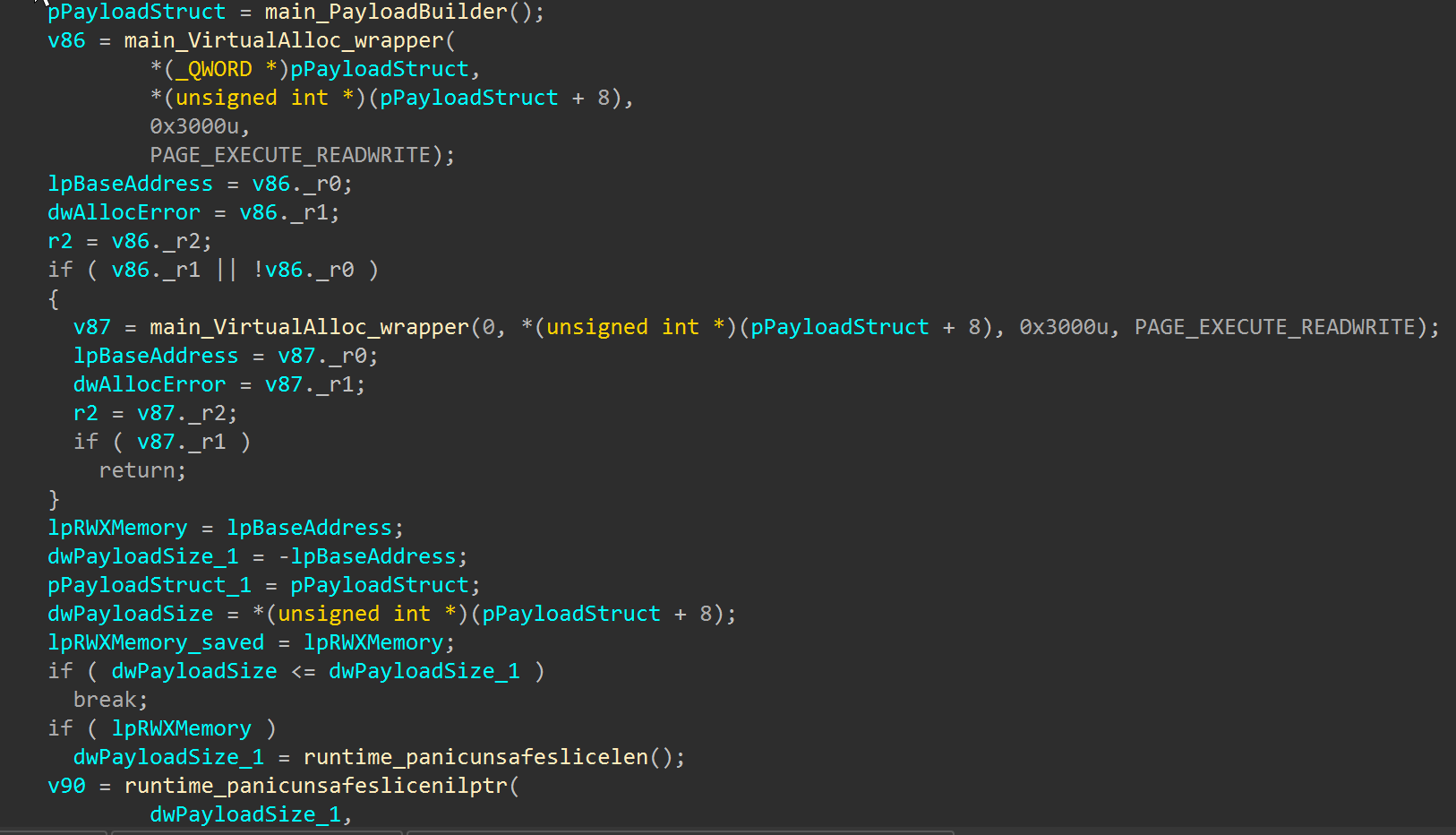 IDA pseudocode after annotation:
 main_PayloadBuilder() returns the payload struct, main_VirtualAlloc_wrapper() allocates RWX memory with PAGE_EXECUTE_READWRITE. The retry logic and error checking are clearly visible. Variable names mapped to Win32 API conventions via IDAPython.
Dynamic API Resolution: LoadLibrary → GetProcAddress
main.账户男孩酒吧 (“Account Boy Bar,” 2,262 bytes at 0x472fc0) implements the classic malware pattern of resolving APIs at runtime to avoid static import detection:
; main.账户男孩酒吧 — Dynamic API resolution chain
; Step 1: Load the target DLL
0x004733f5  call  sym.syscall.LoadLibrary    ; LoadLibraryW(dll_name)
0x004733fa  test  rbx, rbx                   ; check error
0x004733fd  jne   0x473456                   ; jump if load failed

; Step 2: Decode the encrypted function name
0x00473529  call  sym.main.__4               ; main.牛肉古代桥 — string decryptor
0x0047352e  mov   rcx, rbx

; Step 3: Resolve the function address
0x00473539  call  sym.syscall.GetProcAddress  ; GetProcAddress(handle, func_name)
0x0047353e  nop
0x00473540  test  rbx, rbx                   ; check error
0x00473543  jne   0x4735af                   ; jump if resolve failed

; Step 4: Execute via direct syscall
0x00473555  call  sym.main.__5               ; main.资产酒吧协助 → SyscallN
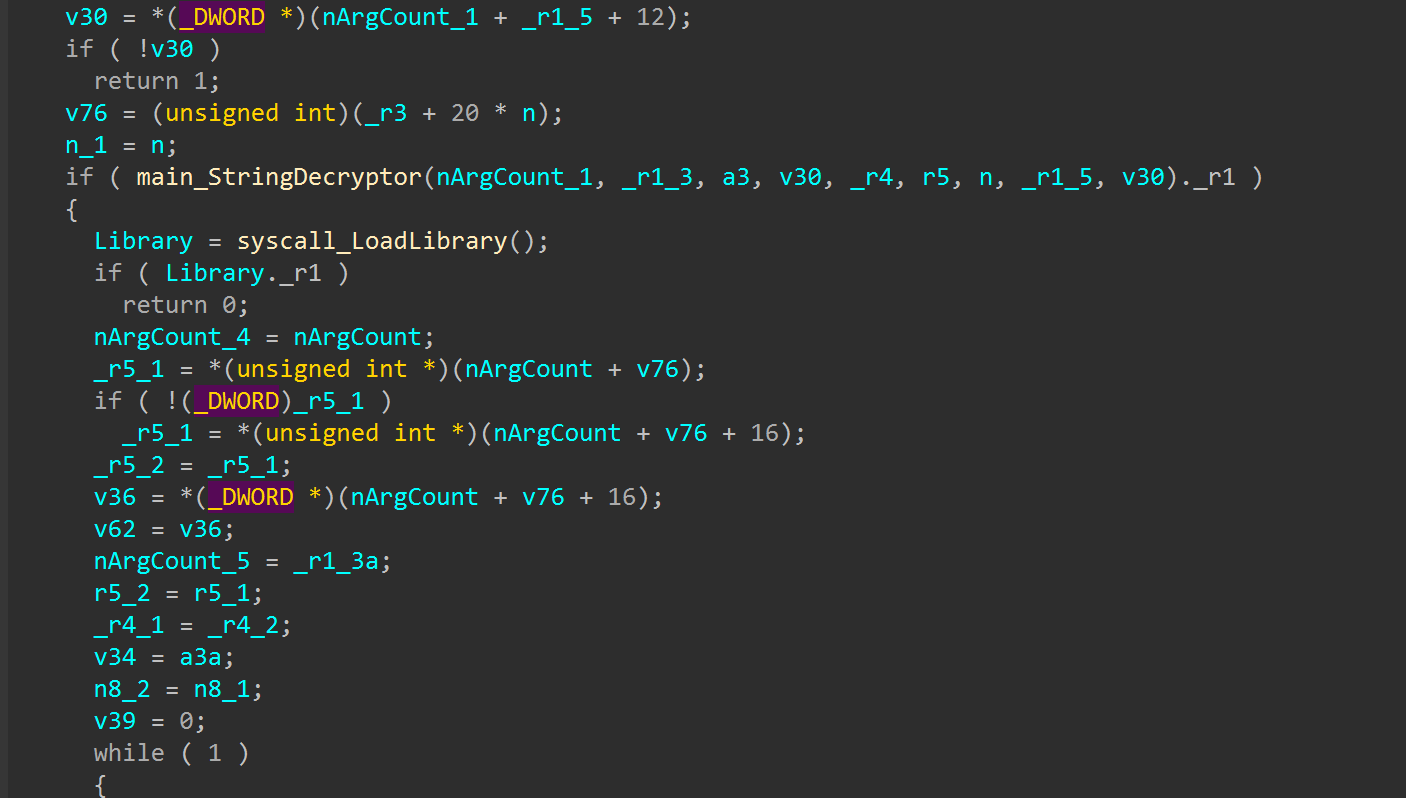 IDA pseudocode:
 main_StringDecryptor decrypts the API name, syscall_LoadLibrary resolves the DLL handle, then the resolved function is called with the decrypted arguments
The function name is not passed as a plaintext string. It’s decoded at runtime by main.牛肉古代桥 (“Beef Ancient Bridge”), the string decryption helper. This is why the C2 configuration and API names aren’t visible in static strings.
Direct Syscall Execution
main.资产酒吧协助 (“Asset Bar Assist,” 1,750 bytes at 0x4740e0) bypasses usermode API hooks entirely by calling syscall.SyscallN directly:
; main.资产酒吧协助 — Direct syscall execution
0x00474225  mov   rax, [0x543668]            ; load LazyDLL/Proc pointer
0x00474235  call  sym.syscall._LazyProc_.Find ; resolve the system call
0x0047423a  test  rax, rax                   ; verify success
0x0047423d  jne   0x4742b4                   ; jump if failed

0x00474250  mov   rsi, [rsi + 0x20]          ; get procedure address
0x00474254  mov   rax, [rsi + 0x18]          ; function pointer
0x00474278  mov   ecx, 2                     ; argument count = 2
0x00474280  call  sym.syscall.SyscallN        ; invoke the syscall directly
0x00474285  test  rax, rax                   ; check return value
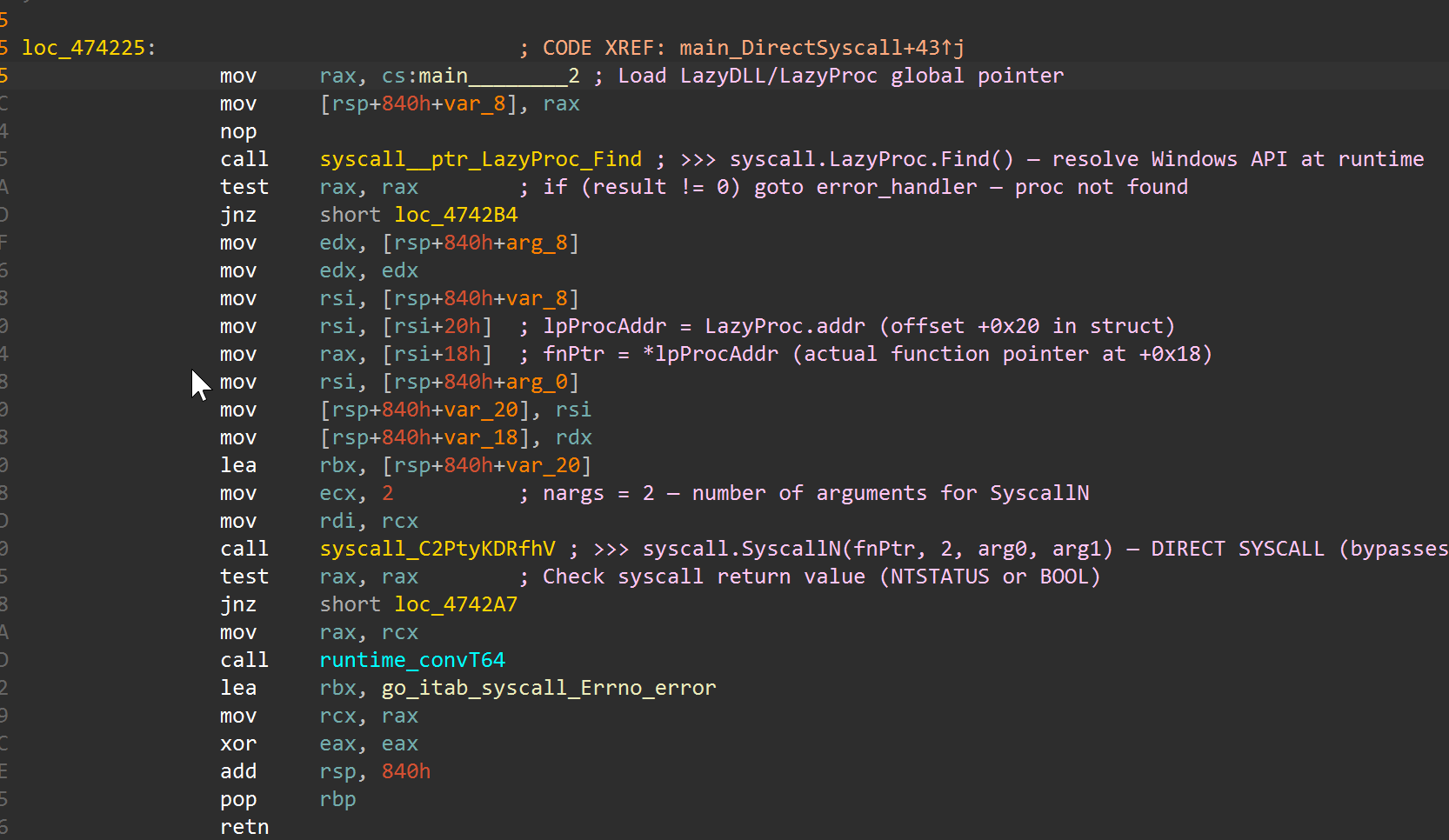 IDA ASM view with analyst annotations:
 LazyProc.Find resolves the procedure, lpProcAddr and fnPtr are extracted from the struct, nargs = 2 sets the argument count, then SyscallN executes the call directly, bypassing any usermode API hooks
SyscallN is Go’s mechanism for making arbitrary Windows API calls with a variable number of arguments. Combined with LazyProc.Find, this resolves and invokes system calls without going through the normal kernel32.dll dispatch, making EDR hook-based detection ineffective.
The APIs Being Resolved
The binary dynamically loads these DLLs through Go’s syscall package lazy loading infrastructure:
| Module | Purpose |
|---|---|
kernel32.dll | Memory allocation, process/thread management, file I/O |
advapi32.dll | Privilege management, token manipulation |
crypt32.dll | Cryptographic operations |
shell32.dll | Shell execution |
ws2_32.dll | Network socket operations (Winsock) |
ntdll.dll | Low-level NT API access |
Individual API targets (from import resolution and lazy proc setup):
1
2
3
4
5
6
7
8
9
VirtualAlloc, VirtualFree, VirtualQuery
CreateThread, SuspendThread, ResumeThread
SetThreadContext, GetThreadContext
DuplicateHandle, OpenProcess
CreateProcessAsUserW
GetProcessAffinityMask, GetSystemInfo
LoadLibraryW, LoadLibraryExW, GetProcAddress
WriteFile, CreateFileW, DeleteFileW
GetTempPathW, GetCurrentProcessId
The SuspendThread → SetThreadContext → ResumeThread pattern combined with VirtualAlloc(RWX) is a strong indicator of thread hijacking injection, a technique where the malware suspends a thread in a remote process, rewrites its instruction pointer to point at injected shellcode, then resumes it.
Embedded Payload: 227KB Encrypted Blob
Inside main.main, the binary allocates a 227,403-byte object and fills it with data from the .rdata section:
1
2
3
4
5
// From IDA pseudocode — payload construction
p_payload = runtime_newobject(&RTYPE__227403_uint8);      // allocate 227,403 bytes
*p_payload       = 0x6F078DAE4D6FA05F;                    // 8-byte header (mov)
*(p_payload + 8) = 0x7A85BB050C0B66E2;                    // 3 more header bytes
qmemcpy(p_payload + 11, &src_, 0x37840);                  // copy 227,392 bytes of encrypted data
The blob lives at file offset 0xAE421 with entropy of 7.73 bits/byte, firmly in the encrypted/compressed range. The byte frequency distribution is skewed toward values with low nibble 0xA (0x0A at 2.06%, 0x8A at 2.04%, 0xEA at 1.68%), suggesting a specific encoding scheme on top of encryption.
This data is then processed by main_map_alloc, which references go:rodatafipsstart, a Go 1.24 FIPS 140 compliance section boundary. This means the decryption uses Go’s built-in FIPS-certified crypto module (likely AES), not a custom algorithm. The decompiled code shows the output buffer size is 70,096 bytes (0x111D0), which is the actual payload that gets copied to the RWX memory.
I was unable to extract the decrypted shellcode statically, the decryption key is derived at runtime through the Go FIPS crypto chain. To recover the payload, you would need to:
- Break at
0x472100(theVirtualAlloccall) in a debugger and dump the RWX region after thememcpy - Capture a memory dump from a sandbox run at the right execution point
- Emulate the Go runtime’s FIPS crypto initialization (non-trivial due to Go’s complex startup sequence)
I also attempted runtime extraction via emulation:
- Speakeasy (Mandiant’s Windows PE emulator): killed by OOM. Go’s runtime initialization allocates hundreds of MB before reaching
main.main - Unicorn (targeted emulation of just the decryption path): same result. Go functions depend on the full runtime being initialized (GC, goroutine scheduler, memory allocator)
- Brute-force key search: tried single-byte XOR (0x00–0xFF), multi-byte XOR, ROL/ROR rotation, AES with every plausible key derivation (header bytes, build hash, SHA256 variants, certificate signer). None produced structured output.
- UnpacMe (automated unpacking service): processed this sample but recovered zero children, confirming the payload can’t be extracted without live execution
The absence of standard AES constants (S-box, T-tables) in the binary suggests Go 1.24’s FIPS module uses bitsliced AES, a constant-time implementation that doesn’t use lookup tables, making the algorithm harder to identify statically.
The raw encrypted blob is preserved in the analysis bundle as embedded_blob_227403.bin for anyone with a Windows debugger environment to extract the decrypted 70KB payload at runtime.
C2 Configuration
The C2 config is not visible in static strings, it’s encrypted and decoded at runtime by the main.牛肉古代桥 string decryption function. I was unable to crack the encryption statically (it’s not simple XOR, likely uses Go’s crypto packages).
However, threat.rip’s automated dynamic analysis extracted the config at runtime:
| Field | Value |
|---|---|
| C2 Host | 72[.]61[.]25[.]108 |
| C2 Port | 6789 |
| Protocol | TCP (raw) |
| ASN | AS-HOSTINGER |
| Infrastructure | Hostinger VPS |
Port 6789 is unusual, not a standard service port, but also not suspicious enough to trigger port-based alerting. The Hostinger ASN is a budget VPS provider frequently used for ephemeral C2 infrastructure.
The Builder Framework: Factory-v3
The build path leaked in the Go binary metadata reveals the framework:
1
Factory-v3/builder/temp/7061c16a7a05b72f2cf8d5e57bdcc1d0/main.go
Key observations:
Factory-v3, versioned builder framework (implying v1 and v2 exist)builder/temp/, the builder generates temporary source files, compiles them, then cleans up7061c16a7a05b72f2cf8d5e57bdcc1d0, likely an MD5 hash serving as a build ID-trimpath=truein build flags, the developer tried to strip source paths, butFactory-v3leaked through the module root
The -trimpath flag strips absolute filesystem paths from the binary but doesn’t remove the module path. This is a common OPSEC mistake, the builder name survives compilation.
The framework likely provides:
- A builder GUI or CLI that generates customized Go implant source code
- Nuclear reactor type name generation as the obfuscation layer
- CJK function name randomization (garble-style)
- Embedded Authenticode signing with the
www[.]glass[.]comcertificate - Per-build encryption key for the C2 configuration
The Authenticode Certificate
The binary carries a valid Authenticode signature issued to www[.]glass[.]com. This is significant because:
- It passes Windows SmartScreen, unsigned binaries trigger warnings; signed ones don’t
- It bypasses some AV heuristics, several engines reduce alerting on signed PE files
- The certificate is from an unknown CA.
Country Unknownin the certificate metadata suggests a self-signed or fraudulently obtained cert, but it validates as “valid” in Windows’ trust store
The signing happens at the builder level (the Factory-v3 framework applies it), as evidenced by the overlay containing a 2,176-byte PKCS#7 signature block.
IOC Appendix
Network Indicators
| Type | Value | Context |
|---|---|---|
| IP | 72[.]61[.]25[.]108 | C2 server |
| Port | 6789/tcp | C2 port (raw TCP) |
| ASN | AS-HOSTINGER | C2 hosting |
Host Indicators
| Type | Value | Context |
|---|---|---|
| Build Path | Factory-v3/builder/temp/ | Builder framework artifact in binary |
| Certificate | www[.]glass[.]com | Authenticode signer |
| Go Build ID | vIOXNUGrDWmi7-CT--qK/YkkHv7Jla5AY52C3CNL_/KDTloTCYQHuKnv65BC_L/FSZG-podQva36lp5t6_6 | Unique per-build identifier |
| RWX Allocation | VirtualAlloc(NULL, size, 0x3000, 0x40) | Shellcode staging |
File Hashes
| Hash | Value |
|---|---|
| SHA-256 | 072533c1d31d83b056a1a9f4174a23763c53597df1c89ad9c545df2c3bb35f5e |
| MD5 | 650c00bed1b3ce7db2e8ddfb949a5576 |
| SHA-1 | 350c7b55675d1cd6903ac8f12dcdceace13f1d43 |
MITRE ATT&CK Mapping
| ID | Technique | Evidence |
|---|---|---|
| T1027.010 | Obfuscated Files: Command Obfuscation | CJK function names + nuclear decoy types |
| T1055.003 | Process Injection: Thread Execution Hijacking | SuspendThread + SetThreadContext + ResumeThread + VirtualAlloc(RWX) |
| T1106 | Native API | Direct syscall via SyscallN bypassing API hooks |
| T1129 | Shared Modules | Runtime LoadLibrary + GetProcAddress |
| T1140 | Deobfuscate/Decode | main.牛肉古代桥 runtime string decryption |
| T1553.002 | Subvert Trust Controls: Code Signing | Valid Authenticode cert from www[.]glass[.]com |
| T1587.001 | Develop Capabilities: Malware | Factory-v3 custom builder framework |
Detection
YARA Rules
Two rules. Full file: backdoors/gsb/factory_v3_go_implant.yar
1
2
3
4
5
6
7
8
9
10
11
12
13
14
15
16
17
18
19
20
21
22
23
24
25
26
27
28
29
30
31
32
33
34
35
36
37
38
rule Factory_v3_Go_Implant_NuclearDecoy
{
    meta:
        description = "Detects Factory-v3 Go implant with nuclear reactor decoy types + CJK names"
        author = "Tao Goldi"
        family = "Factory-v3"
    strings:
        $builder = "Factory-v3/builder/temp/" ascii
        $nuke1 = "BeamEnvelope" ascii
        $nuke2 = "ControlDrum" ascii
        $nuke3 = "FuelRodBundle" ascii
        $nuke4 = "XenonTransientTable" ascii
        $nuke5 = "LatticeCell" ascii
        $cjk1 = { E5 8A A8 E4 BD 9C E5 85 AB E6 9C 88 E9 B8 9F }
        $cjk2 = { E8 B4 A6 E6 88 B7 E7 94 B7 E5 AD A9 E9 85 92 E5 90 A7 }
        $gobuild = "Go build ID:" ascii
    condition:
        uint16(0) == 0x5A4D and filesize < 5MB and
        ($builder or (4 of ($nuke*) and 1 of ($cjk*)))
}

rule Factory_v3_Go_Implant_Generic
{
    meta:
        description = "Generic Factory-v3 detection via nuclear decoy naming convention"
        author = "Tao Goldi"
        family = "Factory-v3"
    strings:
        $n1 = "BeamEnvelope" ascii
        $n2 = "ControlDrum" ascii
        $n3 = "FuelRodBundle" ascii
        $n4 = "XenonTransientTable" ascii
        $n5 = "MagnetFlavor" ascii
        $n6 = "LatticeCell" ascii
        $go = "runtime.main" ascii
    condition:
        uint16(0) == 0x5A4D and 5 of ($n*) and $go
}
Network (Suricata)
1
2
3
4
5
6
7
alert tcp $HOME_NET any -> $EXTERNAL_NET 6789 (
    msg:"MALWARE Backdoor.Win64.Gsb C2 communication";
    flow:established,to_server;
    dsize:>50;
    detection_filter:type count, track by_src, count 3, seconds 300;
    sid:2026043; rev:1;
)
Certificate-Based Detection
1
2
3
4
5
alert tls $HOME_NET any -> $EXTERNAL_NET any (
    msg:"MALWARE Gsb backdoor - www[.]glass[.]com signed binary";
    tls.cert_subject; content:"www[.]glass[.]com";
    sid:2026044; rev:1;
)
Reversing Methodology: How to Approach Go Malware
For analysts encountering Go-compiled malware for the first time, here’s the workflow that worked for this sample:
-
Try GoReSym first. Mandiant’s tool parses the pclntab for function names and metadata. It failed here (pclntab stripped), but it works on ~80% of Go samples.
-
Fall back to radare2.
r2 -c 'aaa; afl~main.' sample.exerecovers function boundaries even without pclntab. Theaanganalysis pass is Go-aware. -
Check the
.symtabsection, even when pclntab is stripped, the.symtaboften retains symbol names. Useizz~main.in radare2 to dump them. -
Look for the Go build ID.
strings sample.exe | grep "Go build ID"reveals the compiler version and build fingerprint. -
Search for the build path. Go embeds the source path in the binary. Even with
-trimpath, the module root often leaks (asFactory-v3did here). -
Map
syscall.*calls. Go’s standard library wraps Windows API calls throughsyscall.LoadLibrary,syscall.GetProcAddress, andsyscall.SyscallN. Finding these in the disassembly pinpoints the malicious code. -
For obfuscated samples, try GoResolver (CFG-based function name recovery) or GoStringUngarbler (garble string decryption).
Conclusion
This sample represents a step up in Go malware craftsmanship from what I usually see in my triage queue. The combination of a custom builder framework (Factory-v3), dual-layer obfuscation (nuclear physics cover + CJK garble), valid code signing, and runtime-encrypted configuration achieves a 15.8% VirusTotal detection rate, meaning 84% of AV engines think this is a legitimate application.
The nuclear reactor simulation isn’t cosmetic, it’s functional code that executes real math, making behavioral analysis harder. The CJK function names break signature engines that expect ASCII patterns. And the dynamic API resolution via LoadLibrary/GetProcAddress into SyscallN bypasses the usermode API hooks that most EDR products rely on.
But the operator made mistakes. The -trimpath flag didn’t fully strip the Factory-v3 module path. The .symtab section was left intact, exposing all CJK function names. And the Authenticode certificate from www[.]glass[.]com is a pivotable indicator, any other binary signed by this cert is almost certainly from the same operation.
For defenders: the nuclear type names (BeamEnvelope, ControlDrum, FuelRodBundle, XenonTransientTable) are highly specific and unlikely to appear in legitimate software outside of actual nuclear engineering tools. A YARA rule matching 5+ of these names in a Go PE binary is a high-fidelity detection with near-zero false positives.
The GCleaner distribution chain means this backdoor is being sold as a service, the Factory-v3 builder likely has other customers generating variants with different C2 addresses and build IDs. The framework name and certificate are the constants to hunt on.
Appendix: External Intelligence Sources
| Source | URL | Finding |
|---|---|---|
| threat.rip | File Report | Backdoor.Win64.Gsb, score 100/100, C2 config extracted |
| threat.rip | MalConfig | C2: 72[.]61[.]25[.]108:6789/tcp (AS-HOSTINGER) |
| Loader Insight Agency | Payload View | Distributed by GCleaner, 5 delivery tasks |
| MalwareBazaar | Sample | Tagged dropped-by-GCleaner, reporter: Bitsight |
| Scanner | Detection |
|---|---|
| Kaspersky Opentip | Backdoor.Win64.Gsb (dynamic) |
| ReversingLabs | Win64.Malware.Heuristic (ML) |
| VirusTotal | 12/76 (15.8%) |
| ANY.RUN | 100/100, Malicious |
| Hybrid Analysis | 87/100 |
| CyberFortress | 94.9% — #injection #obfusc #crypt |
Tools used: radare2 (disassembly), GoReSym (attempted symbol recovery), pefile/dnfile (PE metadata), custom Python string extraction. C2 config extracted by threat.rip. Kill chain mapped via Loader Insight Agency. Win32 API analysis referenced from Microsoft Learn.