Mirai-like ELF Reversing, Part I: Stage1 Trust Gate, Command Dispatch, and Killer Loop
Static analysis of a Mirai-lineage ELF bot covering C2 trust verification, seven-method command dispatch, anti-competition killer logic, and reproducible extraction scripts.

Mirai’s source leak in 2016 turned a single botnet into an entire lineage of Linux threats, and new variants keep surfacing on commodity IoT infrastructure. This post tears apart one such sample – a statically linked x86-64 ELF that showed up on an open download server – to document exactly how it authenticates to its controller, selects an attack method, and locks out competing malware. Every claim maps to a script, a virtual address, or a disassembly slice you can reproduce yourself.
For less technical readers: this malware is a bot. It connects to a control server, checks that the server is the one it expects, receives commands, and launches network flood routines. At the same time it runs a cleanup loop to remove or kill other tools/processes on the same device.
For technical readers: all findings below are tied to reproducible scripts, offsets, and disassembly slices in the local workspace.
Sample and Scope
| Artifact | SHA-256 |
|---|---|
d40cf9c95dcedf4f19e4a5f5bb744c8e98af87eb5703c850e6fda3b613668c28.elf (Stage1 sample) | d40cf9c95dcedf4f19e4a5f5bb744c8e98af87eb5703c850e6fda3b613668c28 |
094e9d6ee057d38f40c35f018488e35ab6ccd006ed261b17322e78fd5ea2c0cb.elf (Variant validation sample) | 094e9d6ee057d38f40c35f018488e35ab6ccd006ed261b17322e78fd5ea2c0cb |
Acquisition source (defanged): http://144[.]172[.]108[.]230/bins/mynode.x86_64
Working assessment: Mirai-like Stage1 loader/bot, high confidence for lineage overlap.
Download Artifacts
- Analysis bundle (repo folder): analysis_data/mirai_mar_2026
- Notebook: mirai_stage1_analysis.ipynb
- Scripts: scripts/
- IDA Python: ida/
- Reports: reports/
- YARA (high fidelity): mirai_like_d40cf9_stage1_highfidelity.yar
- YARA (variant heuristic): mirai_like_d40cf9_stage1_variant_heuristic.yar
- YARA (new variant high fidelity): mirai_like_094e9_stage1_highfidelity.yar
- YARA (family heuristic, both variants): mirai_like_stage1_family_heuristic.yar
Cross-Variant Validation (094e.. sample)
I reran the same scripts, notebook flow, and YARA checks against:
094e9d6ee057d38f40c35f018488e35ab6ccd006ed261b17322e78fd5ea2c0cb.elf
What changed:
- This variant does not expose the same named
method_*symbol set as the original sample - It still exposes resolver and flood-family markers (
__dns_lookup,udpfl00d,tcpFl00d,ovhudpflood,watchdog_maintain) - The pipeline now emits variant-scoped reports under
reports/variant_<sha12>/...so runs do not overwrite each other - Dispatch mapping falls back to heuristic mode when callsite-level symbols are missing
YARA validation now covers both files:
MIRAI_LIKE_D40CF9_STAGE1_HighFidelity+MIRAI_LIKE_D40CF9_STAGE1_VariantHeuristichit ond40...MIRAI_LIKE_094E9_STAGE1_HighFidelityhits on094e...MIRAI_LIKE_STAGE1_Family_Heuristichits on both
Executive Workflow
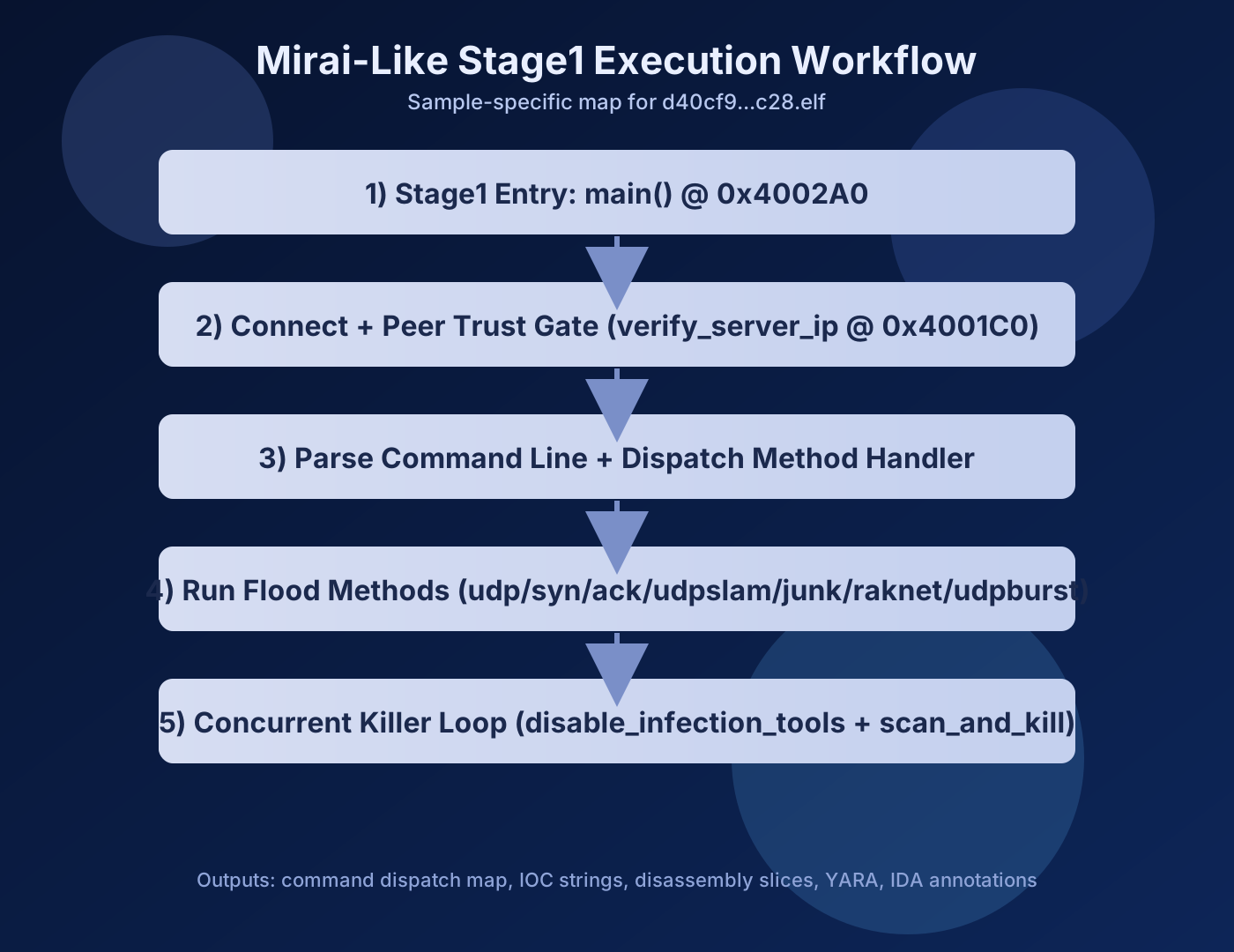
Stage map (sample-specific)
mainat0x4002a0: command/control loop and method dispatch.verify_server_ipat0x4001c0: trust gate for connected peer.killer_thread_funcat0x400730: endless anti-competition loop.disable_infection_toolsat0x400a10: downloader/tool disruption.scan_and_killat0x400d60:/procscan and process termination.
What the Malware Does
1) Connects and verifies who it is talking to
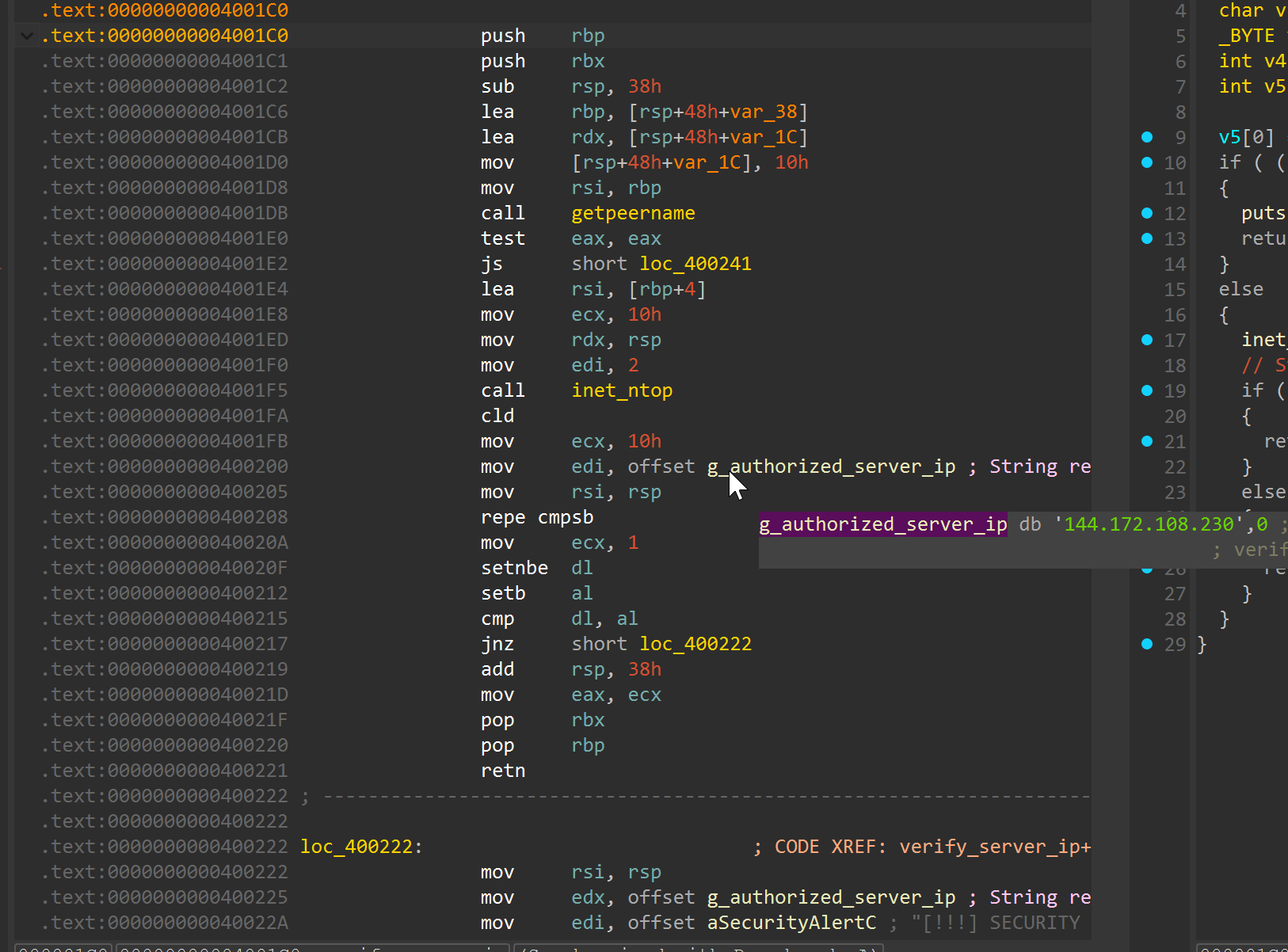
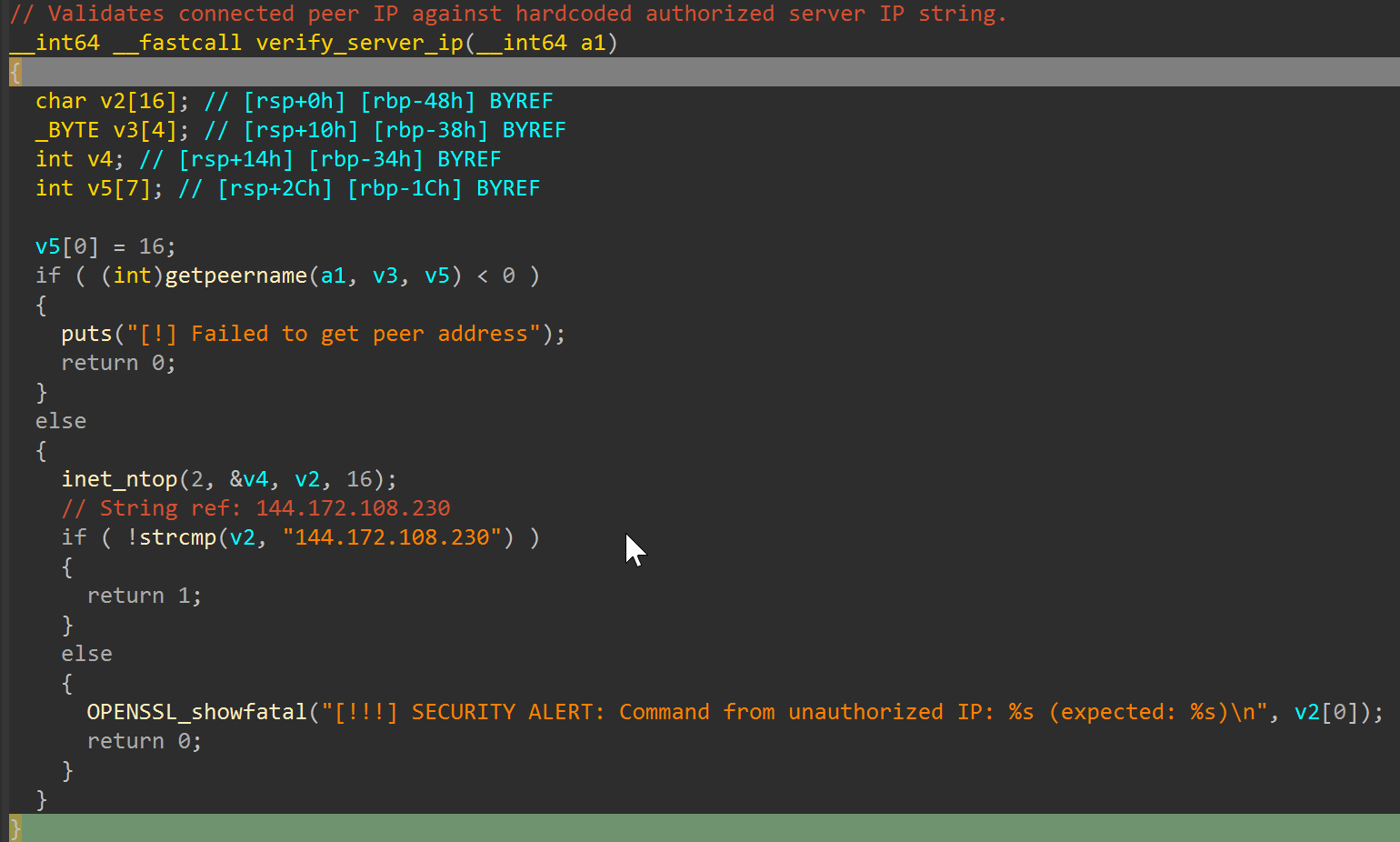
The sample contains a hardcoded server IP string at 0x41498a: 144[.]172[.]108[.]230.
main establishes a connection, then calls verify_server_ip. If the connected peer IP does not match the hardcoded value, the command path is rejected.
Plain language: this is a trust check so the bot listens only to its expected controller.

verify_server_ip in assembly:
verify_server_ip in pseudocode:
2) Parses command lines and dispatches attack methods
The parser in main routes method tokens to dedicated handlers.
| Command | Callsite in main | Handler |
|---|---|---|
udp | 0x4004f1 | method_udp (0x401380) |
syn | 0x40052e | method_syn (0x4027b0) |
ack | 0x4005b3 | method_ack (0x4026d0) |
udpslam | 0x400667 | method_udpslam (0x401280) |
junk | 0x4006c6 | method_junk (0x401190) |
raknet | 0x40063e | method_raknet (0x4010a0) |
udpburst | 0x400703 | method_udpburst (0x400f60) |
Observed control tokens include !SIGKILL and !hello.
Plain language: the bot has a menu of traffic attacks, and the server chooses which one to run.
Method tokens in .rodata:

Main dispatch assembly excerpt from main (0x400412 to 0x400703):
400412: cld
400413: mov ecx, 0x9
400418: mov rsi, r15
40041b: mov edi, 0x4149c6
400420: rep cmpsb
400422: je  0x4005bd <force_sigkill path>
...
4004ce: rep cmpsb                    ; "udp"
4004f1: call 0x401380 <method_udp>
...
40050b: rep cmpsb                    ; "syn"
40052e: call 0x4027b0 <method_syn>
...
400590: rep cmpsb                    ; "ack"
4005b3: call 0x4026d0 <method_ack>
...
400617: rep cmpsb                    ; "raknet"
40063e: call 0x4010a0 <method_raknet>
...
400667: call 0x401280 <method_udpslam>
...
4006c6: call 0x401190 <method_junk>
...
4006e0: rep cmpsb                    ; "udpburst"
400703: call 0x400f60 <method_udpburst>
This excerpt is from reports/disasm/main.asm in the published analysis bundle and matches the dispatch table above.
3) Runs anti-competition logic in parallel
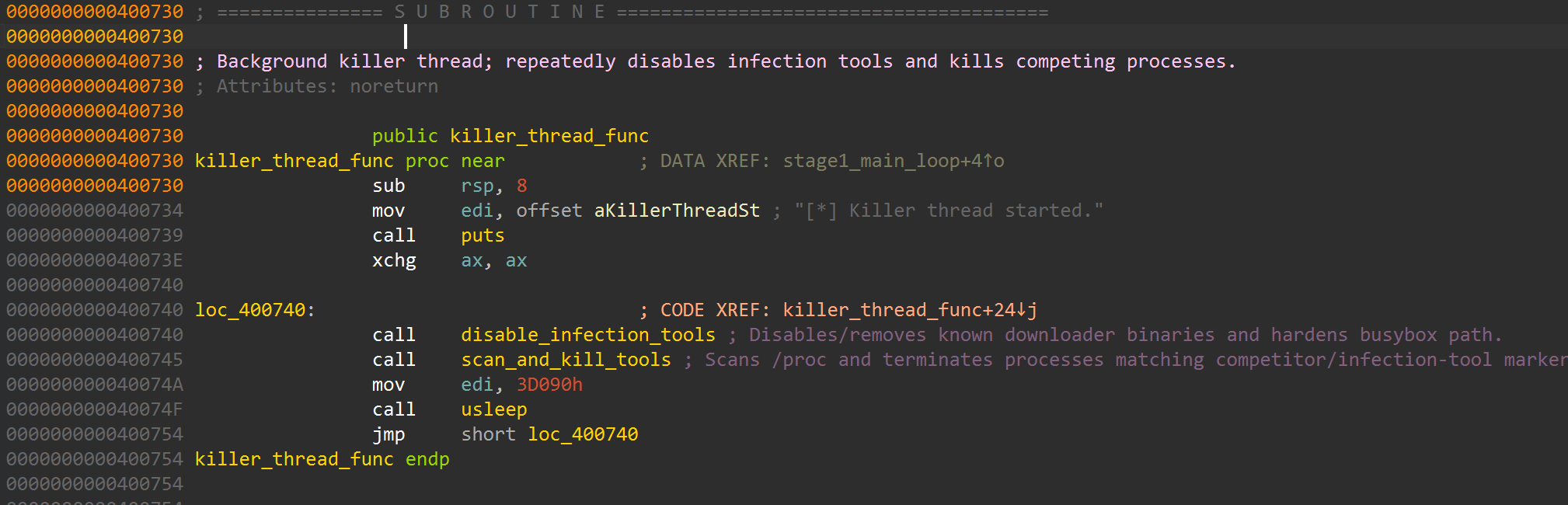
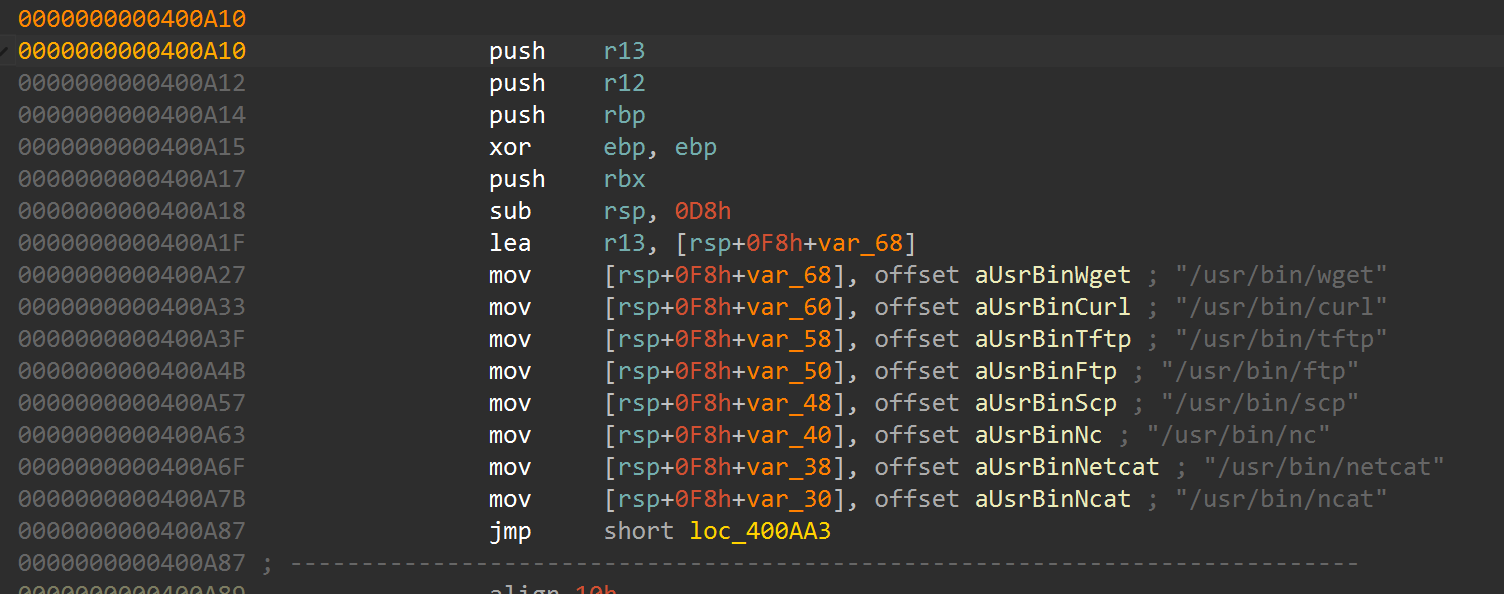
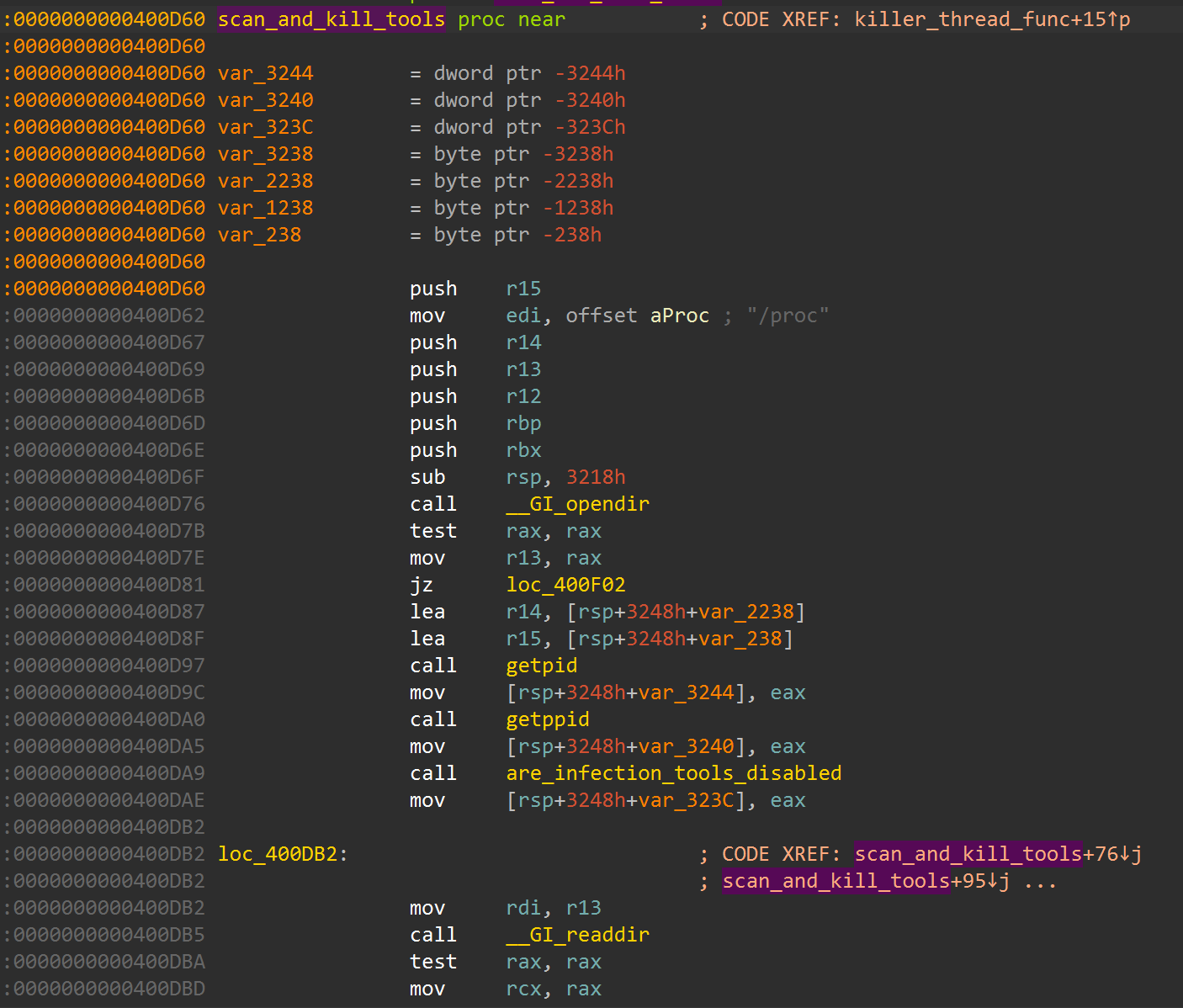
killer_thread_func repeatedly calls:
disable_infection_toolsscan_and_kill- sleep
- repeat
Referenced binary/tool paths include:
/usr/bin/wget/usr/bin/curl/usr/bin/tftp/usr/bin/ftp/usr/bin/scp/usr/bin/nc/usr/bin/netcat/usr/bin/ncat/bin/busybox
Plain language: once installed, it tries to keep control by removing competitors and useful admin tooling.
killer_thread_func loop:
disable_infection_tools routine:
scan_and_kill routine:
4) Carries multiple flood payload templates
.rodata contains traffic templates and markers including:
M-SEARCH * HTTP/1.1Via: SIP/2.0/UDP 192.168.1.1:5060
This aligns with multi-method DDoS behavior and protocol-specific packet crafting.
Subroutines of Interest (What each one does)
| Function | VA (sample-specific) | Role |
|---|---|---|
main | 0x4002a0 | Core bot loop: connect, verify peer, parse command, dispatch method handler. |
verify_server_ip | 0x4001c0 | Compares connected peer IP against hardcoded trusted server IP. |
killer_thread_func | 0x400730 | Long-running worker that repeatedly applies anti-competition logic. |
disable_infection_tools | 0x400a10 | Targets downloader/admin tools to reduce competing access paths. |
scan_and_kill | 0x400d60 | Walks /proc and kills processes matching internal checks. |
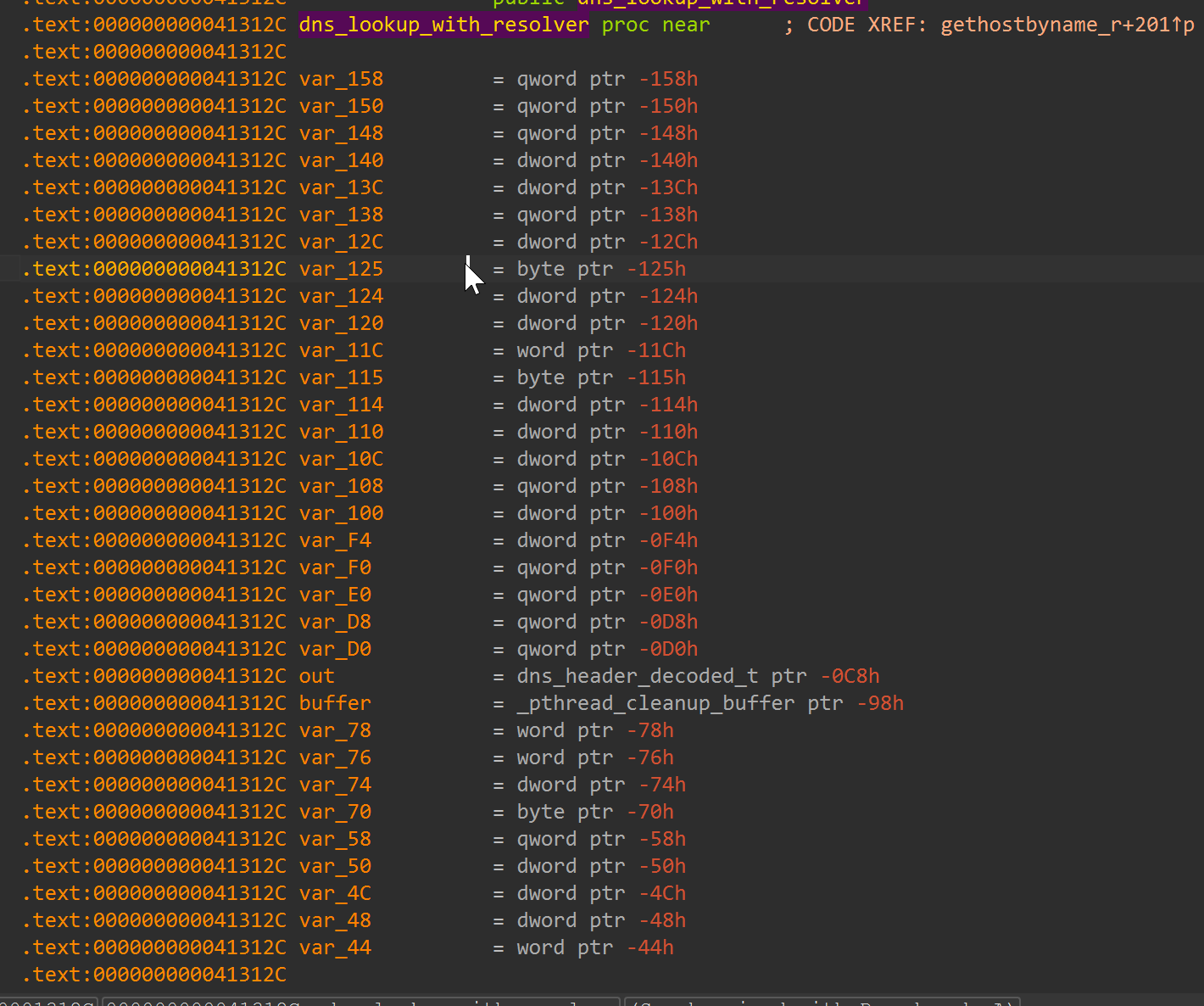
__dns_lookup | 0x41312c | Builds DNS query, sends/receives UDP DNS data, validates response flow. |
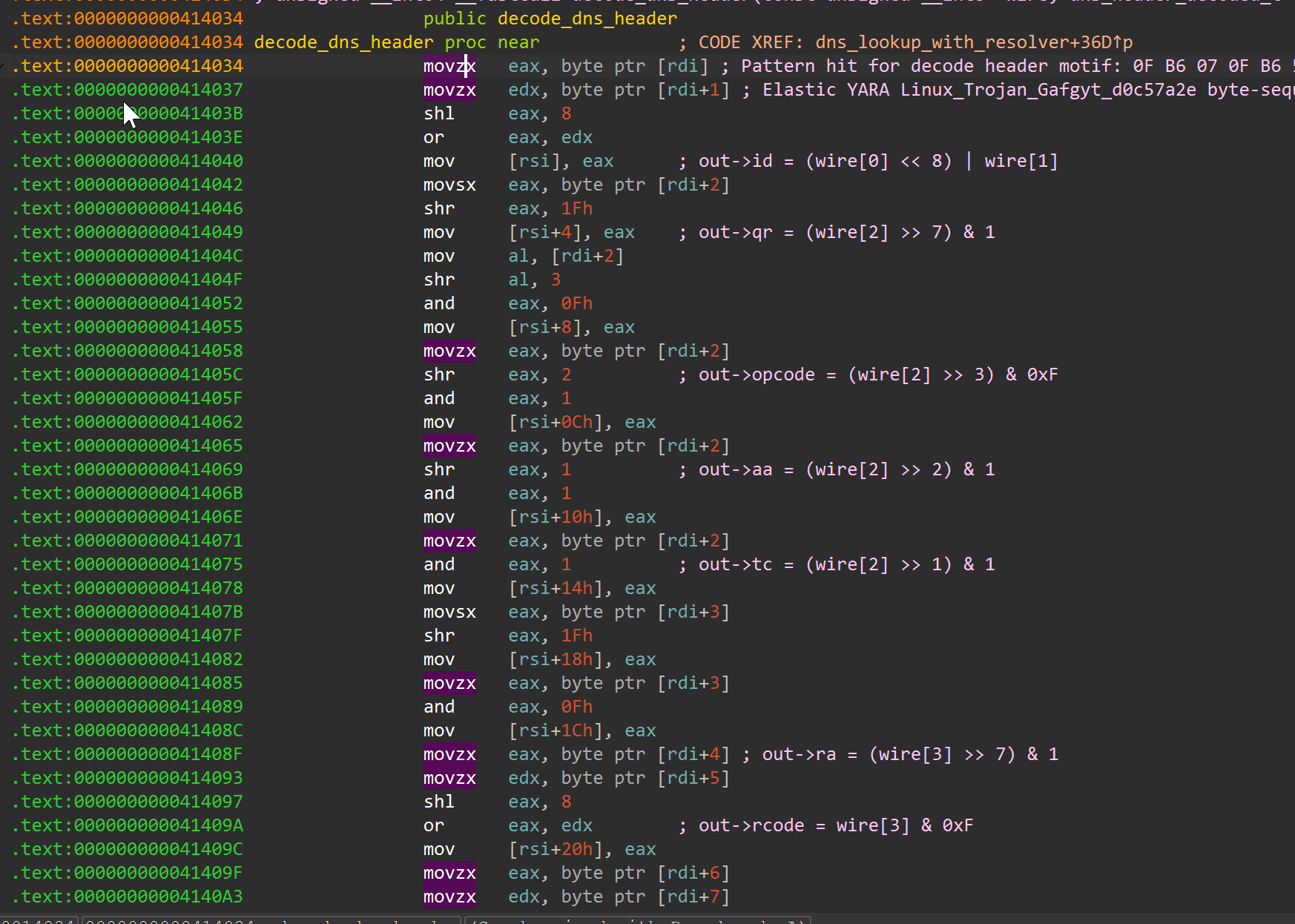
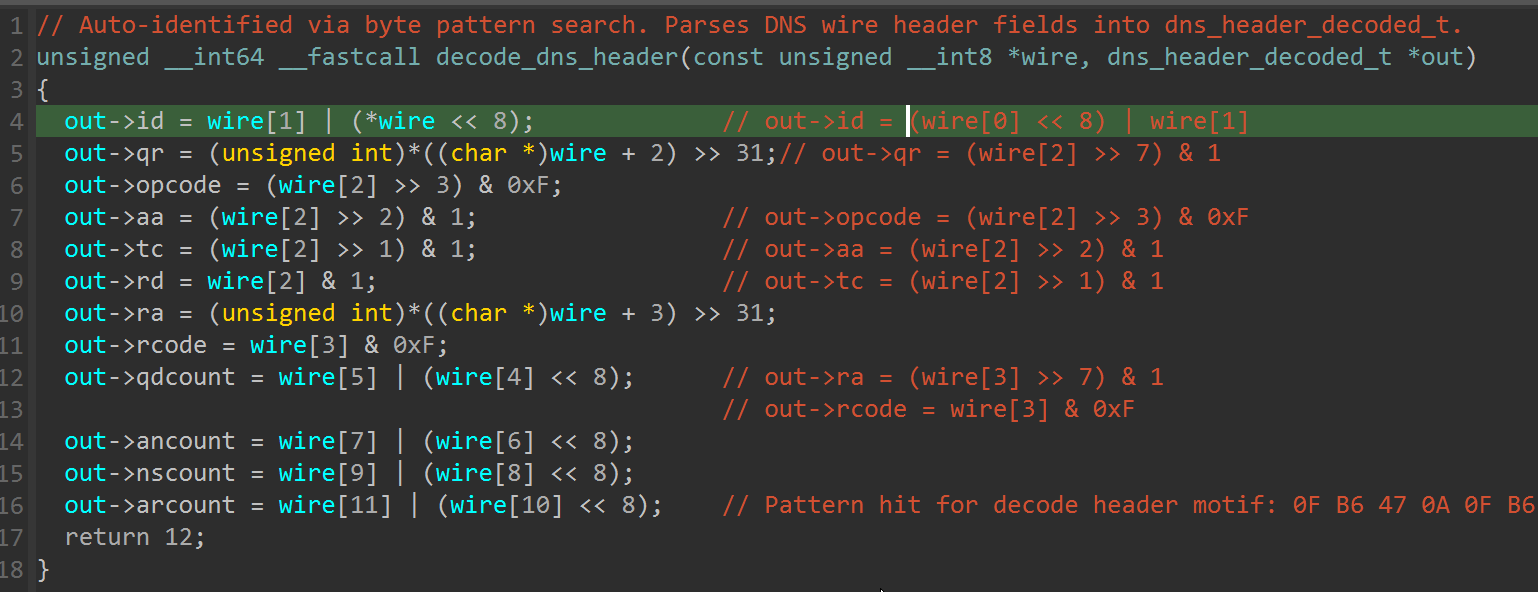
__decode_header | 0x414034 | Parses DNS header bytes into decoded fields (id, flags, section counts). |
method_udpburst | 0x400f60 | One concrete flood method implementation reachable from command parser. |
For less technical readers: these are the key “jobs” inside the bot. Together they explain command intake, trust control, attack execution, and persistence behavior.
Why the DNS decode subroutine matters
The routine identified as __decode_header parses a DNS wire header into decoded fields (id, flags, qdcount, ancount, etc.).
That routine itself is not a unique “family signature” in isolation. It is significant because:
- it sits in the resolver path used by
__dns_lookup, - it shapes response validation behavior,
- and its byte sequence overlaps an Elastic rule motif (
Linux_Trojan_Gafgyt_d0c57a2e), which supports lineage overlap.
Practical analyst takeaway: treat this as shared protocol/lineage evidence, not sole attribution evidence.
__dns_lookup and resolver path:
__decode_header assembly:
__decode_header pseudocode:
Comparison with Fortinet Gayfemboy Campaign
I compared this sample against Fortinet’s campaign write-up and figure-level indicators.
Reference: Fortinet IoT malware Gayfemboy Mirai campaign
What overlaps
- Mirai-style resolver/decoder behavior.
- Process-killer/anti-tooling patterns.
- Shared DDoS template style.
What does not overlap
- No campaign-specific domain strings shown in that report.
- No reported process-killer keywords (
twinks :3,meowmeow,whattheflip,^kill^). - No watchdog control marker
47272in extracted strings.
Conservative conclusion: Mirai-lineage overlap, but not enough to claim same campaign cluster.
Reproducible Data-Extraction Workflow
All outputs below are generated from scripts in malware/Mirai.
Public script bundle: analysis_data/mirai_mar_2026/scripts
End-to-end run
1
python3 scripts/run_full_analysis.py
Step-by-step scripts
1
2
3
4
5
6
7
8
python3 scripts/run_full_analysis.py --sample input/d40cf9c95dcedf4f19e4a5f5bb744c8e98af87eb5703c850e6fda3b613668c28.elf --outdir reports/variant_d40cf9c95dce
python3 scripts/run_full_analysis.py --sample input/094e9d6ee057d38f40c35f018488e35ab6ccd006ed261b17322e78fd5ea2c0cb.elf --outdir reports/variant_094e9d6ee057

python3 scripts/triage_mirai_elf.py --sample input/<sha>.elf --outdir reports/variant_<sha12>
python3 scripts/extract_mirai_rodata_artifacts.py --sample input/<sha>.elf --outdir reports/variant_<sha12>
python3 scripts/extract_command_dispatch.py --sample input/<sha>.elf --triage-json reports/variant_<sha12>/json/triage_report.json --outdir reports/variant_<sha12>
python3 scripts/export_disasm_slices.py --sample input/<sha>.elf --outdir reports/variant_<sha12>/disasm
python3 scripts/compare_fortinet_gayfemboy.py --sample input/<sha>.elf --out reports/variant_<sha12>/json/fortinet_gayfemboy_overlap.json
Artifacts produced
reports/variant_<sha12>/json/triage_report.jsonreports/variant_<sha12>/json/rodata_artifacts.jsonreports/variant_<sha12>/json/command_dispatch_map.jsonreports/variant_<sha12>/json/fortinet_gayfemboy_overlap.jsonreports/variant_<sha12>/disasm/*.asmreports/static/*.txt
Notebook and IDA Scripts
Notebook
What it does:
- runs the pipeline,
- loads JSON artifacts,
- summarizes key IOCs/offsets for reporting.
IDA scripts
ida/mirai_stage1_annotator.py- Variant-aware function/data symbol pass using both name-based and string-xref pivots.
- Adds C2 trust-gate and dispatch comments where structurally valid.
ida/mirai_string_hunt_annotator.py- Finds high-signal strings and tags xrefs for fast triage.
ida/mirai_dns_resolver_pattern_annotator.py- Variant-agnostic byte-pattern search for DNS decode logic.
- Renames/types resolver functions and injects decode comments without hardcoded addresses.
ida/mirai_dns_resolver_annotator.py- Sample-specific resolver annotations (address-driven convenience script).
YARA Rules
Rules files:
- mirai_like_d40cf9_stage1_highfidelity.yar
- mirai_like_d40cf9_stage1_variant_heuristic.yar
- mirai_like_094e9_stage1_highfidelity.yar
- mirai_like_stage1_family_heuristic.yar
1
2
3
4
5
6
7
8
9
10
11
12
13
14
15
16
17
18
19
20
21
22
23
24
25
26
27
28
29
30
31
32
33
34
35
36
37
38
39
40
41
42
43
44
45
46
47
48
49
50
51
52
53
54
55
56
57
58
59
60
61
62
63
64
65
66
67
68
69
70
71
72
73
74
75
76
77
78
79
80
81
82
83
84
85
86
87
88
89
90
91
92
93
94
95
96
97
98
99
100
101
102
103
104
105
rule MIRAI_LIKE_D40CF9_STAGE1_HighFidelity
{
  meta:
    author = "taogoldi"
    date = "2026-02-26"
    version = "2"
    sha256 = "d40cf9c95dcedf4f19e4a5f5bb744c8e98af87eb5703c850e6fda3b613668c28"
    description = "High-fidelity rule for the analyzed Mirai-like ELF sample"

  strings:
    $s1 = "[*] Connected to authorized server (%s)" ascii
    $s2 = "[!!!] SECURITY ALERT: Command from unauthorized IP: %s (expected: %s)" ascii
    $s3 = "144.172.108.230" ascii
    $s4 = "!SIGKILL" ascii
    $s5 = "1337SoraLOADER" ascii
    $s6 = "method_udpburst" ascii
    $s7 = "[*] Killer thread started." ascii

  condition:
    uint32(0) == 0x464c457f and 5 of ($s*)
}

rule MIRAI_LIKE_D40CF9_STAGE1_VariantHeuristic
{
  meta:
    author = "taogoldi"
    date = "2026-02-26"
    version = "2"
    sha256 = "d40cf9c95dcedf4f19e4a5f5bb744c8e98af87eb5703c850e6fda3b613668c28"
    description = "Heuristic Mirai-like detector for this cluster family"

  strings:
    $m1 = "udpslam" ascii
    $m2 = "udpburst" ascii
    $m3 = "raknet" ascii
    $m4 = "M-SEARCH * HTTP/1.1" ascii
    $m5 = "Via: SIP/2.0/UDP 192.168.1.1:5060" ascii
    $m6 = "/proc/%s/cmdline" ascii
    $m7 = "/proc/%s/maps" ascii
    $m8 = "/bin/busybox" ascii
    $m9 = "disable_infection_tools" ascii
    $m10 = "scan_and_kill" ascii

  condition:
    uint32(0) == 0x464c457f and
    7 of ($m*)
}

rule MIRAI_LIKE_094E9_STAGE1_HighFidelity
{
  meta:
    author = "taogoldi"
    date = "2026-03-07"
    version = "2"
    sha256 = "094e9d6ee057d38f40c35f018488e35ab6ccd006ed261b17322e78fd5ea2c0cb"
    description = "High-fidelity rule for the validated Mirai-like variant (094e...)"

  strings:
    $s1 = "watchdog_maintain" ascii
    $s2 = "watchdog_pid" ascii
    $s3 = "udpfl00d" ascii
    $s4 = "tcpFl00d" ascii
    $s5 = "ovhudpflood" ascii
    $s6 = "TSource Engine Query" ascii
    $s7 = "KHserverHACKER" ascii
    $s8 = "/etc/config/resolv.conf" ascii
    $s9 = "__open_nameservers" ascii
    $s10 = "dnslookup.c" ascii

  condition:
    uint32(0) == 0x464c457f and 7 of ($s*)
}

rule MIRAI_LIKE_STAGE1_Family_Heuristic
{
  meta:
    author = "taogoldi"
    date = "2026-03-07"
    version = "2"
    description = "Family-level heuristic intended to match both d40... and 094e... Mirai-like variants"

  strings:
    $core1 = "/etc/config/resolv.conf" ascii
    $core2 = "__open_nameservers" ascii
    $core3 = "dnslookup.c" ascii
    $core4 = "opennameservers.c" ascii
    $core5 = "__dns_lookup" ascii

    $old1 = "!SIGKILL" ascii
    $old2 = "M-SEARCH * HTTP/1.1" ascii
    $old3 = "Via: SIP/2.0/UDP 192.168.1.1:5060" ascii
    $old4 = "udpburst" ascii
    $old5 = "udpslam" ascii

    $new1 = "watchdog_maintain" ascii
    $new2 = "udpfl00d" ascii
    $new3 = "tcpFl00d" ascii
    $new4 = "ovhudpflood" ascii
    $new5 = "TSource Engine Query" ascii

  condition:
    uint32(0) == 0x464c457f and
    3 of ($core*) and
    (2 of ($old*) or 2 of ($new*))
}
MITRE ATT&CK Mapping
| Technique ID | Name | Evidence in Sample |
|---|---|---|
| T1071.001 | Application Layer Protocol: Web Protocols | C2 communication over TCP to hardcoded IP; SIP and SSDP protocol templates in .rodata |
| T1573 | Encrypted Channel | Trust-gate verification of C2 peer IP before accepting commands (verify_server_ip) |
| T1059.004 | Command and Scripting Interpreter: Unix Shell | Command dispatch loop in main parses server-sent tokens and routes to handlers |
| T1489 | Service Stop | scan_and_kill walks /proc and terminates competing processes |
| T1562.001 | Impair Defenses: Disable or Modify Tools | disable_infection_tools removes wget, curl, tftp, ftp, scp, nc, netcat, ncat, busybox |
| T1498.001 | Network Denial of Service: Direct Network Flood | Seven DDoS methods: UDP, SYN, ACK, UDP-slam, junk, RakNet, UDP-burst |
| T1018 | Remote System Discovery | __dns_lookup builds and sends UDP DNS queries to resolve target hosts |
| T1106 | Native API | Direct use of Linux syscalls for socket, connect, process enumeration via /proc |
| T1036 | Masquerading | Loader string 1337SoraLOADER references the Sora variant family name |
IOC Appendix
File Hashes (SHA-256)
| Sample | SHA-256 |
|---|---|
| Stage1 primary | d40cf9c95dcedf4f19e4a5f5bb744c8e98af87eb5703c850e6fda3b613668c28 |
| Stage1 variant | 094e9d6ee057d38f40c35f018488e35ab6ccd006ed261b17322e78fd5ea2c0cb |
C2 Infrastructure
| Indicator | Type | Context |
|---|---|---|
144[.]172[.]108[.]230 | IPv4 | Hardcoded C2 server IP and download host |
Network Indicators
| Indicator | Type | Context |
|---|---|---|
http://144[.]172[.]108[.]230/bins/mynode.x86_64 | URL | Sample acquisition/distribution path |
M-SEARCH * HTTP/1.1 | Payload template | SSDP reflection flood template in .rodata |
Via: SIP/2.0/UDP 192.168.1.1:5060 | Payload template | SIP flood template in .rodata |
Notable Strings
| String | Context |
|---|---|
!SIGKILL | Control token parsed by command dispatcher |
!hello | Control token parsed by command dispatcher |
1337SoraLOADER | Loader/variant identity string |
KHserverHACKER | Present in variant 094e... |
Conclusion
This Stage1 bot follows a clear Mirai-lineage architecture: it connects to a single hardcoded C2 IP, verifies the peer before accepting any instructions, and then enters a command-dispatch loop that routes server-sent tokens to seven distinct DDoS flood methods (UDP, SYN, ACK, UDP-slam, junk, RakNet, and UDP-burst). In parallel, a dedicated killer thread continuously removes common transfer utilities and terminates competing processes through /proc enumeration, ensuring the bot maintains exclusive control of the infected device.
Cross-variant validation against a second sample (094e...) confirmed that the core resolver, flood-family markers, and anti-competition patterns persist across builds, even when named symbols shift. The family-level YARA rule catches both variants while the high-fidelity rules pin each individually. Comparison with the Fortinet Gayfemboy campaign showed shared Mirai-lineage traits but not enough overlap to assert same-cluster attribution.
All findings are reproducible through the published scripts, IDA annotators, and notebook. Part II will extend this work with runtime behavior profiling and broader variant clustering.