Flare-On 13, Challenge 3: the polyglot "document"
This is the one I enjoyed most in the whole set, and it's the one that took the widest range of tools. flareon13.doc is 1,855,887 bytes and it is not a Word document. It is six different file formats at the same...
Archive: 3-flareon13_doc.7z (password flare), containing flareon13.doc · Flag: Ju$7_4_l177l3_7r34$ur3_HUN7@flare-on.com
This is the one I enjoyed most in the whole set, and it’s the one that took the widest range of tools. flareon13.doc is 1,855,887 bytes and it is not a Word document. It is six different file formats at the same time. Each format hides one token, and a checker buried inside the file wants all six.
Some background if this isn’t your field. Flare-On is the FLARE team’s yearly reverse-engineering contest, and each challenge hides a flag ending in @flare-on.com. This one is a polyglot, a single file that is valid in several formats at once. That works because formats are recognized by a few fixed bytes at a known position (magic bytes) and each parser reads only what it cares about: a PDF reader looks near the start, a ZIP reader looks at the end.
file(1), the Unix tool that identifies files by their magic bytes, gives you nothing at all:
1
2
$ file flareon13.doc
flareon13.doc: data
Which is encouraging, actually. data means nothing matched at offset zero and nothing matched any of libmagic’s heuristics either. On a file this large that usually means the structure is somewhere other than the front.
Tools I used
This challenge is basically a tour of file-format tooling, so the list is long:
| Tool | What I used it for |
|---|---|
binwalk, xxd, python3 | finding the six embedded structures and their offsets |
qpdf | decrypting the PDF (RC4-40, empty user password) and expanding it to QDF form |
poppler (pdftoppm, pdfimages) | rendering the page and extracting the JBIG2 image |
python3 + pypdf | reading the content stream and the EBCDIC text object |
| a hand-written UDF parser (~40 lines) | the descriptors aren’t at standard offsets, so no off-the-shelf tool found them |
| a hand-written ZipCrypto implementation | Python’s zipfile won’t decrypt, and nothing I have decompresses PKWARE Reduce |
otool / lipo / nm / codesign | taking apart the Mach-O universal binary |
radare2 | disassembling both Mach-O slices (s0.asm 26 KB, s1.asm 1.9 MB) |
r2ghidra (Ghidra’s decompiler inside radare2) | pseudocode for slice 0’s frame loop, to settle the 19-byte memcpy |
| a 16-bit x86 disassembler (by hand, honestly) | the DOS .COM stub at offset 0 |
pillow | cropping and zooming the JBIG2 output |
The layout

Mermaid source
flowchart LR
    F["<b>flareon13.doc</b><br/>1,855,887 B<br/><code>file(1)</code>: data"]
    F --> A["<b>0x000000</b> DOS .COM<br/>+ near-EICAR string"]
    F --> B["<b>0x000084</b> PDF 1.7, encrypted;<br/>object 1 is a 1,839,086-byte<br/>stream that swallows the rest"]
    F --> C["<b>0x009311</b> UDF disc image<br/>2352-byte raw CD sectors"]
    F --> D["<b>0x09FA30</b> Mach-O universal binary"]
    F --> E["<b>0x1C4E3F</b> ZIP with flag.txt"]
    F --> G["<b>0x1C4F8F</b> VHD footer 'conectix'<br/>disk ID = FLAREONPOLYGLOT!"]
    C --> C1["click_me — 502,816 B<br/>not contiguous: 2048 of<br/>every 2352 B, from block 6"]
    C --> C2["README.TXT —<br/>'benign corpus payload'"]
    D --> D1["slice 0 · subtype 0 · 68,560 B<br/>the one macOS actually runs"]
    D --> D2["slice 1 · subtype 3 · 404,512 B<br/>not a real arm64 subtype"]
    style G fill:#fde8e8,stroke:#d93025
    style C2 fill:#fde8e8,stroke:#d93025
The PDF is the outer wrapper and the reason this works at all. A PDF stream is a block of raw data whose declared length the parser simply skips. Object 1 is a stream declared as 1,839,086 bytes long, which swallows almost the entire file. Everything else (the disc image, the Mach-O, the ZIP) lives inside that stream as far as a PDF parser is concerned, and lives at its own offset as far as every other parser is concerned.
1. The DOS stub, which is not EICAR
The file opens with something that looks like the EICAR antivirus test string and isn’t. (EICAR is a harmless, all-printable DOS program that every antivirus product flags on purpose, so people can test their scanners.)
1
2
h  X5`!P[h @X5#`0G h @X5%`0G!h @X5"`0G"h @X53`0G#h @X57`0G$h  X5@!PZ
h  X5|!P[h  X5[)P^)7CC)7H+H*EICAR-STANDARD-ANTIVIRUS-TEST-FILE!$
I nearly skipped past this. It renders as near-ASCII junk followed by a string I’ve seen a thousand times. But those h groups are 16-bit x86, the machine code DOS runs: 0x68 is PUSH imm16 (push a two-byte constant), and the whole prologue is push/pop/xor sequences that construct register values without ever containing a literal byte an AV signature would match.
(For newcomers: ax, bx, dx, si are registers, ah/al the two halves of ax, and [bx+0x20] the memory at bx + 0x20.)
push 0x2020 / pop ax / xor ax, 0x2160   ; bx = 0x0140
push 0x4020 / pop ax / xor ax, 0x6023   ; al = 0x03
xor  byte [bx+0x20], al                 ; patch file offset 0x60
...                                      ; al = 0x05, 0x02, 0x13, 0x17
push 0x2020 / pop ax / xor ax, 0x2140   ; dx = 0x0160   (string pointer)
push 0x2020 / pop ax / xor ax, 0x217c   ; bx = 0x015c
push 0x2020 / pop ax / xor ax, 0x295b   ; si = 0x097b   (so ah = 0x09)
sub  word [bx],   si                     ; the two bytes "H+" become INT 21h
sub  word [bx+2], si                     ; the two bytes "H*" become INT 20h
radare2 (an open-source disassembler) reads the same bytes the same way when told the file is 16-bit code loaded at 0x100 (r2 -a x86 -b 16 -m 0x100), which is how I checked the hand listing above:
1
2
3
4
5
6
7
8
9
10
11
12
13
14
15
16
17
18
19
20
21
22
23
24
25
26
27
0000:0100     682020         push 0x2020
0000:0103     58             pop ax
0000:0104     356021         xor ax, 0x2160
0000:0107     50             push ax
0000:0108     5b             pop bx               ; bx = 0x0140
0000:0109     682040         push 0x4020
0000:010c     58             pop ax
0000:010d     352360         xor ax, 0x6023       ; al = 0x03
0000:0110     304720         xor byte [bx + 0x20], al
...
0000:0144     682020         push 0x2020
0000:0147     58             pop ax
0000:0148     357c21         xor ax, 0x217c
0000:014b     50             push ax
0000:014c     5b             pop bx               ; bx = 0x015c
0000:014d     682020         push 0x2020
0000:0150     58             pop ax
0000:0151     355b29         xor ax, 0x295b
0000:0154     50             push ax
0000:0155     5e             pop si               ; si = 0x097b
0000:0156     2937           sub word [bx], si
0000:0158     43             inc bx
0000:0159     43             inc bx
0000:015a     2937           sub word [bx], si
0000:015c     48             dec ax               ; "H+" and "H*": the bytes that become INT 21h / INT 20h
0000:015d     2b482a         sub cx, word [bx + si + 0x2a]
0000:0160     45             inc bp               ; "EICAR-STANDARD-..." read as code from here on
The comments are mine. Everything from 0x15c onward is the ASCII string being decoded as instructions, which is why a linear disassembly of the file looks like garbage past the two sub word [bx], si.
The subtraction checks out: H+ is the little-endian word 0x2B48, and 0x2B48 - 0x097B = 0x21CD, stored as CD 21, which is INT 21h. H* becomes CD 20, INT 20h.
A .COM program is the simplest DOS executable, with no header: DOS loads it at 0x100, after 256 bytes of its own bookkeeping, and jumps there. So 0x160 is file offset 0x60: the first byte of EICAR. The five XOR values rewrite exactly five characters:
1
E ^ 0x03 = F    I ^ 0x05 = L    C ^ 0x02 = A    A ^ 0x13 = R    R ^ 0x17 = E
INT 21h is the DOS service call, and AH = 0x09 selects “print $-terminated string,” with DX pointing at it. So the program prints
1
FLARE-STANDARD-ANTIVIRUS-TEST-FILE!
and exits (INT 20h). It even patches the two INT instructions into existence out of ASCII bytes, so the raw file contains no interrupt opcodes.
What I like about this: the bytes on disk are not the EICAR string, so the file is not an AV test file and doesn’t get quarantined on the way to you. Anybody who runs it sees that it meant to be one.
Token 1: FLARE-STANDARD-ANTIVIRUS-TEST-FILE!
2 and 3. The PDF
The PDF starts at 0x84 and is encrypted: /Filter /Standard /V 1 /R 2, which is 40-bit RC4. That sounds like a wall and isn’t. It opens with an empty user password, the standard “owner restrictions only” setup: the user password gates opening the file, the owner password only gates permissions like printing, so any reader can derive the key. qpdf writes a decrypted copy, expanded to QDF form (uncompressed and readable in a text editor):
1
$ qpdf --decrypt --password= --qdf --object-streams=disable doc.pdf dec.pdf
Rendering the page gives you a giant FLARE-ON logo, drawn as vectors, on a 14400 x 14400 page with /UserUnit 75000:

Invisible text
At the end of the content stream, the page’s list of drawing commands:
1
BT /F1 1 Tf 3 Tr 50 50 Td <9481899586998194856d8582838489836d878896a2a3> Tj ET
Tj draws the hex string, and 3 Tr is text rendering mode 3: neither filled nor stroked, i.e. invisible. It’s a real text object, it’s in the page, and it draws nothing.
The hex string isn’t ASCII either; almost every byte is above 0x7F. The giveaway is 0x6d repeating at two positions where you’d expect a separator, and 0x6d is underscore in EBCDIC, IBM’s mainframe character encoding (Python calls the US variant cp037):
1
2
>>> bytes.fromhex('9481899586998194856d8582838489836d878896a2a3').decode('cp037')
'mainframe_ebcdic_ghost'
The token names the trick, which is a kindness. Token 2: mainframe_ebcdic_ghost
The JBIG2 image
Object 7 is an 808 x 48, 1-bit image with /Filter /JBIG2Decode. JBIG2 is the bilevel (black-or-white) fax codec and almost nothing implements it, but poppler, the open-source PDF library, does. I ran it on the copy qpdf had already decrypted:
1
2
3
$ pdfimages -png dec.pdf out
$ ls out-*.png
out-000.png

The token is written out in the pixels.
Token 3: jbig2_fax_geometry
4. The UDF disc image
UDF (Universal Disk Format) is the file system on DVDs and many CDs. This is where the off-the-shelf tools stopped helping. The UDF descriptors (the records describing the volume and its files) are not at their standard offsets, so every tool I pointed at the file said it wasn’t a disc image.
UDF descriptors carry a 16-byte tag with a checksum (byte 4 is the low byte of the sum of the other fifteen) and the sector number the descriptor believes it sits in, its tag location. So I scanned for valid tags instead of trusting offsets:
1
2
def tag_ok(b):
    return sum(b[:4]) + sum(b[5:16]) & 0xFF == b[4]
Two anchor descriptors turned up, at tag locations 256 and 525, sitting at file offsets 0x93010 and 0x12D780 (the anchor is what a UDF reader looks for first; it points at everything else). Two known sectors at two known offsets, and the ratio gives the geometry immediately:
1
(0x12D780 - 0x93010) / (525 - 256) = 2352
2352-byte raw CD sectors: the full Mode 1 sector, with its 16-byte header and 2048 bytes of user data; the other 288 bytes are error correction. That’s why nothing recognized it. Every tool assumes 2048-byte logical blocks.
1
file_offset(sector) = 16 + sector * 2352
There’s no base offset beyond the 16-byte header, so sector 0 lines up with byte 0: the disc image spans the whole file. UDF leaves its first 16 sectors unused, which is where the DOS stub and the PDF header live.
The partition starts at sector 272, and walking the file entries from there:
1
2
FE @blk4:  filetype=5  infolen=502816   extent: 502816 B @ block 6    -> click_me
FE @blk5:  filetype=5  infolen=22       extent: 22 B     @ block 252  -> README.TXT
A file entry (FE) describes one file: type 5 is a regular file, infolen its size, the extent where its data sits. Block 6 of the partition is sector 278, and 16 + 278 * 2352 is 0x9FA30, exactly where the Mach-O shows up.
README.TXT says benign corpus payload, which is a joke and not a token.
The actual token is sitting in plain text in the Implementation Use Volume Descriptor (where the authoring software describes itself), right next to DiscRecording Framework and *UDF LV Info:
1
udf_tagged_descriptor
Token 4: udf_tagged_descriptor
The part that actually mattered
This is the bit I got wrong, and it set me back further than anything else in the challenge.
click_me is a Mach-O (macOS executable), specifically a universal one: several executables, one per CPU type, behind a header starting with 0xCAFEBABE. I found it by scanning for 0xCAFEBABE and carved it out by length (cut that many bytes out of the big file). file said universal binary. lipo -detailed_info worked. It looked completely fine, and it was completely broken: __stubs (the jump table for imported functions) empty, string table blank, 93 of its 133 512-byte blocks all zeros.
Which, in hindsight, is obvious. File data in this image lives in 2048-byte chunks inside 2352-byte sectors, so a contiguous carve swallows 304 bytes of sector header and ECC every 2352 bytes. It only looked valid because the Mach-O header happened to land inside the first chunk.
The fix is to reassemble from the UDF extents, 2048 data bytes per sector:
1
2
3
4
5
6
SEC, BASE, DATA, PART = 2352, 16, 2048, 272
def block(n):
    o = BASE + (PART + n) * SEC
    return data[o : o + DATA]

click_me = b''.join(block(6 + i) for i in range(246))[:502816]
1
2
$ shasum click_me udf_FE@blk4.bin
# identical — and now nm, otool and radare2 all agree
The lesson I’d actually write on a sticky note: a carve that produces a file your tools accept is not a carve that produced the right file. Check a structure that spans the whole file (a string table, a symbol table, a checksum), not just the header.
5. The ZIP
The trailing ZIP at 0x1C4E3F has one entry:
1
2
flag.txt    compression method 2     flags 0x0001 (encrypted)
            CRC 0x25130DEA           compressed 222    uncompressed 18
Method 2 is PKWARE Reduce, from 1989, long before Deflate (method 8, what nearly every ZIP uses). Python’s zipfile doesn’t implement it. Neither does 7-Zip. Neither does Info-ZIP. That’s the whole joke, and the token says so.
The encryption is legacy ZipCrypto, the original ZIP password scheme, which is about thirty lines to implement. Candidate passwords: the conventional one for shared malware samples is infected, and that’s it. The 12-byte header ZipCrypto puts before the data is how you know you’re right once decrypted:
1
11 22 33 44 55 66 77 88 99 aa bb 25
ZipCrypto’s header check only verifies one byte: the last must equal the high byte of the CRC, and 0x25 matches 0x25130DEA. A one-byte check gives you a 1-in-256 false positive rate, which is far too loose to trust on its own. But 11 22 33 44 55 66 77 88 99 aa bb is clearly hand-written, not random, so this isn’t a coincidental hit.
The payload turned out not to need a Reduce decompressor at all: 192 zero bytes (empty Reduce follower sets) followed by the literal text. Follower sets are Reduce’s per-byte-value tables of likely next bytes; 256 empty ones are 256 six-bit zeros, or 192 bytes. The sizes agree: 222 compressed minus the 12-byte header is 210, which is 192 plus the 18-byte token.
Token 5: reduce_not_deflate
6. The Mach-O universal binary
1
2
3
4
5
6
$ lipo -detailed_info click_me
Fat header in: click_me
architecture (null)
    cputype 16777228  cpusubtype 0   offset 16384  size 68560
architecture (null)
    cputype 16777228  cpusubtype 3   offset 98304  size 404512
Both slices claim arm64 (cputype 0x100000C), the CPU of Apple Silicon Macs, and the subtype names the variant. cpusubtype 0 is ARM64_ALL. cpusubtype 3… isn’t anything. There is no arm64 subtype 3 in mach/machine.h. The kernel’s fat-binary selector will never pick it, so slice 1 never runs unless you extract it yourself (the lipo offset and size are all you need). lipo prints architecture (null) for both because it can’t name either one.
Which is an excellent hiding place. A second executable, in the same file, on the same architecture, that the OS will never choose.
Slice 0: the fire
Before running anything, I checked what it could do. nm -u lists the functions it imports from system libraries:
1
2
3
4
5
6
7
8
$ nm -u cm_slice0.bin
__tlv_bootstrap
_bzero
_memcpy
_memmove
_ptrace
_usleep
_write
Seven imports, and when I grepped the disassembly there were no svc instructions (svc is how arm64 code calls the kernel directly), so no raw syscalls. It cannot open a file, touch the network, or spawn anything. The worst it can do is write to my terminal. That’s what made it safe to run, and I want to be explicit that this was the reasoning, not a vibe.
(_ptrace is there for PT_DENY_ATTACH, request 31, which makes macOS refuse debuggers: anti-debug, no added capability.)
The __const section XORed with 0x80 gives up the whole aesthetic:
1
2
3
\e[38;5;52m  \e[38;5;124m  \e[38;5;196m
\e[38;5;208m \e[38;5;220m  \e[38;5;231m
 .,:;=+*oahHGM#
The \e[38;5;Nm codes set the terminal’s text color from its 256-color palette, here a dark-red-to-white ramp, and the third line is a density ramp (sparse to dense characters). That’s a doom fire: the flame effect from the 1995 PlayStation port of Doom, which is a well-known demo. And it is:
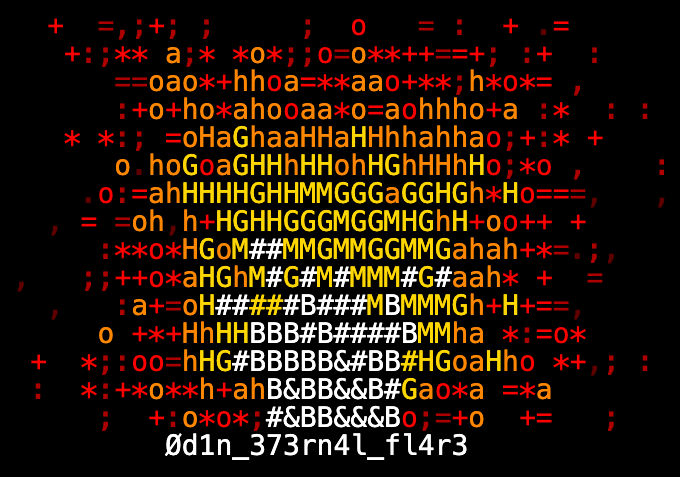
Token 6: Ød1n_373rn4l_fl4r3
And now the detail that will waste your time if you miss it: that first character is a real UTF-8 Ø, two bytes C3 98, and not a zero. In a fire animation rendered in orange on black, at terminal font size, Ø and 0 look near-identical.
I confirmed it from the code rather than my eyes: the routine memcpys exactly 0x13 = 19 bytes for that line. Ød1n_373rn4l_fl4r3 is 18 characters but 19 bytes in UTF-8, because Ø takes two. The ASCII variant 0d1n_373rn4l_fl4r3 is 18. The byte count settles it, and feeding the checker the 0 version is rejected.
Here is that routine, since it’s the whole argument. radare2 with the Ghidra decompiler plugin (r2ghidra) on the reassembled slice 0, around the third of the three memcpy calls in main. (In arm64, csel picks a value based on the last cmp, bl is a call, and memcpy’s length goes in x2.)
1
2
3
4
5
6
7
8
9
10
11
0x100000f68      mov w8, 0xffd2
0x100000f74      sub x8, x8, x25          ; room left in the line buffer
0x100000f78      cmp x8, 1
0x100000f7c      b.lt 0x100000f9c
0x100000f80      cmp x8, 0x13
0x100000f84      mov w9, 0x13
0x100000f88      add x1, sp, 0x1c, lsl 12 ; the source: a buffer on the stack
0x100000f8c      csel x2, x8, x9, lo      ; n = min(room, 0x13)
0x100000f90      add x0, x26, x21
0x100000f94      add x1, x1, 0xe10
0x100000f98      bl sym.imp.memcpy
and the decompiler’s C-like view of the same stretch, with the two "\x1b[0m" color resets that bracket it:
1
2
3
4
5
6
7
8
9
10
11
12
13
14
15
16
17
18
19
sVar6 = 0xfffe - iVar15;
if (0 < sVar6) {
    if (3 < sVar6) { sVar6 = 4; }
    sym.imp.memcpy(auStack_1bcfc + iVar15 + -2, "\x1b[0m", sVar6);
}
...
sVar6 = 0xffd2 - iVar15;
if (0 < sVar6) {
    if (0x12 < sVar6) { sVar6 = 0x13; }
    sym.imp.memcpy(&uStack_1bcd8 + iVar15 + 6, &uStack_180, sVar6);   /* 19 bytes */
}
sVar6 = 0xffbf - iVar15;
if (0 < sVar6) {
    if (3 < sVar6) { sVar6 = 4; }
    sym.imp.memcpy(&uStack_1bcc0 + iVar15 + 1, "\x1b[0m", sVar6);
}
auStack_1bcbb[iVar15] = 10;
sym.imp.write(1, &uStack_1bd00, iVar15 + 0x46);
sym.imp.usleep(33000);
0x13 is a clamp, not a strlen: the copy is capped at nineteen bytes whatever is in the buffer, which only makes sense if the author knew the token was nineteen bytes long. The frame loop ends with one write(2) of the whole assembled frame to file descriptor 1 (the terminal) and a 33 ms sleep, which is the animation’s frame rate, roughly 30 frames a second.
Bait strings in the same slice, for completeness:
1
2
totally_fake_fla
Strings? Where we're going, we don't need strings.
Slice 1: the checker
A Crystal-language binary. Crystal (a compiled, Ruby-like language) statically links its runtime, which is why it’s 404 KB, and the author has leetspeak-mangled the entire runtime string table specifically to ruin strings (the tool that dumps readable text from a binary) for you:
1
2
3
N3g471v3 c4p4c17y             <- "Negative capacity"
1nd3x 0u7 0f b0und$           <- "Index out of bounds"
p4$$1ng 4 cl0$ur3 70 C ...    <- "passing a closure to C ..."
Those are runtime panic messages, so mangling them costs nothing functionally and makes the binary look like it’s stuffed with flag-shaped garbage. The actual program strings are short and buried in the noise:
1
flag[      ]>      n0p3 (
It prompts six times and scores you:
1
2
3
4
5
$ ./checker
flag[1/6]> ...
flag[2/6]> ...
...
flag[6/6]> n0p3 (4/6)
Order doesn’t matter; it takes the six as a set. I looked for the expected values in the binary as literals, as XORed data, and as common hashes, and they’re not there in any of those forms. They have to come from the file.
That is the point of the whole challenge. You can’t crack the checker in isolation; it only verifies work you did everywhere else.
1
2
3
4
$ printf '%s\n' jbig2_fax_geometry reduce_not_deflate udf_tagged_descriptor \
    'Ød1n_373rn4l_fl4r3' 'FLARE-STANDARD-ANTIVIRUS-TEST-FILE!' \
    mainframe_ebcdic_ghost | ./checker
Ju$7_4_l177l3_7r34$ur3_HUN7@flare-on.com
The solve, end to end

Mermaid source
flowchart TD
    S["<b>flareon13.doc</b> — one file, six formats"]
    S --> TOK
    subgraph TOK[" "]
      direction TB
      T1["<b>1 · DOS .COM</b><br/>16-bit stub XOR-patches its own<br/>EICAR string, then prints it<br/><code>FLARE-STANDARD-ANTIVIRUS-TEST-FILE!</code>"]
      T3["<b>3 · PDF / JBIG2</b><br/>808x48 bilevel image;<br/>the pixels spell it out<br/><code>jbig2_fax_geometry</code>"]
      T5["<b>5 · ZIP</b><br/>ZipCrypto, password 'infected',<br/>+ PKWARE Reduce (method 2)<br/><code>reduce_not_deflate</code>"]
      T2["<b>2 · PDF text</b><br/>render mode 3 = invisible;<br/>the hex string is EBCDIC cp037<br/><code>mainframe_ebcdic_ghost</code>"]
      T4["<b>4 · UDF</b><br/>Implementation Use Volume<br/>Descriptor, in plain text<br/><code>udf_tagged_descriptor</code>"]
      T6["<b>6 · Mach-O slice 0</b><br/>doom-fire animation burns it<br/>into the bottom row<br/><code>Ød1n_373rn4l_fl4r3</code>"]
      T1 ~~~ T3
      T3 ~~~ T5
      T2 ~~~ T4
      T4 ~~~ T6
    end
    TOK --> CH["<b>Mach-O slice 1</b> — cpusubtype 3, never auto-selected<br/>a Crystal-language checker: flag[1/6] .. flag[6/6]"]
    CH --> Q{"all six accepted?"}
    Q -- "no" --> N["n0p3 (4/6)"]
    Q -- "yes" --> FL["<b>Ju$7_4_l177l3_7r34$ur3_HUN7@flare-on.com</b>"]
    style FL fill:#dff5e1,stroke:#2f9e44,stroke-width:2px
    style N fill:#fde8e8,stroke:#d93025
Decoys
The misdirection is good:
- The VHD footer (VHD is Microsoft’s virtual disk format,
conectixits magic string) at the very end is valid, and it is also the ZIP archive comment, so neither structure corrupts the other. Its disk unique ID readsFLAREONPOLYGLOT!. It contains no token, which I refused to believe for far longer than I should have. README.TXT, which saysbenign corpus payload.totally_fake_flaandtrue_honest_flagas bait strings.- The fat header advertises slice offsets that are only correct after you reassemble the file from the disc image, so a naive carve gives you a Mach-O that parses and doesn’t work.
A note on running things
Two binaries got executed here, and in both cases I checked capability first. Slice 0’s import table has seven symbols and the disassembly has no syscall instructions, so stdout is the entire attack surface. The Crystal checker imports no socket, fork or exec functions; it ran in a scratch directory with its input piped in and a hard timeout.
These are challenge binaries from a vendor I trust, so this isn’t really about them. It’s that “I trusted the source” stops being an argument the first time you work a supply-chain incident, and reading an import table costs you a minute.
Flag: Ju$7_4_l177l3_7r34$ur3_HUN7@flare-on.com