Flare-On 13, Challenge 7: FlareCalc
Flare-On is the FLARE team's yearly reverse-engineering contest: each challenge hides a flag, a string ending in @flare-on.com, and you find it by taking the program apart.
Archive: 7-FlareCalc.7z (password flare), containing FlareCalc.exe · Flag: t3mplat3s_asn_and_j1t_0h_my@flare-on.com
Flare-On is the FLARE team’s yearly reverse-engineering contest: each challenge hides a flag, a string ending in @flare-on.com, and you find it by taking the program apart.
This one is a 1.5 MB Windows calculator. The calculator is bait. The actual challenge is a 517 KB implant smuggled inside the executable’s Authenticode signature, the code-signing block Windows reads to show who published a program. There it is never mapped into memory and never touched by the program you can run.
Inside that signature sit 1,035 records: one plaintext shellcode loader (shellcode is raw machine code built to run without a normal program around it), one 40-byte ciphertext, and 1,033 tiny functions that are individually encrypted, padded with junk bytes, and executed one at a time from a scratch page that gets wiped afterward. Together they’re a state machine, a program that moves from one state to the next on each input byte, and its final state is the key to the flag.
The useful part of this one, for me, was learning to stop tuning a heuristic and go recover the generator sitting behind it. Accepting that took longer than doing it.
Tools I used
Python for parsing, a disassembler (which turns machine code into readable assembly) and an emulator for running the small functions without Windows:
| Tool | What I used it for |
|---|---|
pefile | reaching DataDirectory[4] and pulling out the certificate table |
python3 + hand-written DER walker | 1,035 records under a private OID; asn1crypto choked on the size, mine didn’t |
openssl asn1parse | sanity-checking my DER reading against something I didn’t write |
capstone | disassembling the shellcode loader and the 1,034 unpacked functions |
r2ghidra (Ghidra’s decompiler inside radare2) | pseudocode for unpacked records 52090 and 4485, to check my C against |
| Unicorn | emulating the tiny functions, hooking cpuid and short-circuiting a million-iteration delay loop |
python3 (again) | an LCG phase-voting attack, a 24-bit brute force, and a depth-first search over the state machine |
cc (clang) | compiling the C reconstruction below and diffing its output against the solver |
Everything here is static or emulated. FlareCalc.exe is a Windows binary and I never ran it; it would not have helped if I had, because the implant and the program that ships it never meet.
The calculator is bait
FlareCalc.exe is an obfuscated but ordinary Win32 calculator: digits, four arithmetic operators, AND/OR/XOR/NOT, and a history line. Its = handler compares the typed expression against four hard-coded strings and answers each with an XOR-encrypted taunt, keyed by the expression itself:
| Expression | Answer |
|---|---|
525+193 | FLAG{NICE_TRY} |
742*186 | ACCESS DENIED |
931-482 | KEY_EXPIRED |
843*952 | spawns a thread that sends a rickroll to its own window |
The rickroll goes through WM_COPYDATA to the window class Flare-OnCalculatorClass, with the lyric XOR-encrypted under the key 843*952. Somebody had fun.
Nothing else in the binary is malicious. It imports no ReadFile, so it cannot read its own file. The certificate table lives outside every section, so the loader never maps it. The implant and the program that ships it never meet.
That last sentence is the deliberate dead end, and it is a good one. The implant’s loader, which can only be found inside the signature, reads its own module’s certificate table. So the packed functions are only reachable through a loader that the shipped program never invokes. If you spend your time hunting for the code path that calls the implant, you will not find one, because there isn’t one.
Accepting that the executable is pure bait, rather than looking for the trigger, is most of the challenge.
Finding the payload
The certificate table is 529,568 bytes. A real Authenticode signature is around five. That is the entire detection step; everything after it is work.
The chain is a joke in itself: FLARE-ON Root CA issues to Never Gonna Let You Down, which issues to Never Gonna Give You Up, also styled the Flare-On Code Signing Authority.
Certificates are stored in DER, a compact binary encoding, and every field is named by an OID (object identifier), a dotted number. The leaf certificate carries a 526 KB extension under the private OID 1.3.6.1.4.1.1337.1. Its value is a SEQUENCE of 1,035 entries, each a SEQUENCE { INTEGER id, OCTET STRING data }. The record ids are 16-bit values scattered between 49 and 65,469. Not sequential, which matters later.
Exactly one record, id 3821, is plain x86-64: position-independent shellcode that walks the PEB (the process’s own list of loaded modules) to find module bases, and resolves the Windows functions it needs by a 64-bit hash of their names instead of storing the names.

Mermaid source
flowchart TD
    A["<b>FlareCalc.exe</b> — 1.5 MB Win32 calculator"]
    A -.-> B["the program you can actually run:<br/>four hard-coded 'magic' sums, each answering<br/>with an XOR'd taunt. <i>All four are decoys.</i>"]
    A --> C["<b>DataDirectory[4]</b>, the certificate table:<br/>529,568 bytes, about 100x a real signature.<br/>It lives outside every section, so the Windows<br/>loader never maps it into memory."]
    C --> D["chain: FLARE-ON Root CA -><br/>'Never Gonna Let You Down' -><br/>'Never Gonna Give You Up'"]
    D --> E["leaf extension under private OID<br/><b>1.3.6.1.4.1.1337.1</b>, 526 KB:<br/>a SEQUENCE of 1035 records, each<br/>SEQUENCE { INTEGER id, OCTET STRING data }"]
    E --> R
    subgraph R[" "]
      direction TB
      F["<b>record 3821</b> — the only plaintext one.<br/>Position-independent x86-64 that walks the<br/>PEB and resolves exports by a 64-bit hash"]
      G["<b>1033 packed functions</b>"]
      H["<b>record 9990</b> — 118 packed bytes,<br/>i.e. 40 bytes of ciphertext"]
      F ~~~ G
      G ~~~ H
    end
    R --> I["the loader opens its own module, seeks to<br/>DataDirectory[4], reads the certificate blob,<br/>and walks that same DER structure by record id"]
    I --> J["per record: key = MD5(master_key || id),<br/>folded to a 32-bit seed by h = h*31 + byte"]
    J --> K["<b>layer 1</b> — XOR with the low byte of<br/>state = state * 1103515245 + 12345"]
    K --> L["<b>layer 2</b> — a second LCG, seeded from the master<br/>key alone, drives the unpack loop: copy one byte,<br/>then skip (r mod 3) + 1 junk bytes"]
    L --> M["VirtualAlloc RWX, call with three arguments,<br/>zero the page, VirtualFree.<br/>Exactly one function exists at a time."]
    style B fill:#fde8e8,stroke:#d93025
    style C fill:#fff8e6,stroke:#c9a227
Resolving the shellcode’s imports
The hash is a rotate-and-add over the uppercased name:
1
2
3
4
5
6
h = 0
for ch in name:
    c = ord(ch) - 0x20 if 'a' <= ch <= 'z' else ord(ch)
    h = ((h << 7) | (h >> 57)) & M64
    h = (h + c) & M64
h &= 0x7FFFFFFFFFFFFFFF
There’s a nice shortcut here. The rotate is a multiply by 128 modulo 2**64 - 1, so this is just the name read as a base-128 number. Names of nine characters or fewer decode straight out of the hash. No dictionary, no searching, just divide by 128 repeatedly and read off the characters. The longer ones fell to a short word list.
The resolved set tells the entire story before I’d read a single unpacked function:
GetModuleHandleW,GetModuleFileNameW,CreateFileW,SetFilePointer,ReadFile: it reads its own fileVirtualAlloc,VirtualFree,RtlAllocateHeap,HeapFree: a scratch page- the
BCrypt*family: MD5 socket,getaddrinfo,gethostname,inet_ntop,WSAIoctl,closesocket: a command channel
Self-reading plus a scratch page plus MD5 plus a socket is a complete architecture sketch. Import hashing is supposed to hide intent, and it does hide it from strings, but once you can invert the hash it hands you more structure than an import table would, because nobody bothers to pad an import-by- hash list with decoys.
How a record is packed
Two layers, both driven by the same classic LCG (linear congruential generator: multiply the state by one constant, add another, repeat), state = state * 1103515245 + 12345.
Layer 1: keystream XOR. The key is MD5(master_key || record_id), reduced to a 32-bit seed by h = h*31 + byte, and each output byte is the low byte of the next LCG state.
Layer 2: junk interleaving. A second LCG, seeded from the master key alone, drives the unpack loop: copy one byte, draw r, skip (r % 3) + 1 bytes, repeat. The skipped bytes are the low bytes of that same generator, so the junk is generated rather than random, and a packed record ends up roughly three times the size of the code it hides.
The result is VirtualAlloced as PAGE_EXECUTE_READWRITE, called with three arguments, then zeroed and freed. Only one function is ever decrypted at a time, so there is no moment at which the payload exists in memory as a whole. Dumping the process gets you one tiny function and a lot of nothing.
Breaking it without the key
The master key is a string built at runtime as "A-B-C" from three 32-bit values passed into the loader by whatever injected it. We never see them.
We also don’t need them, because of one property of a power-of-two LCG: the low byte evolves entirely on its own.
1
(state * 1103515245 + 12345) mod 256  ==  (low * 0x6D + 0x39) mod 256
The high bits never feed down into the low bits. That’s the classic reason you never use the low bits of rand(); here it’s fatal. The map is a single 256-long cycle, so the XOR keystream of any record is one of only 256 sequences, identified by its phase. The junk bytes come from the second generator’s low byte, which is also one of those 256 sequences.
Both generators advance exactly once per byte position, so for every packed record:
1
2
at a junk position:  packed[p] = cycle[(a + p) % 256] ^ cycle[(b + p) % 256]
at a real position:  packed[p] = code_byte ^ cycle[(a + p) % 256]
Vote over all positions and a and b fall out. And because b is derived from the master key alone, it is the same for every record: 243. That gave me a free consistency check across all 1,035 decodes, which is the kind of thing worth looking for early.
The trap
Recovering the phases is not enough, and this is where the challenge took most of my time.
The obvious reading of the junk layer is that a run of junk is however many consecutive bytes match the generator. That reading is correct for about 99.6% of bytes. When a real code byte happens to equal the junk byte it would have taken, the run looks one byte longer and the walk loses sync.
99.6% per byte sounds excellent. On records averaging a couple of hundred bytes it means most records come out wrong.
And the failure mode is nasty, because the output still disassembles cleanly as x86-64, still ends in ret, and still looks like a plausible stirring function. Hundreds of candidate decodes satisfied every constraint I could think of. So I started picking the one with the fewest anomalies, which is wrong often enough that the state machine stalls three steps in with nothing at all to point at the cause.
Refining the anomaly scoring was the mistake. The fix is to stop guessing run lengths and recover the junk generator’s full 32-bit state. The low byte is already known, so only 24 bits remain. One record that decodes unambiguously pins the skip sequence, and a few seconds of brute force gives a unique answer:
1
dejunk seed = 0x429057CE
With the full state the skip pattern is deterministic, and because the generator restarts identically for every record it is also global: real bytes always sit at the same offsets, in every record. Every record then decodes exactly. 1,034 come out as clean x86-64 functions ending in ret; the odd one out, id 9990, is 40 bytes of data.
When a decode is heuristic and the result is almost right, recover the generator instead of tuning the heuristic. An “almost right” decode is not nearly-solved. It’s a different problem that happens to look similar, and no amount of scoring closes the gap.
The state machine
Each of the 1,034 functions follows the same template. It takes a byte in rcx and a pointer to a 32-byte state in rdx, stirs four state bytes, burns a million iterations of a loop whose sum is a constant that gets subtracted straight back off, and returns a 32-bit value:
mov  al, byte ptr [rdx + 2]
add  al, byte ptr [rdx + 1]
xor  al, r8b                 ; the input byte
add  al, 0x1a
mov  byte ptr [rdx + 1], al
...
imul edx, eax, 0x1337
sub  eax, 0x6a4ae6e0         ; exactly cancels the delay loop
xor  ecx, 0x68925143
add  ecx, 0x976a05fa
xor  eax, ecx
ret
That delay loop is pure anti-emulation, code whose only job is to make running it in an emulator too slow to be useful: a million iterations per function, 1,034 functions, 31 steps of search depth, times 256 candidate bytes. Under Unicorn, the CPU emulator I was running these functions in, that’s unfinishable. Short-circuit the loop (the sum is a constant, and the very next instruction subtracts it straight back off) and the whole search takes seconds.
The loader stores the return value as the id of the next function to run. The machine starts at id 52090 with the state zeroed, consumes one byte per step from the socket, and finishes when the id reaches 4485.
And this is what makes it solvable at all. The return is a full 32-bit value, but only 1,035 of those 2**32 values name a real record. So at nearly every step exactly one input byte keeps the machine alive; everything else returns an id that doesn’t exist. A depth-first search over the 256 possible bytes, preferring printable ones, walks the whole chain in seconds:
1
FLAREON_ASN1_Labyrinth_Key_2026!
Thirty-one steps later the state holds:
1
670daa0ff05e7d85472eeb55a716a7b88d63019c27ee22ea447fd4fde87c013d

Mermaid source
flowchart TD
    A["<b>the weakness</b>: in an LCG modulo a power of two,<br/>the low byte evolves entirely on its own —<br/>(s*1103515245 + 12345) mod 256 == (low*0x6D + 0x39) mod 256"]
    A --> B["that map is a single 256-long cycle, so every<br/>record's keystream is one of only 256 sequences,<br/>identified by its phase. The junk bytes are the<br/>other generator's low byte, from the same cycle."]
    B --> C["at junk positions: packed[p] = cycle[a+p] ^ cycle[b+p]<br/>at real positions: packed[p] = code ^ cycle[a+p]<br/>-> vote over all positions to recover a and b"]
    C --> D["b comes from the master key alone, so it is the<br/>same for every record: <b>243</b>. A free consistency<br/>check across all 1035 decodes."]
    D --> E["<b>but this still isn't exact.</b> When a real code byte<br/>happens to equal the junk byte it would take, a run of<br/>junk looks one byte longer and the walk loses sync —<br/>yielding clean, plausible, <b>wrong</b> x86-64."]
    E --> F["so recover the junk generator's <b>full 32-bit state</b>,<br/>not just its low byte. 24 bits left, one unambiguous<br/>record to check against, a few seconds of brute force:<br/><b>dejunk seed = 0x429057CE</b>"]
    F --> G["the generator restarts identically for every record,<br/>so the skip pattern is <b>global</b> — real bytes always sit<br/>at the same offsets. Every record now decodes exactly."]
    G --> H["1034 clean x86-64 functions, each ending in ret,<br/>plus record 9990, which is 40 bytes of data"]
    H --> I["each function takes a byte in rcx and a 32-byte state<br/>in rdx, stirs four state bytes, burns a million-iteration<br/>delay loop whose sum is subtracted straight back off,<br/>and returns <b>the id of the next function to run</b>"]
    I --> J["start at id 52090, state all zeros.<br/>Only 1035 of 2^32 returns name a real record, so at<br/>almost every step exactly one input byte keeps it alive."]
    J --> K["depth-first over the 256 bytes, printable first:<br/><b>FLAREON_ASN1_Labyrinth_Key_2026!</b> — 31 steps, id 4485"]
    K --> L["final state 670daa0f..e87c013d;<br/>XTEA key = second half XOR first half,<br/>as little-endian 32-bit words"]
    L --> M["XTEA, 32 rounds, delta 0x9E3779B9, big-endian blocks,<br/>over record 9990's 40 bytes:<br/><b>t3mplat3s_asn_and_j1t_0h_my@flare-on.com</b>"]
    style M fill:#dff5e1,stroke:#2f9e44,stroke-width:2px
    style E fill:#fde8e8,stroke:#d93025
    style A fill:#fff8e6,stroke:#c9a227
The flag
Record 4485 is XTEA, a small and old block cipher. Its key is sixteen bytes: the second half of the final state XORed with the first half, taken as little-endian 32-bit words. It runs 32 rounds with the usual delta 0x9E3779B9, on big-endian blocks, over the 40 bytes of record 9990:
1
t3mplat3s_asn_and_j1t_0h_my@flare-on.com
Forty bytes exactly, and here’s the detail I found most satisfying: record 9990 is 118 packed bytes, and 118 divided by three is 39, so the length confirms the container was read correctly before I even look at the plaintext. Length arithmetic that checks out is cheap evidence, and I’ve learned to look for it.
The implant’s logic in C
This isn’t the author’s source. It’s my reconstruction from the disassembly, rewritten as C so the moving parts are easier to read than in Python or raw x86-64. The names are mine. I’ve left out the PEB walk, the import hashing and the code that reads the certificate table, since those are covered above and add nothing to the logic. Every piece below was compiled and checked against solve7.py and the real records.
Unpacking a record. Both generators advance once per packed byte, junk or not. That’s the property the whole attack rests on, and it’s easier to see here than in the description:
1
2
3
4
5
6
7
8
9
10
11
12
13
14
15
16
17
18
19
20
21
22
23
24
25
static uint32_t lcg(uint32_t *s)
{
    *s = *s * 1103515245u + 12345u;
    return *s;
}

/* xor_seed:  MD5(master_key || record id), folded with h = h*31 + byte
   junk_seed: derived from the master key alone; recovered as 0x429057CE */
size_t unpack_record(const uint8_t *in, size_t len,
                     uint32_t xor_seed, uint32_t junk_seed, uint8_t *out)
{
    uint32_t k = xor_seed, j = junk_seed;
    size_t n = 0, p = 0;

    while (p < len) {
        uint8_t  ks = (uint8_t)lcg(&k);     /* only the low byte is ever used */
        uint32_t r  = lcg(&j);
        out[n++] = in[p++] ^ ks;            /* one real byte */
        for (uint32_t skip = r % 3 + 1; skip && p < len; skip--, p++) {
            lcg(&k);                        /* junk: both generators still step */
            lcg(&j);
        }
    }
    return n;
}
Fed with seed 0x429057CE and an XOR seed whose low byte matches the recovered phase, this produces output identical to solve7.py for all 1,034 packed records. The upper 24 bits of xor_seed never matter, which is the low-byte weakness again, stated in code.
The dispatch loop. One function exists in memory at a time:
1
2
3
4
5
6
7
8
9
10
11
12
13
14
15
16
17
18
typedef uint32_t (*fsm_fn)(uint8_t c, uint8_t *state, void *ctx);

uint8_t  state[32] = { 0 };
uint32_t id = 52090;

while (id != 4485) {
    uint8_t c = recv_byte(sock);                 /* one input byte per step */
    size_t  n = unpack_record(rec_data(id), rec_len(id),
                              xor_seed_for(id), junk_seed, scratch);

    void *page = VirtualAlloc(NULL, n, MEM_COMMIT | MEM_RESERVE,
                              PAGE_EXECUTE_READWRITE);
    memcpy(page, scratch, n);
    id = ((fsm_fn)page)(c, state, ctx);          /* return value = next record id */
    SecureZeroMemory(page, n);
    VirtualFree(page, 0, MEM_RELEASE);
}
/* record 4485 runs last and decrypts record 9990 with XTEA */
recv_byte, rec_data and the rest stand in for code I’ve skipped. An id that doesn’t name a record is a dead end, which is what made the depth-first search work.
One state-machine function. Here is record 52090, the entry point, translated instruction by instruction:
1
2
3
4
5
6
7
8
9
10
11
12
13
14
15
16
17
18
static uint32_t rotl32(uint32_t x, int n) { return x << n | x >> (32 - n); }

uint32_t fsm_52090(uint8_t c, uint8_t *st, void *unused)
{
    uint8_t t = (uint8_t)(((st[1] + st[0]) ^ c) + 0x13);
    st[0]     = t;
    st[7]    ^= (uint8_t)(t + 0x5A);
    st[0x13] += st[7] ^ 0xA5;

    /* anti-emulation stall: sum of 0..999,999 mod 2^32 == 0x6A4AE6E0 */
    volatile uint32_t sum = 0;
    for (volatile uint32_t i = 0; i < 1000000; i++)
        sum += i;

    uint32_t a = rotl32((uint32_t)st[7] * 0x1337 - 0x55555556, 11);
    uint32_t b = rotl32((uint32_t)c * 0x1337 + 0x55555555, 5);
    return (sum - 0x6A4AE6E0) ^ a ^ b ^ 0x6B82E2BF;
}
In C the stall is obviously dead weight: sum - 0x6A4AE6E0 is always zero. In the binary it’s a million iterations an emulator has to grind through, and the volatile is roughly what you’d need to stop a compiler from folding it away. Compiled and run over all 256 input bytes from a zeroed state, this matches the Unicorn emulation of the real record exactly, and only one input, F, returns the id of a record that exists. That’s the first character of FLAREON_ASN1_Labyrinth_Key_2026!.
For comparison, here is what the Ghidra decompiler plugin in radare2 makes of the actual unpacked bytes of record 52090, 149 bytes of code:
1
2
3
4
5
6
7
8
9
10
11
12
13
14
15
16
17
uint32_t fcn.00000000(void)                 /* rcx = input byte, rdx = state */
{
    uVar1 = in_RDX[1] + *in_RDX ^ in_CL;
    *in_RDX = uVar1 + 0x13;
    in_RDX[7] = in_RDX[7] ^ uVar1 + 0x6d;
    in_RDX[0x13] = in_RDX[0x13] + (in_RDX[7] ^ 0xa5U);
    iStackX_10 = 0;
    uStackX_8 = 0;
    do {
        iStackX_10 = uStackX_8 + iStackX_10;
        uStackX_8 = uStackX_8 + 1;
    } while (uStackX_8 < 1000000);
    uVar2 = in_RDX[7] * 0x1337 + 0xaaaaaaaa;
    uVar3 = in_CL * 0x1337 + 0x55555555;
    return iStackX_10 + 0x95b51920U ^ (uVar3 * 0x20 | uVar3 >> 0x1b)
                                    ^ (uVar2 * 0x800 | uVar2 >> 0x15) ^ 0x6b82e2bf;
}
It agrees with my C line for line, with the constants folded differently. 0x13 followed by + 0x5A becomes a single + 0x6d. Subtracting 0x55555556 is adding 0xaaaaaaaa. Subtracting 0x6A4AE6E0 is adding 0x95b51920. The rotates come out as shift-or pairs. The decompiler doesn’t spot that the loop’s sum cancels, which is the point of the loop.
The last step.
1
2
3
4
5
6
7
8
9
10
11
12
13
14
15
16
17
18
19
20
21
22
23
24
static void xtea_decrypt_block(uint32_t v[2], const uint32_t key[4])
{
    uint32_t v0 = v[0], v1 = v[1], delta = 0x9E3779B9, sum = delta * 32;
    for (int i = 0; i < 32; i++) {
        v1  -= (((v0 << 4) ^ (v0 >> 5)) + v0) ^ (sum + key[(sum >> 11) & 3]);
        sum -= delta;
        v0  -= (((v1 << 4) ^ (v1 >> 5)) + v1) ^ (sum + key[sum & 3]);
    }
    v[0] = v0; v[1] = v1;
}

void decrypt_flag(const uint8_t state[32], uint8_t *buf, size_t len)
{
    uint32_t key[4];
    for (int i = 0; i < 4; i++)                  /* second half ^ first half, LE words */
        key[i] = load_le32(state + 16 + 4 * i) ^ load_le32(state + 4 * i);

    for (size_t off = 0; off + 8 <= len; off += 8) {     /* big-endian blocks */
        uint32_t v[2] = { load_be32(buf + off), load_be32(buf + off + 4) };
        xtea_decrypt_block(v, key);
        store_be32(buf + off, v[0]);
        store_be32(buf + off + 4, v[1]);
    }
}
Given the final state 670daa0f…e87c013d and record 9990’s 40 unpacked bytes, this prints the flag.
Record 4485, decompiled the same way, is the XTEA with its key setup and the byte swaps. Trimmed to the body:
1
2
3
4
5
6
7
8
9
10
11
12
13
14
15
16
17
18
19
20
    iVar8 = 4;
    do {                                     /* key[i] = state[16+4i] ^ state[4i] */
        *(iVar4 + in_R8) = in_R8[4] ^ *in_R8;
        in_R8 = in_R8 + 1;
        iVar8 = iVar8 + -1;
    } while (iVar8 != 0);
    iVar4 = 5;                               /* five 8-byte blocks = 40 bytes */
    do {
        uVar6 = bswap32(block[0]);           /* big-endian load */
        uVar7 = bswap32(block[1]);
        uVar10 = 0xc6ef3720;                 /* sum = 0x9E3779B9 * 32 */
        do {
            uVar2 = auStack_48[uVar10 >> 0xb & 3] + uVar10;
            uVar10 = uVar10 + 0x61c88647;    /* sum -= 0x9E3779B9 */
            uVar7 = uVar7 - ((uVar6 >> 5 ^ uVar6 << 4) + uVar6 ^ uVar2);
            uVar6 = uVar6 - ((uVar7 >> 5 ^ uVar7 * 0x10) + uVar7 ^ auStack_48[uVar10 & 3] + uVar10);
            iVar8 = iVar8 + -1;
        } while (iVar8 != 0);                /* 32 rounds */
        ...                                  /* bswap and store */
    } while (iVar4 != 0);
I replaced the decompiler’s spelled-out byte-swap expressions with bswap32 and added the comments. 0xc6ef3720 is the XTEA delta times 32 and 0x61c88647 is minus the delta, so this is the decrypt direction. The function ends by counting plaintext bytes up to 40 and returning the count.
The solver
solve7.py takes only FlareCalc.exe:
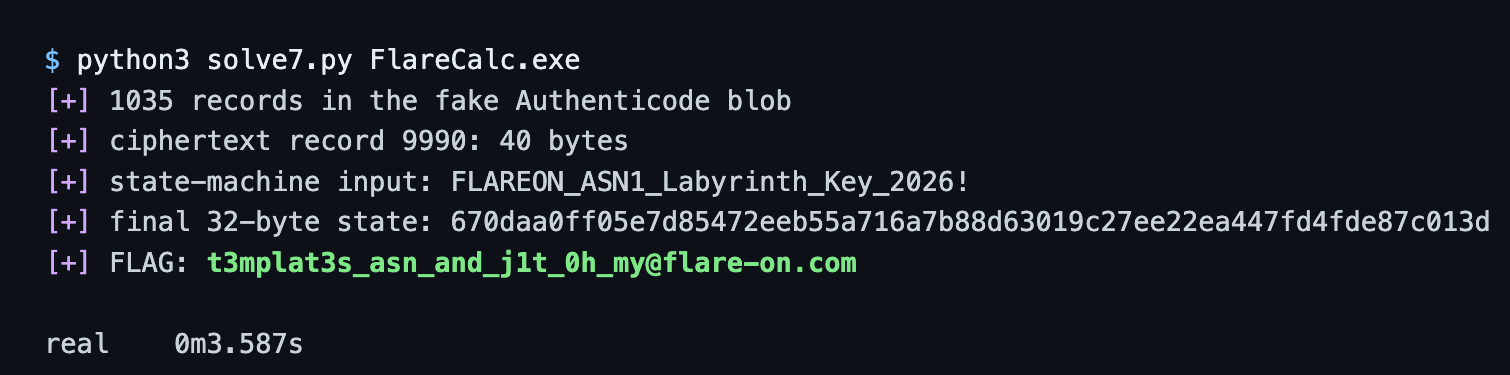
It parses the certificate table, unpacks all 1,035 records with the recovered seeds, emulates the tiny functions with Unicorn, searches the state machine, and decrypts. No master key, no network, no execution of the original binary.
The full solver is in the flare-on-13 repository: solve7.py.
The two traps
The first is architectural. The payload is reachable only through a loader that ships inside the payload, so there is no call site to find. The time you spend looking for one is the time the challenge is budgeting for.
The second is statistical, and it’s the one I’d want to recognize faster next time. A decode that is right 99.6% of the time per byte produces confident, well-formed, wrong output, and the thing it breaks fails many steps later with no trace of the cause. Every instinct says add one more scoring rule. The answer is to go a level down and recover whatever is generating the ambiguity, because nothing you do at the scoring level can close that gap.
Flag: t3mplat3s_asn_and_j1t_0h_my@flare-on.com