Flare-On 13, Challenge 9: NeonOutRun
I submitted the wrong flag for this one. That's going at the top rather than the bottom, because it's the most useful thing in the write-up.
Archive: 9-NeonOutRun.7z (password flare), containing neon_outrun · Flag: R3_ag3nt_4b0ut_t0_f33l_d1zzy@flare-on.com
I submitted the wrong flag for this one. That’s going at the top rather than the bottom, because it’s the most useful thing in the write-up.
(Flare-On is the FLARE team’s yearly reverse-engineering contest: each challenge hides a flag, a string ending in @flare-on.com, and you find it by taking the program apart. This was the last challenge of the set.)
neon_outrun is a 21 MB Linux x86-64 program, stripped of its function names and built as a PIE (position-independent executable, loadable at any address). It’s a Tauri v2 desktop app, a framework whose interface is a web page shown in an embedded browser (NEEDED lists libwebkit2gtk-4.1, libgtk-3 and libsoup-3.0) whose front end is a top-down racing game. On top of that it statically links an entire V8, Google’s JavaScript engine, (the rusty_v8 crate, V8 9.5.172.19), which is where 15 MB of .text and a 2 MB pile of V8 strings come from.
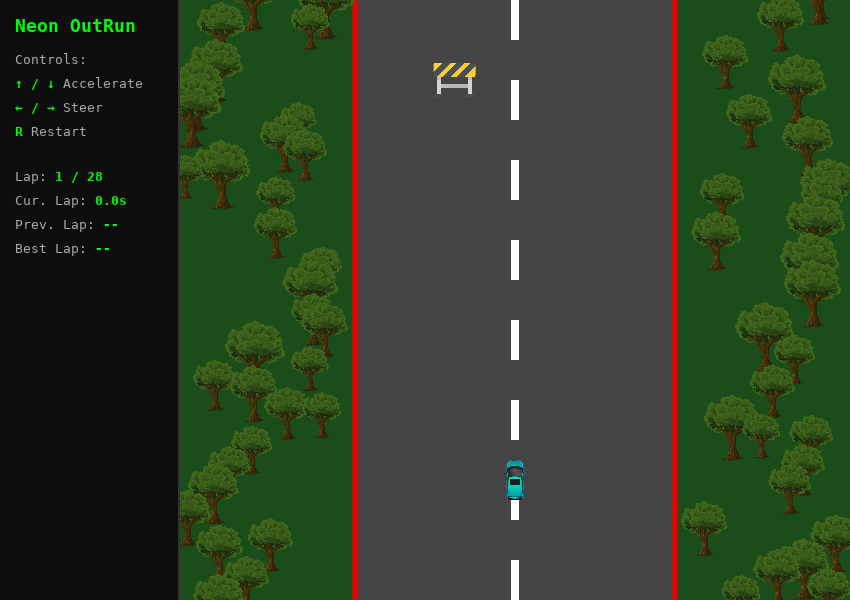
It has three layers, and the first two are traps:
- Win the 28 laps and it prints a flag. It is fake.
- That fake flag reads “decode this system to win it”. Decoding the packer that hides the game’s JavaScript gets you exactly the same fake flag back.
- The real flag is in neither. Before running the script, the Rust side replaces three JavaScript builtins with native code, and the flag is the sequence of lap times those hooks are waiting for.
Tools I used
Binary tools for the Linux executable, a container to run it in safely, and a lot of memory reading:
| Tool | What I used it for |
|---|---|
readelf / objdump / a hand-written ELF helper | sections, R_X86_64_RELATIVE relocations, .eh_frame_hdr to recover function boundaries in a stripped PIE |
capstone | disassembly, and a cached index of every RIP-relative lea target → call sites |
radare2 + r2ghidra | the packer loop listing and pseudocode for the sort and replaceAll hooks |
Docker (--platform linux/amd64, --network none) + Xvfb | running a Linux GUI binary safely on an Apple-silicon Mac |
a custom LD_PRELOAD shim on malloc/free/realloc with backtrace() | because gdb cannot ptrace under that emulation |
/proc/<pid>/mem + a Python sampler | reading V8’s heap and the implant’s globals out of a live process |
brotli, zstandard, zlib | the asset map and the four-stage packer |
| Unicorn | emulating self-contained x86-64 functions rather than reading flattened control flow |
python3 | solve9.py, which does the whole static half from the binary alone |
On running it: neon_outrun is a Linux GUI binary, so it ran inside a linux/amd64 container with --network none, an Xvfb display, and the challenge mounted read-only. Never on the host. Its strace showed no file access outside /usr. Everything I executed was either the stock binary or a copy with its own embedded assets replaced.
Layer 1: the game
Tauri embeds the front end as a phf map (a lookup table built at compile time) of brotli-compressed files. You don’t have to understand phf to get at them: walk the relocations in .data.rel.ro (the table of addresses the loader fixes up at startup) looking for (ptr, len) pairs whose target is an ASCII path, and the whole asset table falls out at once.
1
/index.html   /car.png   /tree.png   /lap.png   /obstacle.png

index.html sends {up,down,left,right,restart,bounds} to invoke('plugin:neon|e', …) once per frame and renders the reply. And here’s the observation that sets up the whole challenge: none of the reply’s field names (carRatio, bestLapSeconds, the rest) exist anywhere in the 21 MB binary. Not as literals, not in any section. So the JSON is not built by Rust. V8 builds it, from a script that isn’t in the file either.
Running the binary under Xvfb in a container and scanning /proc/<pid>/mem finds the 4,229-byte script in V8’s heap about 0.2 s after launch. It spells a flag one character per lap over 28 laps:
1
2
3
4
neon += messages[Math.floor((state.currentLap-1)/2)][map[state.currentLap-1]];
…
neon += String.fromCharCode(64,102,49,97,114,101,45,111,110,46,99,111,109);
state.neon = neon.replaceAll(" ","_");
Actually winning 28 laps of a racing game by hand was not how I wanted to spend an evening, so I patched the embedded index.html with an auto-driver. The cheapest possible cheat: bounds of {left:0, right:1e9} makes the road a billion units wide, so every obstacle is thousands of units off the center line, and holding accelerate wins every time.
The game duly printed:

Where I went wrong
Look at that last String.fromCharCode: 64,102,49,97,114,101,45,111,110,46,99,111,109 is @f1are-on.com. A digit 1, not an l.
I saw it. I decided it was a typo in the challenge, “corrected” it to @flare-on.com, and submitted decode_this_system_to_win_it@flare-on.com.
Rejected, obviously.
The string was telling me, in English. “Decode this system to win it.” That’s an instruction, not a flag. Flare-On flags are usually a sly comment on the solution; this one was a sly comment on the fact that I hadn’t found it yet.
A program handing you something flag-shaped has not told you it’s the flag. An artifact that almost fits the expected format is evidence against it, and the right move is to go find out why it doesn’t fit.
The giveaway was sitting there: nothing in the binary explained why that domain would be stored broken in the first place. “Something later repairs this” was a hypothesis I could have tested in ten minutes. It’s a hook that adds 0x3B to byte 30 once a real check passes. 0x31 + 0x3B = 0x6C. '1' becomes 'l'.
Second time in this set I’d talked myself past a wrong domain, too. Challenge 4’s decoy was @flare.com. I caught that one.

Mermaid source
flowchart TD
    A["<b>neon_outrun</b> — 21 MB stripped Linux x86-64 PIE.<br/>NEEDED: libwebkit2gtk-4.1, libgtk-3, libsoup-3.0 — a <b>Tauri v2</b> app.<br/>Plus an entire statically linked <b>V8</b> (rusty_v8 9.5.172.19), which is<br/>where 15 MB of .text and 2 MB of V8 strings come from."]
    A --> B["front end: a phf map of brotli-compressed assets. Found by walking<br/>.data.rel.ro relocations for (ptr, len) pairs whose target is an ASCII<br/>path: /index.html /car.png /tree.png /lap.png /obstacle.png"]
    B --> C["index.html — a canvas racing game. Once per frame it sends<br/>{up,down,left,right,restart,bounds} to invoke('plugin:neon|e', ...)<br/>and renders the reply."]
    C --> D["Rust command handler -> V8 isolate: tick(input_json)<br/>-> JSON {carRatio, bestLapSeconds, ...} -> back to the canvas.<br/><i>None of those field names appear anywhere in the 21 MB binary,<br/>so V8 is building the JSON, not Rust.</i>"]
    D --> E["<b>sub_688C64</b> — 16,848 bytes, control-flow flattened, reached from<br/>main through an 8-byte thunk. The only function that references both<br/>the rusty_v8 panic strings and 'zstd returned null pointer...'."]
    E --> F["unpacks the 4,229-byte game script from a<br/>1,942-byte blob at .rodata:0x21DB73"]
    E --> G["<b>and, before the script ever runs,</b> replaces three JavaScript<br/>builtins with native Rust callbacks:<br/>Array.prototype.sort · Math.min · String.prototype.replaceAll"]
    style G fill:#fff8e6,stroke:#c9a227
Layer 2: the packer
So where does the script live? I threw everything at the file and found nothing.
Not as text. Not brotli’d, deflated, LZMA’d or zstd’d; I scanned for every container magic and tried every window offset. Not a byte-permutation of itself either, which I checked by frequency signature. And not in any of the three zlib-compressed blobs at the end of .rodata, which turned out to be V8’s own startup snapshots (0xC0DE041B once inflated) and ate a chunk of my evening on their own.
Content-based search was never going to find this. The stored form is XORed and byte-stuffed before it is compressed, so it looks like neither plaintext nor a compressed stream. There is no signature to scan for.
What cracked it was going at the loader instead. Exactly one function references both the rusty_v8 panic strings and the string "zstd returned null pointer when creating new context": sub_688C64, 16,848 bytes, reached from main through an 8-byte thunk. It’s control-flow flattened (an obfuscation that turns a function into one big loop around a switch, so the real order of its steps is hidden) and unpleasant, but one loop in the middle is in the clear:
lea   rcx, [rip - 0x46c2b2]              ; -> .rodata:0x21DB73
loop: mov  edx, eax
      and  edx, 1
      mov  dl,  byte [rsp + rdx + 0x7e]  ; a 2-byte key, built by the flattened code
      xor  dl,  byte [rax + rcx]
      mov  byte [r15 + rsi], dl
      inc  rsi
      inc  rax
      cmp  rax, 0x796                    ; 1942 bytes
      jne  loop
A repeating two-byte XOR over 1,942 bytes at .rodata:0x21DB73, sitting innocuously between ordinary Rust panic strings. I now had the location but not the key, and the key is assembled somewhere in those 16 KB of dispatch.
gdb doesn’t work here
My first instinct was to breakpoint after the loop and read the buffer. That doesn’t work: gdb cannot PTRACE_GETREGS an amd64 process under Docker’s emulation on Apple silicon. The process runs; the debugger cannot see its registers.
So I wrote an LD_PRELOAD shim over malloc/free/realloc: a small library the Linux loader puts ahead of everything else, so its versions of those functions run instead of the real ones. It remembers every 1,942-byte allocation and dumps it a few allocations later (you can’t dump it immediately, since at the moment of allocation it’s still uninitialized).
Two bugs on the way, both the kind that only bite inside an allocator hook:
- It segfaulted instantly, because my
init()used stdio, andfopencallsmalloc, which calls my hook, which callsinit(). Fixed by using rawopen/writeand resolving everything withdlsymin a constructor. __builtin_return_address(n)forn > 0crashed in optimized Rust frames with no frame pointer. Only__builtin_return_address(0)is safe.
(And then the ring buffer wrapped before my sweep could run, so I switched to checking the slot inserted N entries ago, which is O(1) per malloc.)
The dump begins:
1
ff 28 b5 2f fd 00 68 a9 35  ff 00 ad 57 6d 6f e3 36 12  ff fe 2b ac 3f ec 4a …
28 B5 2F FD is the zstd magic. And every 9th byte is 0xFF.
That is byte stuffing, a fixed byte inserted at fixed intervals. Because I knew what those bytes had to be before the XOR, they are a known plaintext, and the key falls out immediately:
1
2
key0 = blob[0] ^ 0xFF = 0xD3
key1 = blob[9] ^ 0xFF = 0x5A
Better still, it’s a file-wide signature. solve9.py finds the blob without knowing the offset by scanning for “XOR with a 2-byte key such that every 9th byte is 0xFF,” and it finds exactly one, which also proves there is no second payload hiding anywhere.
So when content-based search fails, look for a known-plaintext structure in the container rather than in the payload. I was searching for the shape of the data. The thing that was findable was the shape of the wrapper.

Mermaid source
flowchart TD
    A["1,942 bytes at .rodata:0x21DB73, sitting between<br/>ordinary Rust panic strings. Invisible to every scan:<br/>no compressed stream, no high-entropy blob of the<br/>right size, no byte-permutation of the plaintext."]
    A --> B["XOR with a repeating <b>2-byte</b> key"]
    B --> C{"how do you get the key without first<br/>reading 16 KB of flattened control flow?"}
    C --> D["dump one allocation at runtime:<br/>ff 28 b5 2f fd 00 68 a9 35 <b>ff</b> 00 ad 57 6d 6f e3 36 12 <b>ff</b> ...<br/>28 B5 2F FD is the zstd magic, and<br/><b>every 9th byte is 0xFF</b> — byte stuffing."]
    D --> E["known plaintext:<br/>key0 = blob[0] ^ 0xFF = 0xD3<br/>key1 = blob[9] ^ 0xFF = 0x5A"]
    E --> F["de-stuff: drop every 9th byte, 1,944 -> 1,727"]
    F --> G["zstd decompress, 1,727 -> 1,717"]
    G --> H["raw DEFLATE, 1,717 -> 4,229"]
    H --> I["the game script — byte-identical to the copy<br/>found in V8's heap, which confirms the chain"]
    I --> J["...and decoding it by hand gives back the<br/><b>same decoy sentence</b>. A dead end, on purpose."]
    style J fill:#fde8e8,stroke:#d93025
    style D fill:#fff8e6,stroke:#c9a227
The unpacked script is byte-identical to the copy V8 had in its heap, which confirmed the chain end to end. And decoding it by hand gives back exactly the same decoy sentence I already had.
A dead end, on purpose, with the fake flag telling you to walk down it.
Layer 3: the hooks
sub_688C64 builds its strings the way the obfstr Rust crate does: two heap buffers filled from immediates and XORed together. You don’t have to follow the control flow at all: extract every such pair statically and the function’s whole vocabulary falls out.
1
"String"   "prototype"   "replaceAll"   "Math"   "min"   "Array"   "sort"   "tick"
That list is the whole answer in eight words. Three builtins are replaced with native callbacks before tick ever runs:
| builtin | callback | what it really does |
|---|---|---|
Array.prototype.sort | sub_67DEB2 | called once, on the 28 lap positions |
Math.min | sub_67EB83 | called once per lap, from Math.min(bestLapSeconds, lapSecs) |
String.prototype.replaceAll | sub_67E81E | called once, on the finished flag string |
This is a nasty place to hide logic. The JavaScript is clean; it calls sort, Math.min and replaceAll exactly where you’d expect a game to. The semantics are somewhere else entirely. You can read the whole script and learn nothing, which is exactly what happened to me in layer 2.

Mermaid source
flowchart TD
S["<b>Array.prototype.sort</b> hook — sub_67DEB2, called once, on the<br/>28 lap positions. Draws K = 1 + 65534*rand, fills a VecDeque with<br/>queue[i] = lapY[i] * K, and sets g2 = sum(queue)."]
S --> M["<b>Math.min</b> hook — sub_67EB83, called once per lap from<br/>Math.min(bestLapSeconds, lapSecs). Pops q_i from the queue, pushes<br/>trunc(lapSecs) into a byte Vec, and adds<br/>g1 += q_i * sin((A_i + trunc(lapSecs)) degrees)."]
M --> R["<b>String.prototype.replaceAll</b> hook — sub_67E81E,<br/>called once, on the finished flag string"]
R --> Q{"abs(g1) > 1e-6, abs(g2) > 1e-6,<br/>and abs(g1 - g2) < 1e-6 ?"}
Q -- no --> N["plain replaceAll — you get the decoy:<br/>decode_this_system_to_win_it@f1are-on.com"]
Q -- yes --> Y["overwrite the string with the collected byte Vec,<br/>then byte[30] += 0x3B"]
Y --> Z["<b>R3_ag3nt_4b0ut_t0_f33l_d1zzy@flare-on.com</b>"]
Z --> K["<b>Why this is solvable at all.</b> g2 is <i>exactly</i> the sum of the q_i, so<br/>g1 == g2 forces sin(...) == 1 for every single lap — the terms cannot<br/>trade off against each other, and each lap time is pinned individually.<br/>The string the hook emits <i>is</i> the byte Vec, so the flag is the sequence<br/>of lap times. And 0x31 + 0x3B = 0x6C, i.e. '1' becomes 'l' — which is<br/>why the decoy ships a deliberately broken domain."]
style Z fill:#dff5e1,stroke:#2f9e44,stroke-width:2px
style N fill:#fde8e8,stroke:#d93025
style K fill:#fff8e6,stroke:#c9a227
The replaceAll hook is the one place where the whole check is readable without measuring anything. The Ghidra decompiler plugin in radare2 gives this for sub_67E81E, trimmed to the check and the rewrite:
1
2
3
4
5
6
7
8
9
10
11
12
13
14
15
16
17
18
19
    func_0x00604a82(&cStack_c0, 0x1438590);           /* read g1 */
    fStack_88 = *(iStack_b8 + 8);
    ...
    func_0x00604a82(&cStack_c0, 0x1438580);           /* read g2 */
    fStack_98 = *(iStack_b8 + 8);
    ...
    if (((*0x107e28 < (fStack_88 & *0x105460)) &&     /* |g1| > 1e-6 */
         (*0x107e28 < (fStack_98 & *0x105460))) &&    /* |g2| > 1e-6 */
        ((fStack_88 - fStack_98 & *0x105460) < *0x107e28)) {   /* |g1 - g2| < 1e-6 */
        ...
        for (uVar11 = 0; uStack_50 != uVar11; uVar11 = uVar11 + 1) {
            if (uVar11 < uVar8) {
                pcStack_d0[uVar11] = *(iStack_58 + uVar11);    /* copy the lap-time bytes over the string */
            }
        }
        ...
        if (0x1e < uStack_c8) {
            pcStack_d0[0x1e] = pcStack_d0[0x1e] + ';';         /* byte[30] += 0x3B */
        }
The two constants come straight out of .rodata. 0x107e28 holds 0x3eb0c6f7a0b5ed8d, which is the double 1e-6, and 0x105460 holds 0x7fffffffffffffff, the mask that clears the sign bit, so x & mask is fabs(x). The globals it reads are the g1 and g2 I sampled later. And the ';' is 0x3B, written as a character constant because the decompiler typed the byte as char.
Around the check, the function is control-flow flattened: the copy and the + ';' sit inside a do { ... } while (true) that dispatches on a 32-bit state XORed with a new constant each pass. The Math.min hook is the same pattern with no readable body at all, and its decompilation jumps straight into 0x67F9D8, the first of the two functions I measured instead of read.
One more thing the decompiler showed me in the sort hook: the random scale K comes from a 64-bit LCG (linear congruential generator, multiply-and-add) with multiplier 0x5851f42d4c957f2d and increment 0x14057b7ef767814f. Each draw adds the current time in nanoseconds (or 42, if reading the clock fails) to a thread-local state that starts at 0x123456789abcdef0, then steps the LCG. Those are the same PCG constants as the keystream in challenge
- It doesn’t matter here, because
Kcancels out ofg1 == g2.
Three things fall out of that.
g2 is exactly the sum of the q_i, so g1 == g2 forces sin(...) == 1 for every single lap. The terms can’t trade off against each other, which means each lap time is pinned on its own. That’s the difference between this and a 28-dimensional search.
The string the hook emits is the collected byte vector, so the flag is the sequence of lap times.
And byte[30] += 0x3B turns the decoy’s '1' (0x31) into 'l' (0x6C). That’s the explanation for the broken domain, sitting right where I should have gone looking for it.
Measuring instead of reading
A_i, the per-lap phase offset, comes out of two more control-flow-flattened functions, sub_67F9D8 and sub_68003E: 32 KB of dispatch-on-constant with bswap and 0x0f0f…/0x3333…/0x5555… bit twiddling. I did not want to read them, so I measured them instead.
Because the packer is now fully understood, it can be run forward. I compressed a probe script with the same four-stage chain, patched it over the blob, fixed the three 0x796 length immediates at 0x689DE6, 0x689E07 and 0x689E3B, and replaced index.html with a driver.
Those immediates have a gotcha of their own: cmp rax, 0x796 assembles as 48 3D imm32, so the immediate sits at offset 2, not 3. I patched the wrong byte first, and the resulting crash took longer to attribute than it should have.
The probe exposes a tiny command interface:
1
2
3
{"c":"i"}            // build 28 lap values and sort() them  -> arms the hooks
{"c":"m","v":b}      // Math.min(1e9, b)                     -> exactly one hook call
{"c":"r"}            // "…41 chars…".replaceAll(" ","_")     -> test the check
while a sampler reads g1, g2 and the queue out of /proc/<pid>/mem at .data:0x1438590, .data:0x1438580 and .data:0x1428500.
Dividing each g1 step by its q_i gives the sine directly, and four probe rounds (b = 0,1,2,3) show it is exactly sin((A_i + b)°):
1
2
lap  0 : 0.139173  0.156434  0.173648  0.190809   = sin  8°,  9°, 10°, 11°
lap 11 : 0.669131  0.681998  0.694658  0.707107   = sin 42°, 43°, 44°, 45°
Whole degrees, cleanly. So A_i = asin(s_i) and the required lap time is simply b_i = 90 - A_i:
1
2
3
 8 39 -5 -7 -13 39 -20 -26 -5 38 -8 42 -27 -26 -5 -26 42 -5 -12 39 39 -18 -5 -10 41 -32 -32 -31
82 51 95 97 103 51 110 116 95 52 98 48 117 116 95 116 48 95 102 51 51 108 95 100 49 122 122 121
 R  3  _  a   g  3   n   t  _  4  b  0   u   t  _   t  0  _   f  3  3   l  _   d  1   z   z   y
(Yes, the first row contains negative numbers. The hook takes trunc(lapSecs) and never checks the sign, which is how a “lap time” can be -26.)
Feeding those 28 bytes back through the real Math.min hook makes the real replaceAll hook print it itself:
1
R3_ag3nt_4b0ut_t0_f33l_d1zzy@flare-on.com
“RE agent about to feel dizzy.” Which, after three layers and a wrong submission, felt earned.
For what it’s worth: driving this by hand would need sum(flag bytes) = 2,531 seconds of lap times. About 42 minutes of holding an arrow key to exactly the right second, 28 times in a row, with negative values somewhere in there. The intended solution is definitely not to play the game.
Odds and ends
tree.pngis a 1185×1280 WebP with a 143 KBALPHchunk, despite the.pngname. That screams steganography and isn’t. The alpha is a lossy tree silhouette, and theinfercrate (which drags incfb, which looks like OLE parsing, which looks like a clue) is just Tauri’s MIME sniffing. I did not work that out quickly.- The three high-entropy blobs at the end of
.rodataare V8’s own zlib-compressed startup snapshots (0xC0DE041Bonce inflated), not challenge data. - The decoy is well built. Searching a memory dump for
flare-onfinds nothing, because the domain is assembled from character codes and left broken until the real check passes. Both halves of that are necessary and both are deliberate.
solve9.py
Takes neon_outrun and prints both flags. Stage 1 is fully static: it finds the packed script by signature rather than by offset, recovers the XOR key from the stuffing bytes, runs the de-stuff → zstd → inflate chain, and decodes the decoy sentence. Stage 2 turns the hook measurements in neon_oracle_trace.json into the real flag. It needs zstandard (or the zstd CLI) and nothing else.
The full solver is in the flare-on-13 repository: solve9.py.
Flag: R3_ag3nt_4b0ut_t0_f33l_d1zzy@flare-on.com