Flare-On 13, Challenge 6: ThreatInvaders
Flare-On is the FLARE team's yearly reverse-engineering contest: each challenge hides a flag, a string ending in @flare-on.com, and you find it by taking the program apart.
Archive: 6-ThreatInvaders.7z (password flare), containing ThreatInvaders.exe and challenge.pcapng · Flag: wh4t_4_l0ng_str4ng3_tr1p_1ts_b33n@flare-on.com
Flare-On is the FLARE team’s yearly reverse-engineering contest: each challenge hides a flag, a string ending in @flare-on.com, and you find it by taking the program apart.
This one is a 116 MB Space Invaders clone and a packet capture (a recording of network traffic) of it talking to a highscore server. Here is the shape of this challenge in one sentence: the managed game is entirely clean, and proving that is most of the work.
Every bundled framework assembly is a genuine signed Microsoft build. The game’s own 4,929 lines of C# contain three separate things that look exactly like the payload and aren’t. The actual implant is in the native host: the .NET single-file launcher has been patched to hook five managed methods at JIT time.
Some background for that sentence. A .NET program ships as assemblies, libraries compiled to an intermediate language (IL) rather than to machine code. The runtime’s JIT compiler turns each method into machine code the first time it runs. “Managed” code is the IL side; the “native host” is the ordinary machine-code program that starts the runtime.
And then everything you need is in the capture, so nothing has to be run.
Tools I used
A .NET decompiler for the game, a disassembler (which turns machine code into readable assembly) for the native host, and Python for the rest:
| Tool | What I used it for |
|---|---|
python3 | a ~50-line single-file-bundle extractor, a TCP reassembler, and the final solver |
ilspycmd (ILSpy) | decompiling ThreatInvaders.dll to C# |
dotnet 10 | because ilspycmd needs DOTNET_ROOT pointed at a real runtime on macOS |
radare2 + capstone | the 10 MB native host, which is where the challenge actually lives |
r2ghidra (Ghidra’s decompiler inside radare2) | pseudocode for the implant’s keystream routine |
strings + grep | the single grep that cracked it open (see below) |
| a hand-written Authenticode verifier | checking all 251 bundled assemblies in one pass |
scapy (for a first look), then my own parser | the pcapng |
Unpacking the bundle
ThreatInvaders.exe is a .NET 10 self-contained single-file bundle, one executable that carries the runtime and every library it needs: a 10 MB native host followed by a 106 MB overlay (data appended after the program itself). The bundle header is located from a fixed 32-byte signature:
1
2
8b 12 02 b9 6a 61 20 38 72 7b 93 02 14 d7 a0 32
13 f5 b9 e6 ef ae 33 18 ee 3b 2d ce 24 b3 6a ae
with the header offset stored in the eight bytes immediately before it. The manifest lists 254 entries, each int64 offset, int64 size, int64 compressedSize, byte type, 7-bit-length-prefixed path.
Decompiling the one interesting assembly needs the runtime pointed at explicitly on macOS, which is the step that trips people up:
1
2
$ export DOTNET_ROOT=/opt/homebrew/Cellar/dotnet/10.0.105/libexec
$ ilspycmd -o src -p ThreatInvaders.dll
That gives 4,929 lines across SpaceInvaders, SpaceInvaders.Core, SpaceInvaders.Game and SpaceInvaders.Scores.
Everything managed is clean, and it is maddening
I read the whole decompilation. Nothing in it is malicious. But four things look like they are, and three of them are deliberately placed:
HttpRemoteScoreClient speaks plain HTTP to http://threatinvaders.domain with an API key in a header. No crypto anywhere. Suspicious for a game, normal for a CTF.
HighscoreStruct has a native-looking layout: an InlineArray(20) name buffer and a raw Comment pointer into a manually allocated arena. It is screaming “buffer overflow.” Every bound is checked correctly.
TelemetryReporter base64-encodes a fixed 4,096-byte buffer regardless of how short the actual feedback is. That’s the textbook shape of an uninitialized-memory leak, Heartbleed-style. Except this is managed code, where arrays are zero-filled on allocation, so it leaks precisely nothing. (It becomes relevant later, but not for that reason.)
UpdateLauncher carries a base64 blob that decodes to:
1
2
--install-dir Wouldn't_it_be_nice_if_this_was_the_real_flag@no-flare.com
--cwd But_sadly_it_isn't
An explicit troll, and I appreciated it.
Then there were the 251 bundled framework assemblies, which is where a trojanized DLL would be an excellent place to hide. Authenticode is Microsoft’s code-signing format: the signature covers a hash of the file, so a modified DLL stops matching it. Rather than eyeball them I wrote an Authenticode check: recompute each PE hash (skipping the checksum field, the security data-directory entry, and the certificate table) and confirm the result appears inside the signature blob.
All 251 intact. The only unsigned file in the bundle is the game itself.
So the payload is not in any assembly. Which is the point at which the challenge actually starts.
The grep that cracked it
I ran strings over the native host looking for anything that didn’t belong in a stock CoreCLR (the .NET runtime itself, linked into the host), and found this:
1
2
3
TieredCompilationManager::DoBackgroundWork: ...
ReplaceHighscores
.NET Tiered Compilation Worker
ReplaceHighscores is a method in ThreatInvaders.dll. It has been dropped into padding between two stock CoreCLR format strings in .rdata.
A statically-linked CoreCLR has no reason whatsoever to contain the name of a method belonging to the application it is hosting. The runtime resolves methods through metadata; it never hardcodes application identifiers. That one string is the whole tell, and in hindsight it’s the first thing I should have looked for: grep the native parts for identifiers that only exist in the managed parts.
The hook machinery
One code path references that string, and it’s inside the tiered-compilation path, the part of the runtime that decides when each method gets compiled and recompiled. A MethodDesc is the runtime’s record for one method:
cmp  qword ptr [rip+...], r15      ; is the global slot still empty?
jne  skip
mov  rcx, rbp                      ; rbp = MethodDesc
call get_method_name
mov  rcx, rax
lea  rdx, [rip+...]                ; "ReplaceHighscores"
call strcmp
test eax, eax
jne  skip
mov  qword ptr [rip+...], rbp      ; remember this MethodDesc
With addresses, as radare2 lists it. The function is 0x14016c050, and it is called from three places in the runtime:
1
2
3
4
5
6
7
8
9
10
11
12
13
14
15
16
17
18
19
            ; CALL XREF from fcn.14016e040 @ 0x14016e1e3(x)
            ; CALL XREF from fcn.14016ea50 @ 0x14016ec9b(x)
            ; CALL XREF from fcn.14016f0b0 @ 0x14016f299(x)
/ 514: fcn.14016c050 (int64_t arg1, uint64_t arg2, int64_t arg3);
|  0x14016c073  mov rax, qword [rdx + 8]
|  0x14016c077  cmp dword [rdx], 1
|  0x14016c07a  cmovne rax, rdx
|  0x14016c07e  mov rbp, qword [rax + 8]          ; the MethodDesc
|  0x14016c082  cmp qword [0x1407fe5a0], r15      ; r15 = 0: slot still empty?
|  0x14016c089  jne 0x14016c0ae
|  0x14016c08b  mov rcx, rbp
|  0x14016c08e  call fcn.1400c17e0                ; get the method's name
|  0x14016c093  mov rcx, rax
|  0x14016c096  lea rdx, str.ReplaceHighscores    ; 0x140755dd0
|  0x14016c09d  call qword [strcmp]
|  0x14016c0a3  test eax, eax
|  0x14016c0a5  jne 0x14016c0ae
|  0x14016c0a7  mov qword [0x1407fe5a0], rbp      ; remember this MethodDesc
|  0x14016c0ae  mov edi, 1
The comments are mine. The string at 0x140755dd0 has exactly one reference, and this is it.
The other four hooks don’t use a literal at all. They match a 64-bit hash of the name, which is why only one of the five showed up in strings. The hash is a mutating-multiplier variant of FNV, a simple and well-known string hash:
1
2
3
4
5
6
7
8
9
10
11
12
13
MASK = 0x8f3a2c91d7b4e6a5
P    = 0xc53a1b7f2d9e4467
M0   = 0x5ca6e801706eaaac
K    = 0x2545f4914f6cdd1d

def h(s):
    b = s.encode()
    x = ((b[0] ^ MASK) * P) & M64
    m = M0
    for c in b[1:]:
        x = ((c ^ x) * m) & M64
        m = (m * K + 1) & M64      # the multiplier changes every round
    return x
Hashing every name in the assembly’s metadata resolves all of them in one pass, which is the trouble with name hashes in a closed system. The author gets obscurity; you get a dictionary attack with a dictionary of size 5,000.
| Hash | Method |
|---|---|
0x3f926793476b8710 | GetMachineGuid |
0xa3a845aec791499a | GetSessionID |
0x5f6e18db1be45dc7 | HasFeedback |
0x6397c52d5293345e | EncodeFeedbackBuffer |
0x6f8ff9636eae6c5a | LaunchUpdate |
0x322131f288b022a7 | ReplaceHighscores |
0xce723a0a685e63e4 | cmd: |
The patch sits at the tail of the prestub, the stub a method runs on its first call to get itself compiled, after the JIT has produced native code. It saves the original code pointer in a global and substitutes the address of a replacement, so the managed caller transparently lands in the implant. Each replacement reaches the original through a small trampoline that shifts the arguments back and jumps to the saved pointer.
Hooking at JIT time is a good trick. There’s no IAT patch (rewriting the table of imported functions), no detour in the managed code, no modified IL, and nothing for a managed-code integrity check to catch. The IL on disk is pristine. The native code the JIT produced for it just never gets called.

Mermaid source
flowchart TD
    A["<b>ThreatInvaders.exe</b><br/>116 MB .NET 10 bundle"] --> C["106 MB overlay, 254 bundled files:<br/>251 framework assemblies, every one<br/>Authenticode-signed and verified intact,<br/>plus ThreatInvaders.dll — 4,929 lines<br/>of C# and <b>completely clean</b>"]
    A --> B["10 MB native host,<br/>statically linked CoreCLR"]
    B --> F["<b>the implant.</b> The JIT prestub is patched:<br/>once the JIT has emitted native code it<br/>compares the method name — one literal,<br/>four 64-bit FNV-ish hashes — and swaps in<br/>a replacement address."]
    F --> HOOKS
    subgraph HOOKS[" "]
      direction TB
      G["<b>GetMachineGuid</b><br/>copy the 16-byte GUID into<br/>the implant's key slot"]
      I["<b>ReplaceHighscores</b><br/>for each downloaded row:<br/>first 4 bytes of the name<br/>XOR the 32-bit score<br/>== 'cmd:' ?"]
      H["<b>GetSessionID</b><br/>keep the session GUID"]
      M["<b>LaunchUpdate</b><br/>overwrite the 260-byte path<br/>and 1024-byte argument buffers,<br/>then call the original,<br/>which does Process.Start"]
      G ~~~ I
      H ~~~ M
    end
    I --> L["on a match: decrypt the comment in<br/>place, skip 4 bytes, split on ';'<br/>into two implant globals"]
    L --> M
    M --> N["encrypt the captured stdout, same keystream"]
    HOOKS --> O["<b>EncodeFeedbackBuffer</b> fills the<br/>4096-byte telemetry buffer: either the<br/>key leak (length tag 0x2010) or the<br/>command output (bit 0x4000 set)"]
    N --> O
    O --> P["POST /api/v1/telemetry"]
    style C fill:#eef3fb,stroke:#4c6ef5
    style F fill:#fff8e6,stroke:#c9a227
What each hook does
GetMachineGuid calls the original and copies the resulting 16-byte GUID into the implant’s key slot. This is the only key material in the entire implant. There is no embedded secret anywhere.
GetSessionID does the same for the session GUID.
ReplaceHighscores receives the freshly downloaded HighscoreStruct[]. It checks the array stride and FormatVersion, then for every entry computes the first four bytes of the player name XOR the 32-bit score, and hashes the result. A match means cmd:. Working it out by hand for the two anomalous entries in the capture:
1
2
"BANA" ^ 0x7B2A2C21 -> "cmd:"      (player BANANA, score 2066361377)
"BENI" ^ 0x732A2821 -> "cmd:"      (player BENIGN, score 1932142625)
I like this a lot as a C2 channel (command and control, the way an implant receives its orders). The marker is the XOR of a player name and their score, so both halves are innocuous on their own, the board renders normally, and the server needs no side channel at all.
For a matching entry it decrypts the comment in place, skips four bytes, and splits the rest on the first ; into two implant globals.
LaunchUpdate is the managed updater launcher. The hook overwrites the 260-byte path buffer and the 1,024-byte argument buffer with the two stashed halves, calls the original (which does Process.Start with RedirectStandardOutput), then encrypts the captured stdout with the same cipher and stores it.
And this is where those earlier “clean” findings come back: the version endpoint always answers {"latest":"1.0.0.1","message":""}, which is newer than the assembly’s 1.0.0.0, so LaunchUpdate is reached on every sync. And Program.Main hard-codes headlessUpdate = true, so there is never a prompt. Both of those read as ordinary application logic in the C#. They are the delivery mechanism.
EncodeFeedbackBuffer builds the telemetry feedback_b64 field. Depending on which implant flag is set it writes either the key leak or the stored command output into that 4,096-byte buffer (the one that looked like a memory-disclosure bug) and reports a length that doubles as a tag: 0x2010 for the key leak, and the real length with bit 0x4000 set for command output.
So the “fake vulnerability” in the managed code is the exfil channel after all, just not in the way it was advertising.
The cipher
One routine, used for both decrypting commands and encrypting stdout, with state that persists across calls:
1
2
3
4
5
6
7
8
9
# seeded once, from the MachineGuid
a = int.from_bytes(guid[:8],  'little')
b = int.from_bytes(guid[8:], 'little')
h = (((a >> 2) + 0x9e3779b97f4a7c15 + (a << 6) + b) & M64) ^ a
state = fmix64(h)          # the MurmurHash3 finalizer

# one byte at a time
state = (state * 0x5851f42d4c957f2d + 0x14057b7ef767814f) & M64
keystream_byte = state >> 56
Those are recognizable constants if you’ve seen them before: 0x9e3779b97f4a7c15 is the 64-bit golden ratio (it’s boost::hash_combine), fmix64 is MurmurHash3’s finalizer, and 0x5851f42d4c957f2d / 0x14057b7ef767814f are PCG’s 64-bit LCG constants (a linear congruential generator: multiply the state by one constant, add another, repeat). Taking only the top byte of the state is PCG-ish too, since it’s the high bits that are well-mixed in an LCG.
That is a paraphrase in Python. Here is the routine itself, at 0x1400c65e0, from the Ghidra decompiler plugin in radare2:
1
2
3
4
5
6
7
8
9
10
11
12
13
14
15
16
17
18
19
20
21
void fcn.1400c65e0(int64_t buf, int64_t len)
{
    if (*0x1407ffa20 == 0) {                         /* first call only: seed */
        fcn.140633d70(&uStackX_18, 0x1407ffa30, 8);  /* a = guid[0:8]  */
        fcn.140633d70(&iStackX_20, 0x1407ffa38, 8);  /* b = guid[8:16] */
        uStackX_18 = (uStackX_18 >> 2) + 0x9e3779b97f4a7c15 + uStackX_18 * 0x40 + iStackX_20
                     ^ uStackX_18;
        uVar1 = (uStackX_18 >> 0x21 ^ uStackX_18) * -0xae502812aa7333;
        *0x1407ffa20 = (uVar1 >> 0x1d ^ uVar1) * -0x3b314601e57a13ad;
        *0x1407ffa20 = *0x1407ffa20 >> 0x20 ^ *0x1407ffa20;
    }
    uVar1 = 0;
    if (len != 0) {
        do {
            *0x1407ffa20 = *0x1407ffa20 * 0x5851f42d4c957f2d + 0x14057b7ef767814f;
            *(buf + uVar1) = *(buf + uVar1) ^ *0x1407ffa20 >> 0x38;
            uVar2 = uVar1 + 1;
            uVar1 = uVar2;
        } while (uVar2 < len);
    }
}
The two negative multipliers are how the decompiler prints fmix64’s constants as signed values: -0xae502812aa7333 is 0xff51afd7ed558ccd and -0x3b314601e57a13ad is 0xc4ceb9fe1a85ec53, which is what the disassembly has in its movabs immediates. The state lives in one global, 0x1407ffa20, and is only seeded while it is zero. That single if is the whole reason the keystream runs continuously across every call. The routine has two callers, at 0x1400c686f and 0x1400c6b4b, which fits one decrypt path and one encrypt path through the same state.
The critical property for solving: the state is global, so the keystream runs continuously through command 1, then output 1, then command 2, then output 2. You must decrypt them in that order or everything after the first mistake is noise.
It’s worth seeing what the failure looks like, because it is very easy to walk into. The two commands are the obvious pair to grab first, and the 530-byte output between them is easy to treat as a separate problem:
1
2
3
4
5
correct order        cmd1 = b'cmd:cmd.exe;/c dir'
                     cmd2 = b'cmd:cmd.exe;/c type flag.txt'

both commands first  cmd1 = b'cmd:cmd.exe;/c dir'
                     cmd2 = b'\x12^d\x80\x9e\xb3\xfd\x7f\xfa\xf6\x9e\xf2...'
Skip output 1 and the keystream is 530 bytes out of phase by the time it reaches command 2. That shape, first item perfect and everything after it noise, is worth recognizing on sight: it says your key is right and your ordering is wrong. A wrong key gives you garbage from byte zero.
Reading the capture

Mermaid source
flowchart TD
A["challenge.pcapng — 966 packets, one keep-alive HTTP session"] --> B["naive reassembly from the IP total-length field:<br/><b>198 requests but 203 replies</b>, five ~5,890-byte gaps<br/>in the client stream. Looks like deliberate redaction."]
B --> B2["It isn't. <b>Large send offload</b> on the capturing host means<br/>some frames are longer than their IP header claims.<br/>Trust the captured frame length (allow 6 bytes of padding)."]
B2 --> C["203 requests, 203 replies, including<br/>five POST /api/v1/telemetry"]
C --> E["telemetry #2: feedback_length = 8208 = <b>0x2010</b>, the key tag.<br/>buffer[i] = machineGuid[i] XOR sessionId[15-i] —<br/>and session_id is in the same JSON document."]
E --> F["guid = 78584d61-6348-496e-8045-4964586c756c"]
F --> G["h = ((a>>2) + 0x9e3779b97f4a7c15 + (a<<6) + b) ^ a<br/>state = fmix64(h), the MurmurHash3 finalizer"]
G --> H["per byte: state = state * 0x5851f42d4c957f2d<br/>+ 0x14057b7ef767814f, keystream = state >> 56<br/>(PCG's 64-bit LCG constants)"]
H --> D["ciphertext, in capture order:<br/>— two one-shot highscore rows marked cmd:<br/> BANANA / 2066361377, BENIGN / 1932142625<br/>— telemetry #4 and #5, length with bit 0x4000 set"]
D --> J["<b>the cipher state is global</b>, so decrypt strictly in order:<br/>command 1, output 1, command 2, output 2"]
J --> K["cmd:cmd.exe;/c dir -> a listing containing flag.txt, 46 bytes"]
K --> L["cmd:cmd.exe;/c type flag.txt -> 46 bytes:<br/><b>wh4t_4_l0ng_str4ng3_tr1p_1ts_b33n@flare-on.com</b>"]
style L fill:#dff5e1,stroke:#2f9e44,stroke-width:2px
style B fill:#fde8e8,stroke:#d93025
style B2 fill:#fff8e6,stroke:#c9a227
The trap
The capture is a single keep-alive HTTP session, 966 packets. My first reassembly computed the TCP payload length from the IP total-length field, which is the textbook way, and produced 198 requests but 203 responses, with five gaps of roughly 5,890 bytes each in the client stream.
Five missing requests. Five telemetry uploads. That is exactly what a deliberately redacted capture would look like, and I spent a while building a theory in which the challenge wanted me to reconstruct the uploads from the server’s responses.
The capture is complete. It was taken on a Windows host with large send offload active, so a handful of frames are up to 4,150 bytes long while their IP total-length field describes only part of the frame. The NIC was going to segment them, so the stack never filled in a correct length. My reassembler trusted the header and threw away the rest of every oversized frame.
The fix is three lines: trust the captured frame length when it exceeds what the IP header claims, while still allowing the usual six bytes of Ethernet padding on short frames.
1
2
end = 14 + ip_total if (len(frame) - 14 - ip_total) <= 6 else len(frame)
payload = frame[tcp_header_end:end]
With that, all 203 requests appear, including the five POST /api/v1/telemetry.
So when reassembled request and response counts disagree, suspect the reassembler before you conclude the capture is incomplete. Captures taken on an endpoint rather than on the wire routinely contain frames that violate what the IP header says, because offload means the final packet never existed in that form in software.
Recovering the key
The second telemetry POST reports feedback_length of 8208 = 0x2010, the key-leak tag. Its buffer begins with sixteen bytes of
1
machineGuid[i] XOR sessionId[15 - i]
and the session GUID is sitting in the same JSON document, as session_id. So the implant exfiltrates its own key XORed with a value it transmits in cleartext two fields away.
1
2
3
4
exfil = base64.b64decode(t['feedback_b64'])[:16]
sid   = uuid.UUID(t['session_id']).bytes_le
guid  = bytes(a ^ b for a, b in zip(exfil, sid[::-1]))
# -> 78584d61-6348-496e-8045-4964586c756c
(Note the [::-1]: the XOR is against the session ID reversed. Get that wrong and you still get sixteen plausible-looking bytes out, just not a GUID that reproduces the keystream.)
The two commands
The injected board entries appear in exactly one highscore response each and then vanish, which is what one-shot C2 delivery looks like. Decrypting in capture order:
1
2
command 1: cmd:cmd.exe;/c dir
command 2: cmd:cmd.exe;/c type flag.txt
And the outputs, from telemetry POSTs 4 and 5:
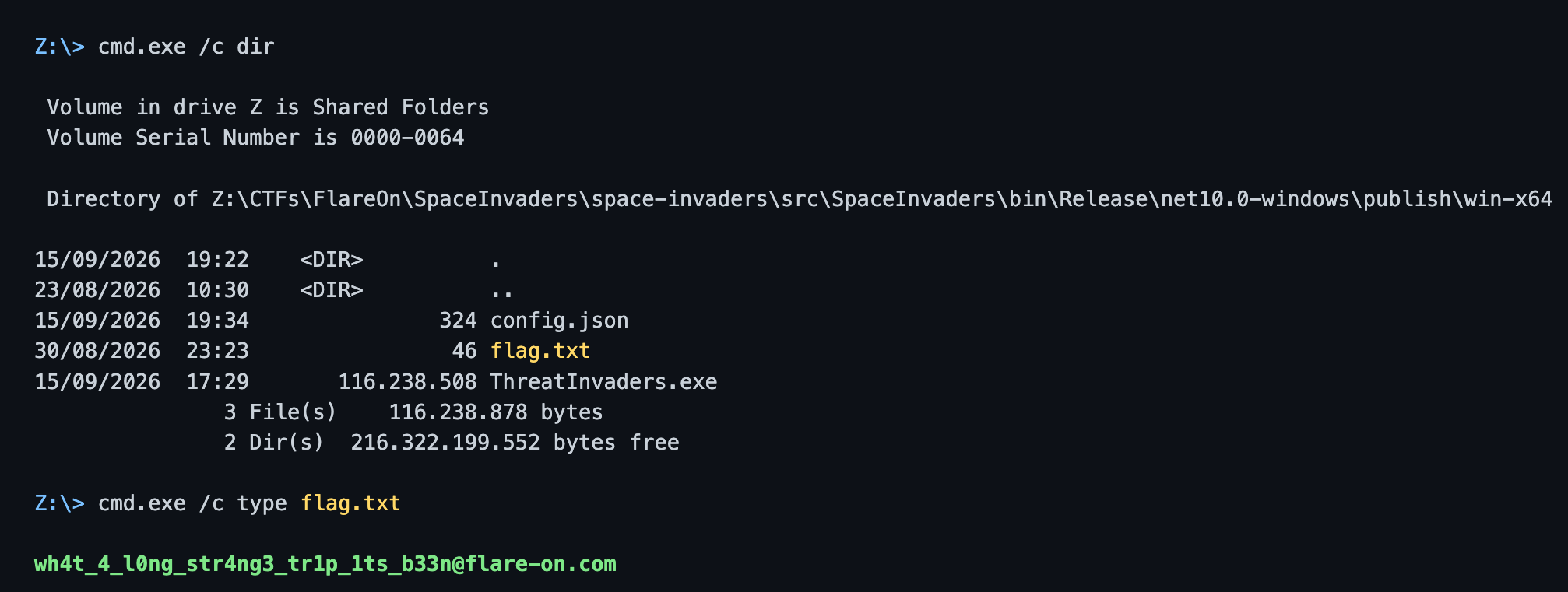
530 bytes and then 46 bytes. The dir listing even leaks the author’s build path, Z:\CTFs\FlareOn\SpaceInvaders\space-invaders\src\SpaceInvaders\bin\Release\net10.0-windows\publish\win-x64, which is exactly the kind of accidental detail you find in real incident data.
The solver
solve6.py reads challenge.pcapng and nothing else. It’s 105 lines, and the core is this:
1
2
3
4
5
6
7
8
9
10
11
12
13
14
15
16
17
def fmix64(x):
    x ^= x >> 33; x = (x * 0xff51afd7ed558ccd) & M64
    x ^= x >> 29; x = (x * 0xc4ceb9fe1a85ec53) & M64
    return (x ^ (x >> 32)) & M64

class Keystream:
    def __init__(self, guid16):
        a = int.from_bytes(guid16[:8], 'little')
        b = int.from_bytes(guid16[8:], 'little')
        h = (((a >> 2) + 0x9e3779b97f4a7c15 + ((a << 6) & M64) + b) & M64) ^ a
        self.st = fmix64(h)
    def xor(self, data):
        out = bytearray()
        for c in data:
            self.st = (self.st * 0x5851f42d4c957f2d + 0x14057b7ef767814f) & M64
            out.append(c ^ (self.st >> 56))
        return bytes(out)
Commands are located by the cmd: marker, the key by the 0x2010 tag, the outputs by the 0x4000 bit, and then everything goes through one keystream object in capture order.
The full solver is in the flare-on-13 repository: solve6.py.
What I’d take away
Three layers each look like the answer and are not: the fake uninitialized-memory leak, the troll flag in UpdateLauncher, and the deliberately native-looking HighscoreStruct arena. Confirming all three are benign isn’t wasted work; it’s what forces you out of the managed code and into the host binary, which is the only place left.
Two checks did almost all of the real work:
- Verifying Authenticode on all 251 bundled assemblies ruled out a trojanized framework DLL in a single pass, instead of 251 manual looks.
- Grepping the native host for managed identifiers found the implant immediately.
That second one generalizes. In any mixed-language artifact (a .NET bundle, a Java fat jar with JNI, an Electron app, a Python app with native extensions), look for names that have crossed a layer boundary they had no business crossing. Strings that belong to one layer and appear in another are almost always somebody’s hook table.
Flag: wh4t_4_l0ng_str4ng3_tr1p_1ts_b33n@flare-on.com