Flare-On 13, Challenge 8: crux
Flare-On is the FLARE team's yearly reverse-engineering contest: each challenge hides a flag, a string ending in @flare-on.com, and you find it by taking the program apart.
Archive: 8-crux.7z (password flare), containing a Chrome MV3 extension · Flag: Pr4tt_Pr1M4lItY_C3rt5_4nd_Wa4aA4aAA4aAA4a4a5M@flare-on.com
Flare-On is the FLARE team’s yearly reverse-engineering contest: each challenge hides a flag, a string ending in @flare-on.com, and you find it by taking the program apart.
This one is a Chrome browser extension with a one-line text box and a Check button.

Everything that matters lives in a 5.8 MB main.wasm: a Go program compiled to WebAssembly (a compact bytecode format browsers can run next to JavaScript) and obfuscated with garble, including -literals, so every string and constant in the module is encrypted and only decrypted onto the stack at the instant it is used.
The extension exposes exactly one entry point, window.check(text). It returns "Bad input" for everything.
What it wants is an AES-encrypted, serialized Pratt primality certificate for one specific 256-bit prime that the module keeps encrypted inside itself.
To produce one you have to recognize the verifier, extract the prime, factor P-1 recursively, find a primitive root at every level of the recursion, and re-serialize the proof in the module’s own binary format. There’s no shortcut and nothing to brute-force. You don’t extract an answer from this one, you build it, which is a large part of why I liked it so much.
If the math is unfamiliar: a Pratt certificate is a proof that a number p is prime. You exhibit a number w whose powers, taken modulo p, run through every value from 1 to p-1 (a primitive root). Checking that needs the prime factors of p-1, and each of those factors carries its own certificate, so the proofs nest like a tree until they reach the prime 2.
Tools I used
Mostly a WebAssembly toolkit, the browser’s own developer tools, and Python:
| Tool | What I used it for |
|---|---|
wabt (wasm-objdump, wat2wasm) | the first look: 3,255 functions, no names; later, the call sites in the validator |
| a hand-written WASM parser and rewriter (~600 lines of Python) | section parsing, the memory image, and the instrumentation below |
| Chrome + a local page + DevTools | running the module, driving window.check, reading my own trace |
python3 | re-implementing the parser, the validator, the AES layer, and the certificate builder |
sympy-free python3 (Pollard’s rho / Brent, Miller–Rabin) | factoring P-1; no CAS needed, it comes apart in under a second |
python3 -m http.server | because a WASM module won’t instantiate over file:// |
On running it: the module was never installed as an extension. It was loaded in a plain local page in a browser tab. Its import list is the stock Go wasm_exec.js set, with no filesystem, no network and no chrome.* of any kind, so inside a tab it is a pure function from bytes to bytes. I’d check that import list before doing the same with any other WASM module.
Getting a foothold
wasm-objdump -x gives 3,255 functions with no names. garble strips them, and the Go WASM backend compiles every function into one giant loop with a br_table dispatch (a jump table that picks the next block), so even the disassembly fights you: function 3270, the checker, is 39 KB of bytecode and 18,184 lines of wasm-objdump -d output, almost all of it dispatch plumbing.
Static reading alone was not going to work. Two pieces of tooling made the rest tractable, and both are reusable.
1. Rewriting the module to trace itself
Go’s wasm_exec.js import object contains runtime.clearTimeoutEvent, a one-argument import that in practice is essentially never called. Hijacking it gives a free logging channel without renumbering any import indices, which matters because every call instruction in a 5.8 MB module refers to indices by number.
A script inserts, at the top of every function body:
i32.const <funcidx>
call 1                  ;; the hijacked import
global.get 0            ;; Go's stack pointer
i32.const 0x40000000
i32.or
call 1
and, inside function 3270 only, right after its dispatch loop:
local.get 0             ;; Go reuses the resume parameter as the block index
i32.const 0x20000000
i32.or
call 1
The JavaScript side tags each value by its top nibble, so one import yields three channels: a complete function-call trace, a block-level trace through the checker’s br_table, and the stack pointer at every entry. That last one means I can read the arguments of every call straight out of linear memory, the single flat block of memory a WASM module works in.
Two things I got wrong on the way there, both worth recording:
- My first attempt at reconstructing the memory image asserted out. I’d forgotten to skip the
0x0bend opcode after each data segment’si32.constoffset expression. One byte. - My first stack-pointer trace logged all zeros. I’d used
local.get 0, which in a Go WASM function is the resume index for the goroutine scheduler, not the stack pointer. The stack pointer isglobal 0. Half an hour of staring at a column of zeros.
2. Recovering Go’s type metadata
garble renames types, but it keeps the runtime type descriptors. It has to, or interfaces and reflection would break. Finding the module’s types base (52,096, located by finding a pointer type whose Elem points back at a type I already knew) makes abi.Type.Str resolvable, and then struct layouts, field names and interface method sets all come back:
1
2
3
4
5
6
7
8
9
10
11
12
13
14
type FPJNbG8y interface{ aMpKVv60(...) }        // the node interface

type VSZ2lqvlggVb struct{}                       // size 0 — this is the prime 2

type MQljbiUyAfc struct {                        // the challenge's bignum
    hpAszrJRyg   bool                            // negative
    mFVADEr7Oo13 []byte                          // magnitude, little-endian
}

type B1698pyli struct {                          // a certificate node
    qY5cSFByu    []FPJNbG8y                      // children
    lSOQ_hx      *MQljbiUyAfc                    // the prime
    zETCbXEQdiyE *MQljbiUyAfc                    // the witness
}
The names are garbage, but the shapes are not. A 40-byte struct holding children plus two bignums. An empty struct as a second implementation of the same interface. A recursive validator that calls modular exponentiation.
That is a Pratt certificate and nothing else. The empty struct is the base case, the prime 2; the two bignums are a prime and a witness. I knew what the input had to be before I’d read a line of the parser.

Mermaid source
flowchart TD
    A["popup.js — one text box, one Check button.<br/>The only entry point is window.check(text)."] --> B["base64 decode (funcs 3231/3232/3233)"]
    B --> C["AES-256-CBC decrypt.<br/>Key and IV are garble literals, decrypted<br/>onto the stack at the moment of use."]
    C --> D["PKCS#7 unpad (func 3190)"]
    D --> E["SHA-256 of the plaintext (func 3217)<br/><i>— computed, then never used. A red herring:<br/>a digest comparison would have made this<br/>a preimage problem.</i>"]
    E --> F["recursive-descent parse (func 3267)"]
    F -- "error" --> Z["'Bad input'"]
    F --> G["recursive certificate validation (func 3269)"]
    G -- "false" --> Z
    G --> H["the root node must be a compound node<br/>(itab 0x4EF60), not the empty struct"]
    H --> I["decrypt one more 32-byte garble literal<br/>into the stack frame"]
    I --> J{"root.prime == those 32 bytes<br/>read little-endian ?"}
    J -- no --> Z
    J -- yes --> K["<b>Pr4tt_Pr1M4lItY_C3rt5_4nd_<br/>Wa4aA4aAA4aAA4a4a5M@flare-on.com</b>"]
    style K fill:#dff5e1,stroke:#2f9e44,stroke-width:2px
    style Z fill:#fde8e8,stroke:#d93025
    style E fill:#fff8e6,stroke:#c9a227
The crypto layer
AES-256-CBC (the standard AES block cipher in its common chaining mode) with a fixed key and IV, both garble literals. Rather than reverse the literal-decryption scheme twice, I lifted them straight out of live memory after the decryption loop ran.
Which nearly derailed the whole thing, because of byte order.
The key schedule in memory, the per-round keys AES expands from the key, is 480 bytes. Reading the first 32 bytes in raw order gives
1
7ababeca1d8056d1…
which is a perfectly plausible-looking key and does not reproduce the plaintext I was observing. The reason: each schedule word is stored as a little-endian uint32 whose value is the big-endian reading of four key bytes. The byte order has to be undone per word, not over the whole buffer. Writing each of the first eight words back out big-endian:
1
2
key = cabeba7ad156801d1c82381c7cb8a3c406ae2c3cd168a96cd8373684cdbf8723
iv  = 5ff26040c4c20b9f2ffdefa7ecf65d91
The plaintext’s SHA-256 is also computed, in function 3217, and then never used for the decision.
I lost time to that, because a digest comparison would have made the challenge a preimage problem (finding an input that produces a given hash), which is to say unsolvable, so I kept hunting for whatever I must be misreading. The trace eventually showed the result simply being discarded.
The input format
Function 3267 is a recursive-descent parser over the decrypted plaintext. From its bytecode:
1
2
3
4
5
node := 0x00                                   -- the prime 2 (VSZ2lqvlggVb{})
      | 0x01 u32(nchildren)
             ( u32(len) <node> ) * nchildren    -- each child length-prefixed
             u32(len) <prime magnitude>         -- little-endian bytes
             u32(len) <witness magnitude>       -- little-endian bytes
All u32 are little-endian. A 0x00 must be the whole of its slice; anything else is an error. The parser returns (FPJNbG8y, error) and the caller bails to "Bad input" on a non-nil error.
The validator
The validator checks the certificate from the leaves up. The “Lucas test” in it is the step that proves a node’s witness really is a primitive root.

Mermaid source
flowchart TD
    A["check(node) — func 3269, recursive"] --> B{"is this the empty<br/>struct VSZ2lqvlggVb ?"}
    B -- yes --> C["true — 2 is prime by fiat"]
    B -- no --> D["recurse: check(child) must hold for every child.<br/>value(child) = child.prime, or 2 for the empty node."]
    D --> F{"child values non-decreasing,<br/>AND their product == prime - 1 ?"}
    F -- no --> X["false -> 'Bad input'"]
    F -- yes --> H["Lucas test, func 3268, with the node's witness w"]
    H --> I{"w^(prime-1) mod prime == 1, and for every<br/>child value q, w^((prime-1)/q) mod prime != 1 ?<br/><i>So w must be a primitive root,<br/>not merely a Fermat witness.</i>"}
    I -- no --> X
    I -- yes --> K["true"]
    style K fill:#dff5e1,stroke:#2f9e44
    style C fill:#dff5e1,stroke:#2f9e44
    style X fill:#fde8e8,stroke:#d93025
The supporting functions, named by what the dynamic trace showed them doing rather than by any symbol:
| func | role |
|---|---|
| 3251 | newBignum(int) |
| 3252 | newBignum(bytes, neg) |
| 3254 | Cmp |
| 3256 | Add |
| 3257 | Sub |
| 3258 | Mul |
| 3261 | Div |
| 3262 | ExpMod |
| 3268 | the Lucas step |
| 3269 | the recursive certificate check |
The two functions, from the bytecode
The dispatch plumbing hides the logic, but the call instructions survive it. Filtering wasm-objdump -d down to just the calls in each function, in address order, gives this:
1
2
3
4
5
6
7
8
9
10
11
12
13
14
func[3268]  the Lucas step             func[3269]  the certificate check
0x40eddc  call 1348                    0x40f323  call 1348
0x40ee0d  call 3251   newBignum        0x40f3b3  call 3251   newBignum
0x40ee38  call 3257   Sub              0x40f3ee  call 3251   newBignum
0x40ee86  call 3262   ExpMod           0x40f557  call 3269   itself, per child
0x40eebb  call 3251   newBignum        0x40f631  call 3251   newBignum
0x40eee5  call 3254   Cmp              0x40f688  call 3254   Cmp
0x40efc0  call 3251   newBignum        0x40f6db  call 3258   Mul
0x40efeb  call 3257   Sub              0x40f787  call 3268   Lucas step
0x40f0bc  call 3251   newBignum        0x40f7c5  call 3251   newBignum
0x40f110  call 3261   Div              0x40f7ff  call 3251   newBignum
0x40f163  call 3262   ExpMod           0x40f82a  call 3256   Add
0x40f19d  call 3251   newBignum        0x40f87f  call 3254   Cmp
0x40f1c7  call 3254   Cmp              0x40f926  call 3268   Lucas step
The names in the second column are the roles from the table above. call 1348 is the same 23-byte helper at the entry of both functions, which I didn’t need to name.
Read top to bottom, 3268 is the Lucas test in the order the diagram gives it: p - 1, then w^(p-1) mod p compared against 1, then a second block that divides p - 1 by a child’s value and raises w to that power before comparing again. 3269 calls itself on the children, compares them pairwise for order, multiplies them together, and uses Add and Cmp before the second Lucas call. That last pairing reads like a check of product + 1 against the prime rather than prime - 1 against the product; either way it is the same test. Each call lives in its own br_table block, so this is the order the calls appear in, not proof of the order they run in. The dynamic trace is what settled that.
The first input that worked
Before building anything large, I wanted proof I’d read the format right. The product rule hands you a minimal accepted tree: a compound node with no children has an empty product, which is 1, so it needs prime - 1 == 1.
1
01 00000000 00000000  02  00000000
A childless node whose prime is 2. I fed it in and the block trace moved out of the "Bad input" block and into the next stage. Thirteen bytes, and they confirmed the container format, the field order, the endianness, the parser and the validator all at once.
I’d reach for that sooner next time. I was well into planning the full certificate builder before it occurred to me to go looking for the smallest input the machine would accept.
The target prime
Past the validator, the checker decrypts one more 32-byte literal with garble’s swap-and-subtract scheme and compares the root node’s prime against it. Dumping the stack frame after the 16-iteration decryption loop gives:
1
61e230c979e1be78551b7c44963c5a65e3e827b3b04a7adacc029a37bbdf89d3
Read big-endian, that number is composite.
Which is impossible. The whole program is a primality certificate verifier, so the thing it certifies has to be prime. Either my dump was wrong, my factoring was wrong, or the challenge was broken.
None of the above: it’s a byte-order bug, mine, and the same one as the AES key. Read little-endian, which is the order the challenge’s own bignum type uses for its magnitude, and it’s a 255-bit prime:
1
P = 95681613235744740119807961018865688051340183696570761153419351987106658443873
A value that fails a test it cannot possibly fail is a byte-order bug, not a dead end. I now treat “this is mathematically impossible” as a strong signal that I’m reading bytes in the wrong direction, rather than as a result.
And:
1
2
P - 1 = 2^5 * 1777 * 117013415621
        * 14379885447462257985539844615548173977763374139182362877999463
That 203-bit cofactor is itself prime, so no hard factoring is needed anywhere in the tree. The author picked P so the whole recursive factorization is easy, which is exactly right for a challenge. The work is in understanding the structure, not in burning CPU. Pollard’s rho, a standard factoring method that is fast when the factors are small, finishes in under a second and the certificate comes out at 357 nodes.
Building the answer
solve8.py factors P-1, builds the certificate (choosing the smallest primitive root at each level), verifies it against my re-implementation of the WASM validator, serializes it to 3,891 bytes, and encrypts it:
1
2
sha256(plaintext) = c9c3e3392c54fa79b313b8f9696539b8838740cafe086e036ba888ac1e358086
blob = 5208 base64 characters
Paste that into the popup, press Check, and wait about ten seconds. The bignum library uses byte limbs and the proof needs a few hundred 256-bit modular exponentiations, so it’s slow in a way that feels broken the first time:
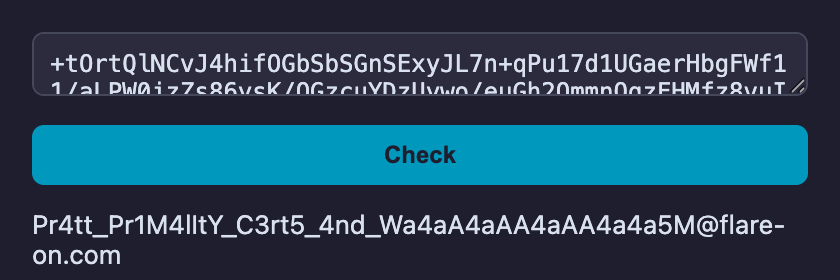
The full solver is in the flare-on-13 repository: solve8.py.
Four details that caught me out
Repeated factors are repeated children. P-1 has 2^5, so the root needs five 0x00 children before its three larger ones. The validator multiplies child values and compares to prime - 1; it does not collect exponents.
Children must be in non-decreasing order of their certified prime. Sorting the factor list is enough, and the empty node (2) is naturally smallest. This is checked, and it fails silently as "Bad input" like everything else.
The witness must be a primitive root, not merely a Fermat witness. The test demands w^((p-1)/q) != 1 for every prime q dividing p-1, which is the definition. I found this the easy way, by reading the validator, but a certificate built with a random Fermat witness would fail at some arbitrary depth with no indication why.
A malformed child kills the instance. Feeding the module bad input at the wrong place made the Go program call os.Exit(2) with no message, after which every subsequent call returns nothing. My probe harness re-instantiates the module between attempts rather than reloading the page, which also makes the whole thing scriptable.
Why this one stuck with me
Most reversing challenges end with you extracting something. This one ends with you building something: to a specification you had to recover from obfuscated bytecode, in a format you had to infer, for a number you had to find encrypted inside the program.
And the mathematics isn’t decoration. A Pratt certificate is a recursive proof of primality, linear to verify and, for a well-chosen prime, cheap to construct. I had not expected to spend an evening writing one because a 5.8 MB obfuscated Go module wouldn’t accept anything else.
Flag: Pr4tt_Pr1M4lItY_C3rt5_4nd_Wa4aA4aAA4aAA4a4a5M@flare-on.com